

Sophie Baldwin, The Koondrook and Barham Bridge Newspaper
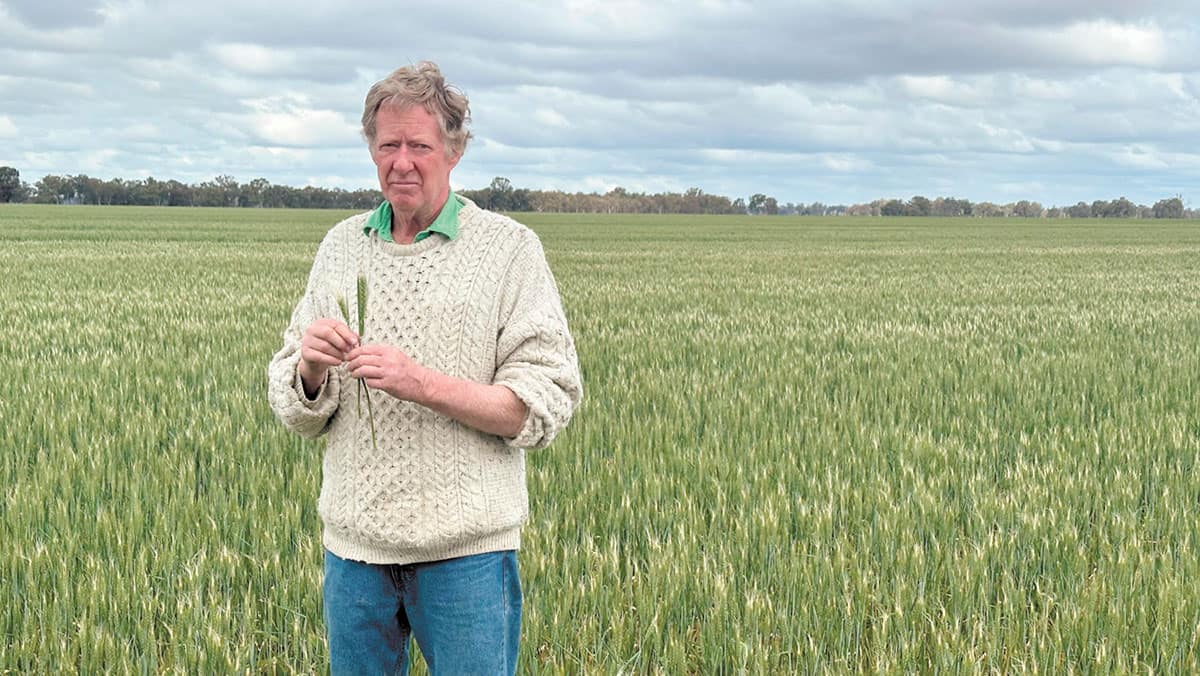
Roger Reid thought he was doing the right thing when he made the decision to invest some big dollars into water efficiency projects on his mixed farming property in the Riverina.
However, Roger has been left scratching his head and questioning his decision this season, after the Bullatale Creek was reduced to water holes and he couldn’t access water.
Roger estimates he has lost around 3 tonne/ha on his Scepter wheat crop.
Doing all the right things from a management perspective and under the assumption he would have access to water, Roger sowed the Scepter at 120kg/ha, applying 100kg/ha of MAP and top dressing with two applications of 150kg/ha of urea.
“I was working toward an achievable target yield of around 8.5t/ha.
“I based these decisions on the fact I had carryover water and there was plenty of water in Hume and Dartmouth – I honestly didn’t think as a licensed and metered irrigator, with access to high security water there would simply be no water.
“We have been preached to year after year to get more water efficient, but that is all irrelevant if we can’t actually access water and irrigate.”
He said the last time the Bullatale ran dry was during the Millennium Drought.
The regulated section has operated as an important environmental flow corridor between the Murray and Edward rivers for over a hundred years.
While most flows in the Bullatale are not extracted for irrigation, farmers like Roger who do have entitlements rely on accessing water in spring and autumn – changes in how the Murray River is being operated has contributed to this disaster.
“We are talking about a creek that has significant environmental assets – is home to Murray cod, black fish and some rare broad shell tortoises and is also a critical connector for the Murray to the Edward River.
“I can’t believe there is plenty of water in the system, the Mary Ada regulator is open, they are flooding the bush and sending water all over the place and yet they let the Bullatale run dry.
“The Basin Plan is meant to be about saving the environment – what about our creeks and rivers here in the Riverina?
“Why should they run dry while water is prioritised for delivery to South Australia?”
He questions current river management and despairs at the ineptness of it all.
He said irrigators on the Bullatale had been screaming for water since February this year.
“I have a small storage, which is an old cutoff lagoon that can hold about 130ML. I was able to fill this up and use it for some critical waterings back in autumn, but that was it.”
Roger said by the time all the departments got their act together and put some water into the Bullatale, his promising 185ha wheat crop was a sea of white and suffering from the effects of tipping.
“What grain we have left after the tipping is plump, but we can never make up for the productivity loss because we couldn’t access irrigation at a critical time.”
Roger said he put the pivoting lateral in as the best option for efficiency and positioned to fit in with his on-farm storage and future pipe and riser irrigation that he completed in 2022 and 2023.
“The 70ha pipe and riser system I use to irrigate fodder crops for the livestock side of my business. I grow oats for hay and I have sown 30ha of Antas sub clover, which I will be able to graze once it is established.”
As part of the business, Roger runs 900 angus breeders and at the peak, he can have up to 700 young calves at foot.
As a second-generation farmer, Roger said the farm has evolved and come a long way from when his dad first bought the property in 1944.
Back then it was a large 7,000ha operation predominantly running sheep and cattle, until a foot rot outbreak upended the operation.
“Back then, they didn’t have the treatments we have today, so Dad moved to cropping and kept the cattle.”
He said even though there was irrigation to the property, it was undeveloped and very limited.
Roger said he returned home to the family farm in 1990 after a stint working for his family helping to run some of the family’s other properties in South Australia.
He has made changes to the business over the years and today crops around 1,600-2,000ha annually, dependent on the season.
“I just love farming and I want there to be a future for the next generation – water efficiency and irrigation both play a critical role in that future and government and water management need to get their act together and get it right,” Roger said.

This article appeared in The Koondrook and Barham Bridge Newspaper, 3 October 2024.

