

Celebrating Corryong’s centenary of reticulation
John Murphy, Corryong Courier
Next Thursday, October 10th, will mark exactly 100 years since the residents of Corryong were connected to reticulated (piped) or mains pressure water.
For a dry town perched up on the edge of Playles Hill, where the benefits of a permanent water supply were obvious, obtaining such had been a long and difficult road.
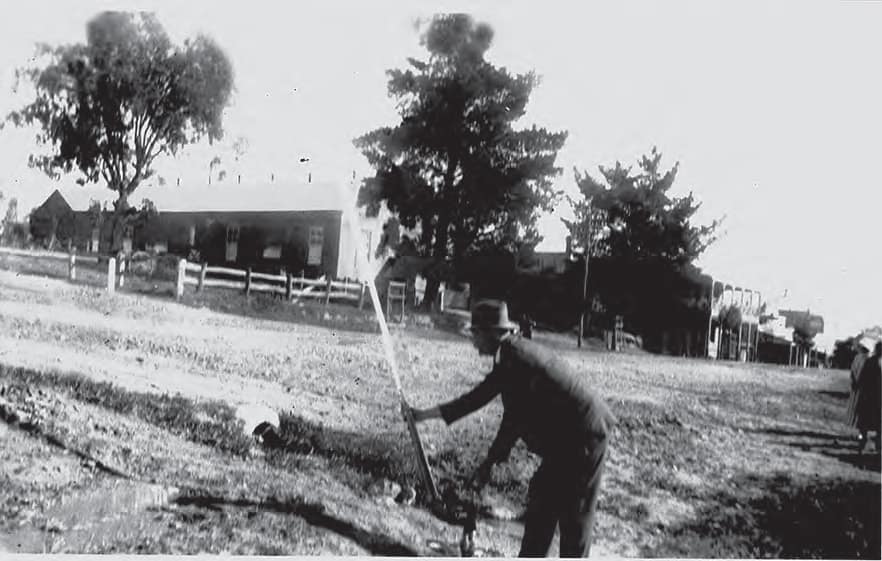
Corryong was officially designated a town in 1875 and from that time until late 1924 householders and businesses were totally reliant for all their domestic and trade water needs on water tanks and often, unreliable wells sunk into granite soil. The thought of additional water for decorative and vegetable gardens and other green spaces was out of the question and during late summer and in times of drought, water shortages during the early days of Corryong, were severe.
The town sits near two clear, crisp mountain streams and in times of scarcity water could be supplied from Hanson’s Bridge on Parish Lane (approximately 3kms distant) or School Lane (approximately 2kms) and the Thowgla Bridge (approximately 3.5kms from town) via water carts but by these means it was expensive to purchase and difficult to handle and time-consuming to procure.
The prospect of reticulating the town was first investigated when Government Surveyor Mr E. J. Brown, Chief Engineer of the Water Supply Department, Melbourne, made his way to Corryong in 1889. Reticulation had been achieved in other rural towns to great benefit.
The obvious advantage of Corryong’s location was the two nearby streams emanating from the mountains and these he considered as viable options to supply the town’s water needs. The two streams were Corryong Creek (also known as Nariel Creek further upstream) and Thowgla Creek. Both had reasonable ‘fall’ at were not too great a distance to supply the township with water by natural gravitation. The thought at that time of pumping water up to the town (at an elevation of 314 metres) was out of the question. The only appliance in those days capable of such was a steam engine connected to a hydraulic pump which would have needed constant attention and a never-ending supply of fuel.
Dismissing this option, Brown conducted a contour survey to potentially cut an open channel to the Corryong starting at 100 feet (30.5m) above the business centre of the town to “points of supply” on both Thowgla Creek and Corryong or Nariel Creek with a fall of two feet per mile (0.38 metres/kilometre). He envisaged bringing the water to his chosen starting point on the slopes of Playles Hill via an open water race and this fall would allow the water to flow without eroding the walls or bed of the race.
Coincidently, he found the distance following up both valleys to where the streams could be tapped was the same at eleven and a half miles (approximately 18.5kms).
In his report he designated that the Corryong Creek scheme would be the more favourable of the two in that during the summer months Thowgla Creek had a much-reduced supply. At this time (1889) Corryong’s population amounted to 110 souls. He estimated the costs at £995 ($1990) for the construction of the race and other infrastructure but this did not take into account compensation to the land holders through which the race would pass. Despite all this good work Brown’s report languished on various people’s desks and the scheme was taken no further.
In 1895 Councillor C. M. Findlay called a public meeting in Corryong to consider a proposal for a water supply sourced from Thowgla Creek. This was devised by Towong Shire Engineer Mr Peter Wright. It was a variation on Surveyor E. J. Brown’s proposal. In the mid 1890s Corryong’s population was estimated at 280 individuals, its numbers being very recently increased by the discovery of gold on Mount Elliot.
The cost of the scheme was calculated at £1,000 ($2,000) using an open water race from the point of supply on the upper reaches of the Thowgla Valley to the site already chosen for the reservoir above the town. However, Findlay’s proposal was considered too great a financial burden by a majority of other councillors in the Corryong Riding and the scheme was voted down. Little did they realise how much they would rue this decision.
The mid-1890s saw the beginnings of the great Federation Drought – so-called because it commenced in 1895 and reigned until 1903 – right through the transformational period in our history where Australia became a single nation. It was perhaps the most severe drought experienced since European arrival and many experts still consider it was more damaging than any drought since.
Big dry forced the water issue
The extreme dry spell affected mostly the eastern states. The worst years were 1901 and 1902.
Corryong, although being reasonably drought resistant, did not escape its consequences.
The Federation Drought was absolutely ruinous, especially for rural Australia and the smell of death hung everywhere. This long extended dry spell saw enormous stock losses. Sheep numbers Australia wide fell from 91 million to 54 million and cattle numbers fell from 11.8 million to seven million. In addition to this, in Eastern Australia, rabbit numbers increased to plague proportions and they stripped the country of nearly all vegetation in their desperate quest for sustenance. This saw the end to many long-term farming dynasties – some which had existed since early squatting days. With the majority of livestock lost on many properties, debts could not be paid and banks foreclosed with their owners losing everything.
Near Mildura the Murray River ran dry and more locally, both Corryong Creek and Thowgla Creek ceased to flow. Once again water had to be carted from Corryong Creek and this was sourced from questionable pools still remaining in the creek’s bed. Water for drinking purposes had to be boiled. Also during this period, students at the Corryong Rural School had to bring their own water in bottles as no water was available on the school grounds. How the horses in the school paddock coped during the day isn’t known.
Through the next two decades, since the worst years of the drought, with regard to the water situation, among those concerned there was still much indecision, differences of opinion and delay with some still opposed to reticulation.
Another proposal, with various alternatives, was submitted in 1912. This time, although not completely disposing of the idea of an open race, the committee also looked at piping water to the town reservoir; one of the main factors being the continuing rabbit plague. One way of dealing with these pests was poison baits but when they ate them, they soon afterwards headed for the nearest pools and dams to find relief and these water sources became putrid with their corpses. By this time costs for the scheme had risen considerably with the Shire Engineer submitting the following:
- Piped water from Nariel Creek – Wooden pipes were being considered – £5,000 ($10,000)
- Open channel from Nariel Creek – £4,000 ($8,000)
- Pumped water from Thowgla Creek near the Cudgewa Butter Factory – £3,000 ($6,000)
- Pumped water from Corryong Creek near Hanson’s Bridge (Briggs Gap Road) – £3,000 ($6,000)
The above expenses included the cost of the town reservoir and reticulation and, if the Thowgla Creek option was not taken up, then the Butter Factory would be supplied with water from the town.
Still, nothing was done in making a final decision and physically getting the project off the ground. Then came the drought of 1914, another drought so severe that Corryong Creek, below Mt Mittamatite, ceased to flow.
Another public meeting was held in September 1916 this time with a more determined committee comprising Mr Albert Bartlett, a strong and long-time advocate of reticulation, Mr T. Brown, Mr A. Acocks, Mr Hamilton and Councillor H. Nankervis. The meeting was convened at the Athenaeum Hall, forerunner to the Memorial Hall. The Towong Shire Engineer, Mr. Sambell, was also in attendance to offer technical advice.
At this time Corryong’s population, even with many young men away at the war, stood at about 500.

This article appeared in the Corryong Courier, 3 October 2024.

