A history of Camellia Shows, Camellia Festivals and the Narrandera District Garden Club (last updated 1996) has been provided to the Narrandera Argus.
Narrandera’s reputation for the production of top quality camellia blooms has been growing over a period of 23 years. It has involved a large number of individuals and organisations, the major forces being the St John’s Presbyterian Women’s Association, the Narrandera District Tourist Committee, the Riverina Branch of the Australian Camellia Research Society and the Narrandera District Garden Club.
It began in 1973 when the ladies of the St John’s P.W.A. changed from their traditional Annual Fete to an afternoon of “Flowers and Fashion” on Saturday 15th September. In the “flowers” section were a few classes for camellia blooms – similar to those which were already in the Annual Narrandera Show.
During the ensuing 12 months, Sydney camellia growers, Mr and Mrs Russell Thomas (brother-in-law and sister of Mrs J. Bull, president of the Narrandera P.W.A.) were responsible for the staging of a Camellia Show at Wollongong, to raise funds for Legacy. They offered to assist the Narrandera P.W.A. stage a similar show, and on Friday August 9th and Saturday August 10th 1974, the Riverina’s first Camellia Show was held in Narrandera.
It was a most successful, non-competitive display of both Sydney and local blooms, staged by Mr and Mrs Thomas and Mr and Mrs Allan Swinbourne (all members of the N.S.W. Foundation Branch of the Australian Camellia Research Society).
Some of the Sydney blooms came from the “Camellia Grove Nursery” at St Ives, others from “Eryldene” the home of Professor E. G. Waterhouse at Gordon. Professor Waterhouse (then aged 93 years), one of the world’s foremost authorities on the camellia, had hoped to attend the Show, but was prevented by his poor health.
The Show featured many splendid floral arrangements containing camellias, as well as more than 400 blooms (of over 100 varieties).
Referring to local blooms, Allan Swinbourne commented on their quality and particularly the clear reds produced by our soil and climate. He referred to the ideal conditions (hot summers and cold winters) we have for growing camellias, although others regard our hot summers as hostile to this activity. He suggested that it might be appropriate to form a Riverina Branch of the Australian Camellia Research Society in Narrandera.
The Shire President, Cr Ken Kiesling, had opened the Camellia Show and he convened a public meeting to gauge the interest in forming a Camellia Club “to improve members’ knowledge of cultivation, pest control and identification, as well as to give information concerning new varieties”. At the meeting Cr Kiesling expressed his hope that Narrandera would become “a town noted for camellias”. The Council and some Service Clubs backed this idea.
Camellia Society born
As a result of this meeting Narrandera’s Camellia Society was born, with monthly meetings from March to October. The office-bearers were Patron Cr Ken Kiesling, President George Hinchley, Secretary Cliff King, Treasurer George Landow, Assistant Secretary Myra King, Vice-presidents Mesdames Donaldson, F Foley, L Trim.
During October 1974, the Rotary Club completed the camellia grove at Lake Talbot, as an off season attraction – 81 shrubs were planted, to be “a hedge of blooms in late autumn and winter”.
Soon after, the Lions Club set up a camellia grove in the south-eastern corner of Narrandera Park, but unfortunately, during early February 1975, this was damaged by vandals uprooting many of the plants, leaving them on the ground. No trace of this grove can be found today.
By September 1974 the Narrandera District Tourist Committee (Cr George Landow as secretary) had decided to conduct a Camellia Festival and Council permission was sought for 10 days of celebrations during the school holidays, Friday August 29th to Sunday September 7th 1975.
While the planning for the first Camellia Festival proceeded, the Riverina Camellia Society continued to meet in the Shire Chambers and applied to become the Riverina Branch of the Australian Camellia Research Society.
Assistance in the form of growing camellia plants from cuttings was offered to the Council, should they desire it. Members’ knowledge of their favourite plant was being improved, they loved visiting members’ and other gardens, and they offered to plant camellias at the CWA hall.
By March 1975 the group was officially a branch of the A.C.R.S. (George Hinchley as Riverina Councillor) and was keen to promote the Camellia and expand their membership beyond Narrandera. Plans were made for posters and shop window displays, potted plants, a float in the Camellia Festival procession and exhibits at the Narrandera and Leeton shows. Jenny Spencer (now Osmond) was selected as the Branch’s Princess for the Festival.
Housing estate named in honour
Early 1975 saw the development of the first North Narrandera subdivision. The senior surveyor recommended it be called “Park Land Heights” with the street names being Lombardi, Jacaranda and Cypress. However, at the suggestion of Cr Landow the name “Camellia Gardens Estate” was accepted, the streets being named Japonica, Helenor, Lady Loch and Camellia Drive.
As the Riverina Branch of the A.C.R.S. became established and more widely known, visitors from the NSW Foundation Branch (Sydney) addressed Club and public meetings in Narrandera, and two of the members were invited to judge at a Griffith Show.
The 1975 Camellia Festival commenced with a splendid display of over a 1000 blooms from Sydney, Albury, Wagga Wagga, Ganmain, the Cootamundra Garden Club and Narrandera – again organised by the PWA and in the Presbyterian hall.
The Show was still non-competitive, but Allan Swinbourne selected the “Best Camellia Grown in the Riverina” and Mrs R. Bull of Euroley was presented with the perpetual “John Sullivan Memorial Trophy”. (This trophy was donated by Mr and Mrs J. Sullivan of Pine Hill, in memory of their teenage son, John, who died in a 1974 road accident.)
Among the visitors were Mr and Mrs ‘Peter’ Campbell from Camellia Grove Nursery (Sydney) and Mr and Mrs Tom Savige (Albury) – Tom was soon to become President of the International Camellia Society. Over the two days of the Show about 1000 people viewed the blooms, helping to establish it as an annual event in Narrandera.
Camellia Ball welcomes TV icon and Camellia Queen chosen
On the Friday evening, the Camellia Ball had to be moved from the smaller Ex-Servicemen’s Club to the Pioneer Hall because of the 500 guests. Allan Hull compered the evening, which was broadcast over 2WG as the 20 Camellia Princesses were interviewed by Elaine Lee (Vera Collins in the TV program ‘Number 96’), Pearl de Brie and Joan Kent – 18 year old Maryanne Hocking (Rotaract) being crowned as “Camellia Queen” and beginning a busy week of festival activities.
Other Festival activities included garden competitions, arts and craft displays, commercial displays, numerous sporting events (lawn bowls, squash, pistol shoot, race meeting, etc.), the review “Kamellia Kaos” by the Music & Dramatic Society (organised by Jack Rheinberger and Audrey Lean), a street procession organised by Apex, Banana Eating and Orange Peeling Championships, a Horse & Jockey Wheelbarrow Race, and the Kapooka Band led the procession, played at the racecourse and “Beat the Retreat” in the Memorial Gardens.
The Street Procession boasted 30 floats (Narrandera Primary School’s being judged as the best) as well as vintage cars, a Bulldog tractor and decorated bikes. Ian Downes almost broke the world record by eating 25 bananas in 10 minutes, but was disqualified because he could not ingest them all. The Camellia Society joined with the United Farmers & Woolgrowers Association for a most successful Camellia & Lamb Night at which Allan Swinbourne spoke and demonstrated the grafting of camellias.
Such was the success of the 1975 Camellia Festival that planning began immediately for another in 1976 – adding a possible Wagga-Narrandera boat race, a fishing competition, a Leeton-Narrandera road race and a Charity Queen to the list of activities. The highly successful Princess competition was also to become a fundraiser – mostly for the establishment of a Tourist Centre in Narrandera Park.
The week-long 1976 Camellia Festival commenced with the Camellia Show on Friday 20th and Saturday 21st August – organised by the PWA with assistance from the Riverina Branch of the Camellia Society (which had placed blooms in most shop windows to set the theme for the week).
Except for the Champion Bloom it was still a non-competitive Show and was opened by Tom Savige from Wirlinga (Albury). The street procession on the Saturday was lead by the Aboriginal Band from Leeton. There was car racing at the Lakeside Racing Circuit, a Leeton to Narrandera foot race, lawn bowls, squash and many other sporting events (including egg throwing), the Camellia Ball being held to conclude the festival.
Camellia Festival becomes biennial event
Although a most successful festival, the organisers had found it “hard-going” and it was decided to make the Camellia Festival a biennial event, but Narrandera’s Camellia Show had already become part of the Riverina’s calendar.
The 1977 Camellia Show was again opened by Tom Savige. Although largely non-competitive, Allan Swinbourne judged the Best Single, Best Semi-Double, Best Formal Double and Champion Bloom. There were also two sections for floral art. The Show boasted around 700 blooms and again around the 1000 visitors. It was organised by Narrandera’s Camellia Society (the Riverina Branch of the A.C.R.S.), in the C.W.A. hall and the ladies of the PWA catered for lunches and afternoon teas.
By the end of 1977 the members of the Camellia Society were concerned as to whether they were meeting their objectives as a branch of the Australian Camellia Research Society. Despite their efforts they had been unsuccessful at recruiting members from outside Narrandera and they wondered whether Narrandera might be better served by widening their interests.
The Riverina Branch was officially disbanded during May 1978, the Hume Branch of the A.C.R.S. (based at Albury) had already formed and filled the needs of camellia lovers in this part of the state. A Camellia Show had also commenced at Albury (Horticultural Society) and Wagga Wagga (Quota Club) would commence in 1979.
Local Garden Club formed
The Narrandera District Garden Club was formed on Saturday 6th May, 1978 at a meeting in St John’s Uniting Church hall. At its inaugural meeting on 10th June, the 16 members elected the following executive: President George Hinchley, Vice-Presidents Sandra Bruce and Neville James, Secretary Cliff King, Treasurer Robin McKinnon. The main item for discussion was their coming Camellia Show. Later, Tom Redman accepted the responsibility of auditing the Club books, a role he had for many years.
The Garden Club’s 1978 Camellia Show was opened by Tim Fischer, MLA. The judges were Allan Swinbourne and Peter Campbell. There were still only three competitive classes for blooms, but it was a Show which still receives comment – the Champion Bloom was a miniature, “Tiny Princess”, just over 2cm across! While growers had become familiar with the “ordinary” japonica species and even the larger, spectacular reticulatas, miniatures were not widely grown and had not received much attention in Narrandera, until then!
The successful 1978 Camellia Festival also had parachutists, a Lions’ Fun Run and many sporting events, concluding with a street procession and the Camellia Ball at which the Camellia Queen (Yvonne Piper) and Charity Queen (Patricia Coates) were selected from the five Princesses. Over $12,000 were raised towards the proposed Tourist Centre in the Park.
Meanwhile, the new Garden Club had changed to meeting temporarily in the Council Chambers, and then to the Senior Citizens Club in Jonsen Street. Many informative meetings were held with guest speakers, thanks to an active program committee. It was a definite move forward when, from March 1984, meetings were held in members homes and were followed by afternoon tea and a walk around the garden.
In 1979 Neville James became treasurer for the year, the remainder of the executive being unchanged. Although new members were joining, the total remained fairly constant because of those leaving town. The Camellia Show schedule was expanded to contain eight competitive bloom classes and two for floral art. Mr and Mrs A. Swinbourne (blooms) and Mrs G. Dangar (floral art) were the judges.
Camellia Festivals successfully continued every second year, the last being in 1986. The August weather was not always kind, enthusiastic manpower was, as with everything, difficult to obtain. Treemendous Festival takes over.
These factors, together with the commencement of the four-term school year with the vacation late September/October, led to a replacement “Treemendous Festival” in 1988, which was coupled to the “Back To Narrandera” functions in 1990. There was also a “Festival Of Trees” from August to October 1983, with a number of interesting events – this also began with the Camellia Show.
Like most Clubs, the Garden Club has had its ups and downs. From 1980 to 1982 its membership dropped to about 10, went up to 49 in 1992, and at present it stands at 45. At the same time the average age of members has dropped considerably.
During 1982 it was decided to affiliate with both the “Garden Club of Australia” and with the “Hume Branch of the Australian Camellia Research Society”. In 1985 it also affiliated with the “NSW Foundation Branch of the A.C.R.S.” from which help for the Camellia Shows so willingly comes.
Late 1987, in order to protect members, it was decided to become an “incorporated body” – a little more bookwork, but peace of mind. During 1988, with some members exhibiting at the Albury Camellia Show, it also became a member of the Albury Horticultural Society. As a club it was looking forward to August 1997 when the biennial convention of the Garden Club of Australia was to be held in Narrandera – a chance to show still others what the town had to offer, and once more beginning with the two-day Camellia Show.
While the Garden Club letterhead still has its original tree for an emblem, it also has a camellia. Since 1985 it has also had a badge and a bookmark, both of which feature a pink camellia.
The Garden Club executive has changed a little. After the death of George Hinchley in January 1984, Pat Mulholland became President and Joan McLay took over from Pat as Treasurer. Joan remained Treasurer until 1992 when she was relieved by Keith Trees, then Jean Charles from 1993 to 1996.
In 1990 Jennifer Hopwood took over from Pat and was president for six years. Vice-Presidents have included Myra King, Mrs E. Sinclair, Gwen Nielsen, Mrs H. Ware, Denise Di Salvia, Jennifer Hopwood, Neville James, Jean Charles, Judy Heckendorf and Joan McLay. When Cliff and Myra King retired to Wamberal in August 1984, Barry Di Salvia became the secretary and later, at incorporation, also the Public Officer. When Barry was elected president in 1996 Gwen Nielsen took over as Secretary and Public Officer.
Annual garden comp begins
Commencing in 1980, the Garden Club organised an annual Garden Competition, but because of the difficulties associated with judging up to 15 entries, this was discontinued after 1981. Garden Walks were first commenced by the Club to coincide with the “Festival of Trees” in 1983. These have continued annually (except 1989) and the funds raised have enabled the Club to install underground watering in the gardens at the Cypress Centre, donate around $4000 to Teloca House Projects, and to plant over 25 camellias at Teloca House (with still more to be planted in the new area).
Camellia Shows have continued as annual events on the third Friday and Saturday in August, and bring some entries from over 200km away. Over the years the entries in the floral art classes increased and then just as quickly vanished. A memorable year was 1985, when Mrs Ina Bailey came from Yanco to judge nil entries. During 1988 to 1990 there were splendid, non-competitive displays of floral arrangements featuring camellias.
Apparently the thoughts of competition and the rules for flower arranging deterred our exhibitors. However, over the years this non-competitive display has also dwindled. For the blooms they now have 60 competitive classes, including 21 for named varieties, the only non-competitive blooms being the hundreds floating in the tub just inside the doorway, and those decorating the shelves above the tables. Although it is grown and has flowered in Narrandera, organisers are still waiting to see one of the golden yellow blooms of the “chrysantha” species (now called “nitidissima”) at its Camellia Show. They have been exhibited at the Narrandera Agricultural Show in September.
From 1984, Dr Murray Moyes and Peter Campbell (when able) were the Camellia judges, assisted by Peter Levick in 1989 – all from the NSW Foundation Branch of the A.C.R.S. (now called The NSW Camellia Research Society Inc.). Whenever Peter Campbell came he brought with him a splendid display of blooms from the Camellia Grove Nursery at St Ives.
In 1990 Peter was no longer able to travel the large distance from Sydney and Peter Levick assisted Murray with the judging. This continued until 1993 when Peter and Yvonne Young were the judges – Murray, Peter and Yvonne being our judges, as available. Narrandera owes a lot to the NSW Camellia Research Society and its members for their help over the years.
In February 1984 came the death of Allan Swinbourne. Allan had been active in Narrandera Camellia shows since 1974. In order to acknowledge his efforts and those of George Hinchley, two additional perpetual trophies were introduced to the 1984 Show. “The George Hinchley Memorial Trophy” is awarded for the best three informal double japonica/japonica hybrid blooms, “The Allan Swinbourne Memorial Trophy” is for the best semi-double japonica/japonica hybrid bloom.
The year 1986 saw the introduction of still another perpetual trophy, “The Jean Hendry Memorial Trophy” for the Champion Bloom grown in the Narrandera Shire. (Jean Hendry was the mother of Mrs Margaret Thomas and Mrs Jessie Bull, both of whom have been associated with the Shows from the first.) At least one of the major awards must now remain within the Shire.
Coveted award offered for first time
In 1991 the show was granted the right to award the coveted A. W. Jessep Medal for the Champion Bloom at its Show. This medal was struck by the Victorian Branch A.C.R.S. to honour a world authority on camellias, the cofounder and Foundation President of the A.C.R.S. (1952), who was also the first Australian Camellia Registrar and the director of the Melbourne Botanical Gardens from 1941-1957.
In 1995 the Hume Branch of the A.C.R.S. (based at Albury) generously donated the first of their annual trophies for “The Best Formal Double Bloom of the Show” – this first time it was a potted camellia for the grower.
The 1990 Show has been the largest display to date, with over 800 top quality competitive blooms (we ran out of white containers), 250 blooms in the tub near the door and more on the shelves, and 13 floral arrangements. It was a good blooming season, with 42 exhibitors and a lot of visitors to view the spectacular display.
The deep purple blooms of Dona Herzilia de Frietas Magalhaes grown by Dr Ross Hayter of Yackandandah will long be remembered. Being “Back To Narrandera” time it was arranged for 20 gardens to be opened to the public for three days early in September, but continuous wet weather kept most people indoors.
China visit coincides with Show
1991 was probably the most memorable and exciting Show. It was the year that Narrandera acknowledged the origin of many of its camellias by inviting representatives from the Embassy of the People’s Republic of China to participate. The Show was officially opened by Professor Lou Xiaoyan (Cultural Counsellor), while she and Mme Xie Jue (First Secretary), Mrs Wang Ying (Cultural Attache) and Mr Zhao Xinsheng staged a display of Chinese ceramics and photographs, chinese music being played in the background and videos of China being screened.
Prior to the opening there was a well attended Civic Reception in the Shire Chambers as these visitors were welcomed to Narrandera. A town tour was on the agenda for the Saturday morning. Another first, was that all trophies were won by local, novice exhibitors.
It was about this time that many of the town’s older camellia plants were showing signs of yellowing leaves and of ‘twigginess’ where the leaves had all fallen from the tips of the newer growth. Soil tests showed that the acidity of local soil was not sufficient for successful growth – perhaps it had always been slightly alkaline, perhaps it was the water supply (the bore water which had replaced the river water), perhaps younger plants are more tolerant of adverse conditions. ‘Flowers of Sulfur’ came to the rescue of many sick plants, giving a pH of 5.5 to our soil and better growth and blooms than had been seen on them for many years.
Camellia Show comes of age
Special celebrations were held in 1994 to mark Narrandera’s 21st Annual Camellia Show. Mrs Pat Prior (Vice-President and Director of Zones of the Garden Club of Australia) travelled from Sydney to open the Show at which Mrs Jessie Bull and Mrs Ray McLennan, both Foundation members of Narrandera’s Camellia Society and active members of the Garden Club, cut the tastefully iced Birthday Cake. Special guests included Ru Xian and her husband Polat from the Chinese Embassy in Canberra.
Although Camellia Festivals are no longer part of the town’s calendar, camellias are well established in Narrandera and Narrandera is established as a town noted for its camellias. There is the Annual Camellia Show, Camellia Estate, Camellia Motel, Camellia Room at the Exservicemen’s Club, the Rotary Camellia Grove at Lake Talbot, a camellia garden at the High School (established with a special government grant) and another bed of 30 camellia plants is also now established there, numerous camellia plants at Teloca House, the hospital and primary schools and camellias of various species planted and flowering throughout the town from March to September – thanks to the local nurseries for stocking such a variety of this fine shrub.
Narrandera also contributed to the original planting of the Wagga Wagga Bicentennial Camellia Gardens and also to its recent extensions, and in 1993 assisted with the staging of the Wagga Wagga Camellia Show.
Narrandera’s blooms are well known. Not only have its blooms won prizes at the Wagga and Albury Shows, but the Garden Club won 1st Prize for the “Collection of 25 Blooms” at the National Camellia Show when it was in Wagga Wagga in 1988, and second prize at the National Show in Albury in 1989.
A Narrandera bloom was in the winning Club exhibit of four blooms at the National Show in Adelaide in 1993. Club members have also won a number of prizes at National Shows.
Narrandera has indeed, over many years, become established and recognised as the Camellia Town of the Riverina.
*Compiled by the Narrandera District Garden Club Incorporated for the “Back To Narrandera” celebrations in 1990. Based on information obtained from present and former Club members, minutes of Garden Club meetings, copies of “Narrandera Argus” 1973 to 1989. 30/1/1990) (Revised for the occasion of Narrandera’s 21st Annual Camellia Show. 13/8/1994)
(Further revised for the occasion of Narrandera’s 23rd Annual Camellia Show 20/4/1996 and 17/8/1996).
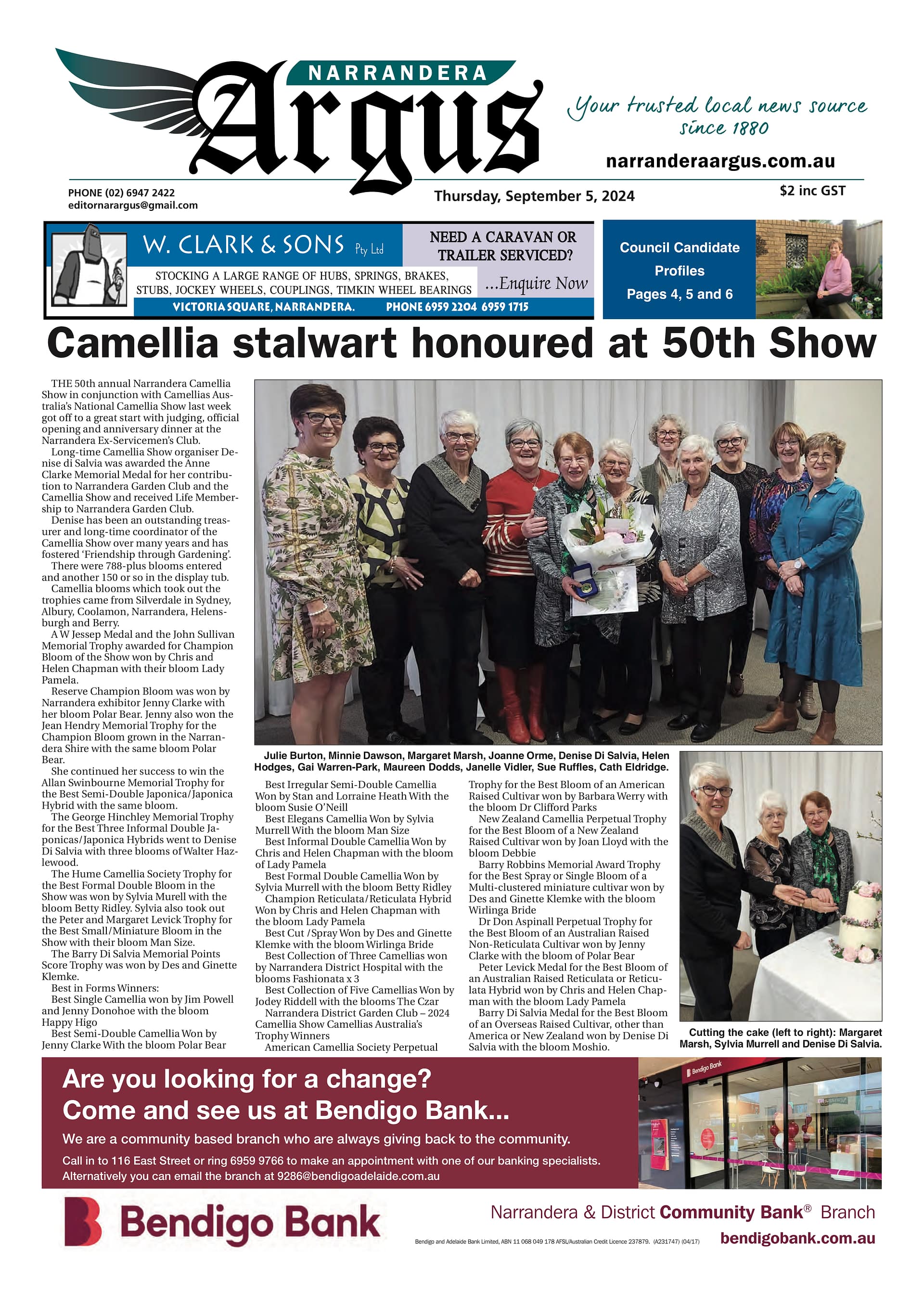
This article appeared in the Narrandera Argus, 5 September 2024.
Related stories: Camellia lovers to celebrate 50th annual show in Narrandera, Camellia Show one of the best ever with over 960 blooms