

Michelle Daw, Yorke Peninsula Country Times
Farming and transport industry representatives have praised a decision by Yorke Peninsula Council to open its roads to higher-productivity heavy vehicles as a victory for common sense.
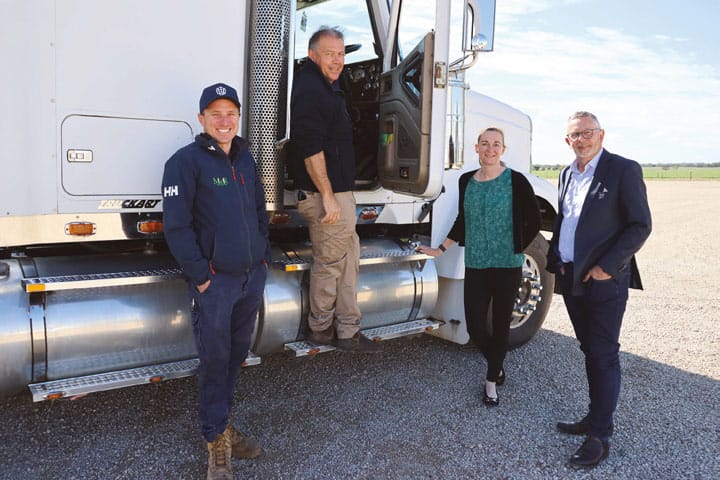
The move followed an enormous response of 789 submissions to council’s public consultation about a proposed strategy to address safety concerns on its roads.
Council’s unanimous decision was made at its monthly meeting on August 14.
Elected members voted to have council’s entire unsealed road network, irrespective of risk rating, gazetted by the National Heavy Vehicle Regulator to allow A-doubles of 30 metres or more to drive on them without permits.
Currently, the YPC road network is only gazetted for B-doubles and other smaller combinations.
The speed limits for A-doubles on these roads will be 40 kilometres per hour in built up areas and 60km/h outside these areas; the speed limit on the sealed road network will remain at 90km/h.
Council also voted not to impose restrictions on A-doubles travelling at night or in wet weather.
The resolution passed by the elected members also states that council considers existing road risks will be reduced by speed restriction conditions and it will continue to undertake works to address high risk areas as funds permit.
This includes removing vegetation that blocks lines of sight at intersections, widening crests and installing new signage on key roads.
Councillor Scott Hoyle, who has been a driving force behind opening up the roads for larger vehicles, said he was “stoked” about the decision, which would make it easier to use the bigger combinations that had become prevalent in the grain industry.
“A-doubles are better for the economy, better for the environment and more cost effective — common sense has prevailed,” he said.
“Upwards of 60 per cent of deliveries to Viterra at Port Giles and Ard – rossan during harvest 2023-24 were by 30m A-doubles.”
Praise for road decision
Mayor Darren Braund thanked everyone who made a submission.
“The Heavy Vehicle Access Strategy has certainly garnered a lot of interest from the community and council always welcomes robust debate,” he said.
“It was important that council provided a full range of options to ensure safety on our extensive dirt road network.
“This input from the community has helped elected members reach a decision that it feels balances the requests of our farming community with the need to ensure safety on our roads.
“The process has led to a good result that will prioritise important works such as intersection upgrades.”
The submissions came from residents and businesses, from farming and freight industry stakeholders outside the council region, and from state and national industry bodies, including Grain Producers South Australia, the SA Road Transport Association, Livestock SA, the SA Freight Council, and Grain Producers Australia.
Most submissions strongly opposed measures council had proposed earlier, which included: banning trucks longer than 19m from driving at night (except for B-doubles operating under gazette at general mass limits); speed reductions to 30km/h, and use of rotating amber hazard beacons on high-risk roads; daylight-driving-only permits; and no permits for driving on high-risk roads in wet weather.
Grain Producers SA chief executive Brad Perry said he was pleased council had heeded concerns expressed in the submissions and taken a common-sense approach.
“This is a win not just for grain producers, but for all stakeholders who rely on the road network for their livelihoods,” he said.
New approach hailed by local group
Submissions to Yorke Peninsula Council on its heavy vehicle strategy were spearheaded by a group representing a dozen local farming and transport businesses, which produced an 11-page document.
The group also made a template available, which most individual respondents used.
Group spokesperson Chelly Litster said she was pleased council had voted to gazette its entire network with National Heavy Vehicle Regulator for A-doubles, rather than just the roads which had been classified as lower risk.
She said the increased use of A-double-plus combinations reduced the number of heavy vehicles on YP roads, which in turn reduced the risk of collisions or other incidents.
“A-doubles also have a greater braking capacity and are governed by stricter standards in relation to performance and maintenance,” she said.
Ms Litster said A-doubles took fewer trips to deliver the same amount of product than B-doubles and semitrailers, resulting in in less wear and tear on roads.
The current gazette system for B-doubles was working well and the group was pleased this would be extended to A-doubles in the YPC area.
“Instead of tying up valuable council and industry resources on time intensive red tape, the system is easily accessible for users,” she said.
“Council can add restrictions to any road they need for a multitude of safety or maintenance reasons and notices are sent by NHVR either fortnightly via email or, if it’s a live change, a text message is sent out.
“It is a system maintained by NHVR, not council and its budget, but allows council to update as needed.”
Ms Litster praised council for its decision, which she said reflected the needs of the community, ratepayers and industry.

This article appeared in Yorke Peninsula Country Times, 27 August 2024.

