

Caitlin Menadue, Yorke Peninsula Country Times
Recent reports from farmers during the early stages of seeding have indicated an increase in locust activity across several cropping regions in South Australia, Grain Producers South Australia has warned.
GPSA chief executive Brad Perry said producers from Yorke Peninsula, the Riverland, Eyre Peninsula and Flinders Ranges had reported locusts on farms.
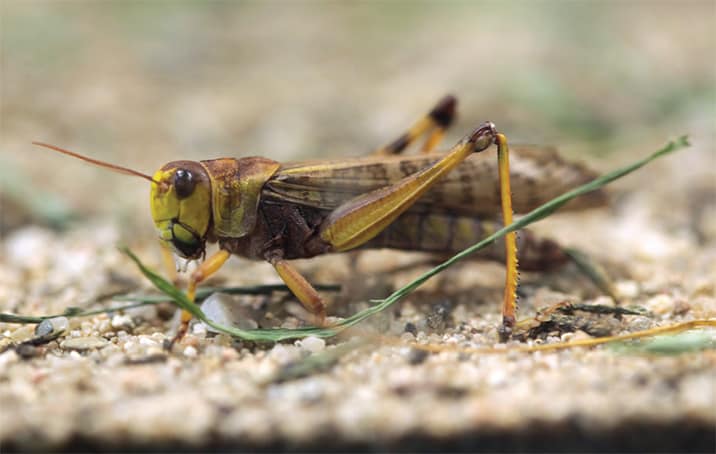
“Initial indications are that these locusts may have moved into South Australia from interstate where activity has been building,” he said.
“We’re seeing reports across multiple regions, which suggests this isn’t an isolated issue and reinforces the need for a coordinated and proactive response.”
Mr Perry said GPSA was working with the Department for Primary Industries and Regions SA to provide information on locust sightings and help to prioritise areas of surveillance.
“Grain producers are dealing with challenges around fuel and fertiliser, growing mice populations and a forecast for a drier season, and now we’re seeing locusts emerge as another risk,” he said.
PIRSA survey teams are being deployed to assess the extent of locust movement and better understand numbers and distribution.
At this stage, the situation has not been classified as a locust plague or outbreak, with authorities responding to a migration event involving adult locusts rather than an established infestation.
“Early action and reporting will be key to preventing what could become a much broader problem for South Australian grain producers,” Mr Perry said.
PIRSA says that while there is currently limited data on population build-up in outback source areas, the scale of movement by locusts into cropping zones suggests favourable breeding and migration conditions.
The South Australian Research and Development Institute’s recent locust update said emerging crops were now exposed to migrating adult locusts.
“Adults are highly mobile and can move quickly between paddocks and districts, readily reinvading treated areas and feeding on establishing crops and pastures, particularly where local densities are high,” the update said.
“Warm daytime temperatures (above 20 degrees Celsius) and light winds are likely to further encourage local movement.
“Egg-laying is also likely to occur over the coming weeks, typically in hard, bare ground where adults tend to aggregate, such as tracks, fence lines and sparsely vegetated paddocks.”
The SARDI update said the eggs would enter a “winter diapause” and were likely to hatch in early spring, between August and September, potentially leading to another increase in activity.
Marking these areas now would assist with monitoring and management at spring hatching time.
What can you do?
Australian plague locusts are a notifiable plant pest and GPSA has urged growers to monitor paddocks closely, particularly during early crop establishment, and report egg-laying activity, hopper bands, adult swarms and high densities of the pest.
“It is critical that grain producers report locust sightings on their farm to the PIRSA Exotic Plant Pest Hotline on 1800 084 881, as this will ensure a cohesive response,” Mr Perry said.
SARDI said it is important to note that seed treatments were not effective against locusts.
For more information on Australian Plague Locusts and the current situation in South Australia, visit pir.sa.gov.au.
What is a locust?
With their ability to form dense and highly mobile swarms, locusts can be serious pests of agriculture.
The large, herbivorous insect are species of short-horned grasshoppers.
In Australia, there a three main pest species of locusts: the Australian plague locust (Chortoicetes terminifera), the spurthroated locust (Austracris guttulosa), and the migratory locust (Locusta migratoria).
Locust or grasshopper?
Locusts and grasshoppers are the same in appearance but the ability to swarm and increase population can be a telling sign between the two insects.
Grasshoppers live solitary lives while locusts tend to stay in swarms.
Some species of grasshoppers can form loose swarms at high densities but don’t generally migrate long distances as locusts do.
Locusts have long, strong wings and stronger bodies allowing them to fly far to attack crops and pastures.
For more information on locusts, visit agriculture.gov.au/ biosecurity-trade.

This article appeared in Yorke Peninsula Country Times, 5 May 2026.

