

The Albanese Government’s legislation change to allow additional water buybacks shocked farming communities that rely on this precious resource. Our communities have witnessed first-hand the devastating impacts of water buyback and modernisation on our economy and environment.
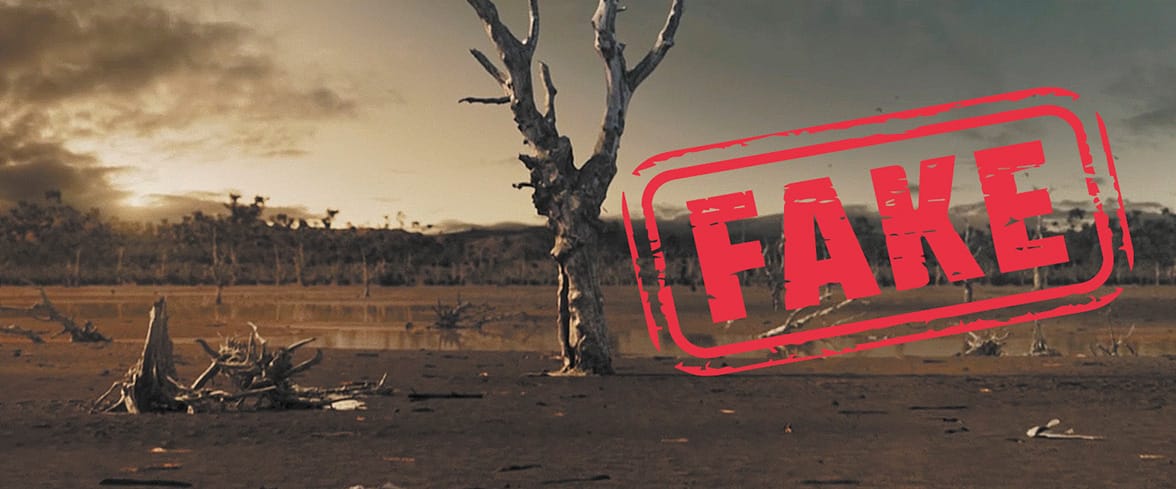
To add insult to injury, the recent $12 million taxpayer-funded advertising campaign used fake computer-generated images of death and destruction in the basin, along with emotive language that only fuels misunderstanding through the misinformation campaign.
During Senate Estimates last Friday, Opposition Water spokeswoman Perin Davey questioned one of Ms Plibersek’s top Department of Climate Change, Energy, the Environment, and Water (DCCEEW) bureaucrats, who admitted to using computer-generated imagery.
DCCEEW’s head of communications and media Anita Agett said there was “one image where CGI (computer generated imagery) was used to show a potential future scenario.”
DCCEEW secretary David Fredericks defended the use of the CGI as an “honest attempt” to illustrate what a dry Basin might look like.
But Mr Fredericks also admitted there were no real images available that matched this scenario, prompting the use of CGI.
Senator Davey pointed out the historical inaccuracies in the campaign’s portrayal saying: “The Murray River did not run dry even during the millennium drought.”
The shocking revelation comes on top of a Weekly Times article on April 29 that pointed the government had been using misleading images that weren’t even in the Murray-Darling Basin to promote the restoring the rivers bill. One image Ms Plibersek posted was a 1989 photograph of tropical Queensland’s Elliott River, another was of Cronulla Bay south of Sydney and even a Turkish orange grove.
With such a diverse basin over a huge geographical area, the Federal Government seems once again prepared to stop at nothing to use our river health, food production and future prosperity as a political propaganda ploy.
Collecting dust on many department shelves will be a litany of social and economic reports detailing the impacts of water removal from basin communities.
The 2016 Murray-Darling Basin Authority Wakool Community profile report acutely outlined the impacts of water recovery. From 2001 until 2016, 38 per cent of the district’s water was removed by the federal government, 91GL through purchases and 6.9GL through water efficiency programs. The report outlined that employment in irrigated agriculture fell a whopping 71.8 per cent, with 47.6 per cent of the change occurring between 2006 and 2011. Agriculture wasn’t the only area where employment was hit hard, the government service workforce decreased by 35.1 per cent, with the total area workforce falling by 53.7 per cent. The town population also decreased by 26.2 per cent, and most alarmingly in the ABARE SEFIA rating (Socio-Economic Indexes for Areas), the community’s wealth fell from 5 to 2.
Member for Mallee Dr Anne Webster came out swinging this week after the release of the ABARES report on the impacts of buybacks.
“The nation’s peak agricultural reporting agency has today laid bare the setback we face if Labor pursues their political target of a 450 gigalitre water recovery, largely via buybacks. On the data we have today, Sunraysia faces an approximate $20 million annual economic hit all so Labor can hang on to the seat of Boothby in metropolitan Adelaide.
“In Sunraysia alone, which produces 15 per cent of the nation’s horticultural output, last year our Gross Value of Production (GVP) was scheduled to grow more than anywhere else in the nation, $500 million – that is – by 32 per cent from $1.7 billion in 2020-21 to $2.2 billion per annum in 2029-30,” Dr Webster said.
Maybe the most alarming aspect of this whole debate is the lack of truth-telling on the issue. I’ve found many people who don’t know the Darling is a separate river from the Murray, or that the water to keep the Murray flowing is allocated first.
If the government wants emotive claims to spend $12 million to inform the public, I thought we’d give them some suggestions, and a bonus no AI images or photos taken from outside the basin!
- The Federal Government purchased water from a 30,000-year-old floodplain inland delta that spans over 300,000 hectares, home to many endangered species and more bird species than Kakadu, without a single environmental impact study.
- The Federal Government drove broad changes that enabled the formation of new irrigation areas below the natural constraints of the river system without any consideration of water deliverability, soil suitability or salinity.
- The Federal Government permitted an almost $2 billion unregulated water trading (financial market) with our most precious resource with no consumer protections or regulations on insider trading or tagging for transmission losses. A market where foreign multinational corporations can compete with family farmers.
- The Federal Government pushed water efficiency without any consideration for holistic management. For example, the $2 billion Northern Victorian Irrigation upgrade scheme saw almost 2,000km of earthen channels piped or plastic lined. Despite a plan to save the environment, the historical channels that formed some of the best wildlife corridors were removed. Once providing food and water for native animals, it is now a pipe where nothing can drink or live, or a plastic-lined channel where most things that attempt to drink drown, such as kangaroos, koalas or dogs. The other doozie is a plastic lined channel that cannot be cleaned by an excavator, so it’s effectively napalmed with chemicals such as Acrolein. A bonus question, where did the endangered small-bodied fish come from to repopulate the site of indigenous significance, the Pollack Swamp? An earthen channel!
- The Murray, a Living Murray icon site and a key icon to save under the MDB Plan has seen a huge increase in the rate of erosion since the plan implementation (also witnessed in the Goulburn and Edward Rivers). From 7-15 metres of Murray River bank have been lost locally, taking with it private infrastructure, habitat for the Azure Kingfisher, eroding RAMSAR-listed forests and threatening buildings of historical significance.
I’m not sure an ad would quite cut it. I’m just warming up, and there’s at least a mini-documentary already.
The Federal Government mis/disinformation bill excludes the government or their departments from having to comply, you can sure see why!
This article appeared in The Koondrook and Barham Bridge Newspaper, 13 June 2024.

