

“Life is 10 per cent what happens to us and 90 per cent how we react to it” started Dr Mark Ferguson, CEO of NeXtgen Agri Ltd as he addressed a packed house at the Wakool sheep management night.
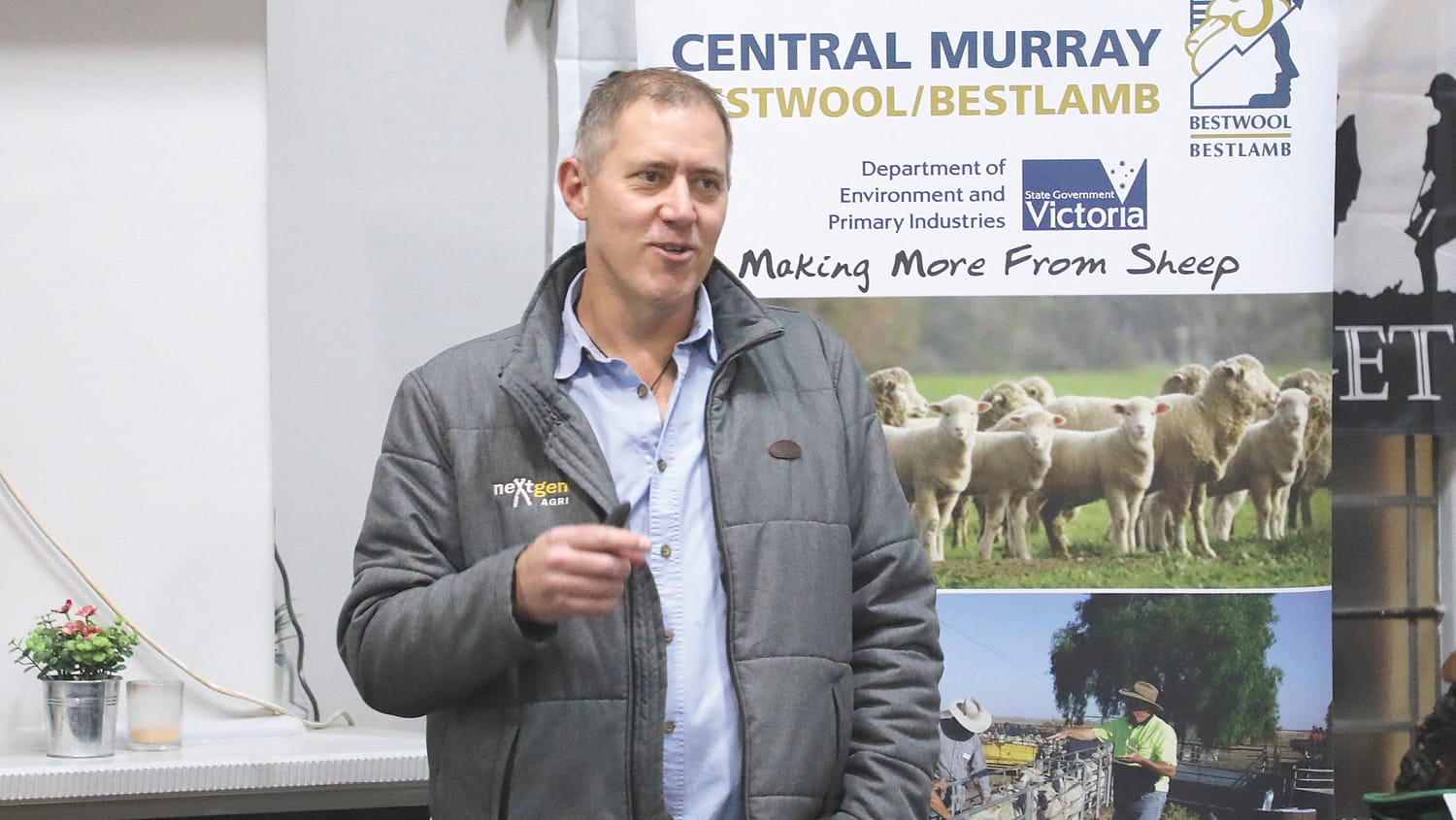
“Everything we can’t control is often the stuff we are whinging about; the stuff we can control is often the stuff we’re not talking about.
“We’re talking about governments, talking about markets, talking about why our agents didn’t give us a better price, but in reality, the stuff we can control is the stuff in our own business.”
Dr Ferguson went on to point out the many factors which are in the sheep producer’s sphere of influence.
“Ewe nutrition starts early, it starts young.
“We’ve got ewes that are lambing, they’re a high priority. We’ve often got lambs we’re trying to finish, they’re a high priority ‘cause we’re going to make some cash, whereas the girls that are going to be our replacement ewes tend to drop off our priority list.
“In the business I’ve watched and worked with, when we focus on those young years and we get them up to good weight and good condition for their first mating, we just start a big snowball effect running through that age group. If that age group is good, then their lambs are good, and away it goes.”
The target Dr Ferguson suggests producers aim for is 100 per cent mature weight by 19 months. To achieve this, producers need to know the data. What do your mature ewes weigh? What are your weight gains?
“You may not get 100 per cent, but you may get 90 per cent. To get that, it’s 90-110 grams a day from birth.
“Up to weaning, they’ll be doing 220, 230, 240 grams a day, somewhere around there.
“In a perfect world, you are weighing a sample monthly, every month for 19 months, weighing 50 of them.
“At 50, it doesn’t matter if your mob is 1,000 or 500, 50 of that mob will give you the average every time.”
Dr Ferguson presented data from a New Zealand client’s farm, demonstrating that in their flock of 8,000 ewes, increased maiden weight gain resulted in more lambs.
Producers were also reminded to condition score their ewes.
“The reality is it is the fuel tank of your ewes; it is a massive opportunity to, without spending any more money, get the right sheep on the right nutrition.
“If you put your hand up at the start of the day stating you want more lambs, and you haven’t put your hand up saying that you condition score your ewes, then you’re not serious about achieving that outcome, and that’s fine, just accept that you’re not properly having a go.”
The next topic Dr Ferguson touched on was teaser rams. Using either vasectomised rams or weathers with injected testosterone in a bid to get the ewes cycling for a timely joining. Sheep ovulation varies with day length and with most joining typically happening in summer, teasing is vital.
“The shorter the nights, the less melatonin. The less melatonin, the less ovulation, basically.
“By putting a teaser in for a couple of weeks, just the smell will turn those ewes from non-ovulating to ovulating. Until you’ve got 100 per cent ovulating, you then whack the rams in and everyone is good to go.
“If you’re joining pre-January, or sort of early January, November, December, you either need to use your rams as a teaser, this makes a seven-week joining, or use a teaser for two weeks and put the rams in for five.
“If you’re joining from February, March, April, then you don’t need a teaser ram and you can join for five weeks.”

When the ewes are pregnant, scanning to identify twins is an important management tool, not only for feeding, but also if you need to reduce flock size.
“In the sheep job, twin bearing ewes are the highest priority mob we can ever play with.
“Once they’re pregnant, particularly the twin bearing ewes, they have the highest priority to make you money, or lose you money.
“If we don’t feed her enough, the lowest priority things get burnt off first. She’ll start burning fat, she’ll start burning muscle, she’ll start losing condition score and she’ll be prioritising the lamb.”
Maintaining a pregnant ewe condition score is critical to a healthy birth weight and proper lactation.
“If we get this wrong, we get low birth rate twins, that is a consequence of getting our twins wrong.”
When it comes to paddock selection for lambing, shelter, privacy and nutrition are the three keys.
“If you have options, it’s about putting the most vulnerable ewes in the best paddocks.
“Maiden twins are a high priority, skinny twins are a high priority, then fat twins and then singles.”
Dr Ferguson said record keeping at lamb marking and weaning is vital.
“If we can record how many lambs come out of each paddock, it informs next year.
“So, it helps work out where on your farm is the best lambing spots.”
The final point of the night was the need for ewes to have six hours undisturbed to mother properly. Disturbance can come from vermin, traffic, searching for nutrition and other ewes.
The event was a joint initiative by BestWool BestLamb and the Western Murray Land Improvement Group, funded by Local Land Services NSW.

This article appeared in The Koondrook and Barham Bridge Newspaper, 13 June 2024.

