

Farming regions such as Yorke Peninsula may need to return large areas of farmland to native vegetation if Australia is to prevent accelerating species loss and meet international biodiversity targets, according to new research.
An Adelaide University master’s project found heavily cleared regions across South Australia fall well short of the internationally endorsed goal of restoring 30 per cent of land to nature, with the Copper Coast retaining just 3.6 per cent of its native vegetation.
Environmental Science master’s graduate Peter Martin said achieving the target would require major changes to land use, with some productive farmland eventually restored to native ecosystems.
“This is not tinkering at the edges,” he said.
“It implies major land use change at a district scale.”
Research calls for major farming rethink
Mr Martin’s 2025 project examined four South Australian council areas — Yorke Peninsula, Copper Coast, the Coorong and Grant — all of which fall well short of the 30 per cent benchmark adopted internationally in 2022.
Scientists say restoring at least 30 per cent of land to nature is critical to slowing biodiversity loss and preventing ecosystems from reaching irreversible decline.
According to the Grantham Research Institute on Climate Change and the Environment, species are disappearing between 10 and 1000 times faster than the natural rate of extinction, with at least 1.2 million plant and animal species threatened worldwide.
A landscape restored
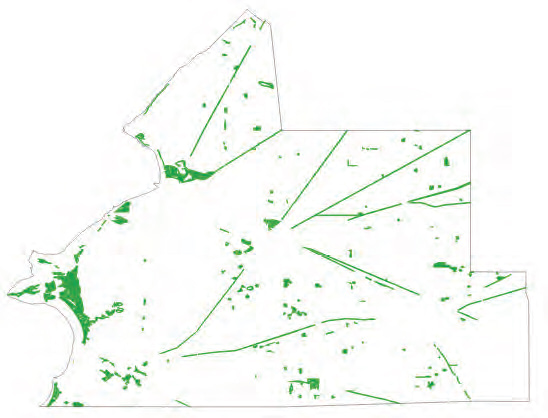
Using historical vegetation maps prepared by the SA Herbarium, Mr Martin mapped what a restored landscape could look like if native vegetation covered 30 per cent of each region.
For the Copper Coast, the scenario included expanding native mallee, woodland and shrubland across parts of the district while accounting for roads, towns, key infrastructure and bushfire risk.
The long-term vision, he said, was not to eliminate farming but to create landscapes where agriculture and restored ecosystems existed side by side.
“Instead of communities seeing their district as a wheat-sheep zone, they’d see and value it as a wheat-sheep-mallee ecosystem zone,” Mr Martin said.
“The region might generate slightly less agricultural produce, but social and health science suggests that a more natural and diverse landscape can significantly improve human health and mental wellbeing.”
Communities first
Mr Martin acknowledged such change would be difficult for farming communities built over generations of agricultural production.
“The biggest barrier isn’t technical,” he said.
“Community acceptance of sweeping, long-term change is slow and difficult.
“Farming regions built over generations of clearing and production are unlikely to embrace rapid and large-scale ecosystem restoration, particularly if it threatens livelihoods.
“Transition guided by such a blueprint would need to unfold over decades, possibly even a century. It is possible, but it would need to be backed by sustained government and community support.”
Future landscapes
Climate change, he said, added urgency to the challenge.
By the end of the century, climate projections suggest Kadina could experience conditions similar to those now found around Hawker in the Flinders Ranges, potentially making some current farming systems increasingly difficult to sustain.
Mr Martin said that could strengthen the case for alternative land uses, including new crop varieties better suited to changing conditions or ecotourism in areas restored to native vegetation.
He believes Australia continues to manage its landscape using outdated approaches despite decades of scientific evidence.
“We continue to maintain an 1840s approach to landscape management long after science has made it clear it is driving species to extinction,” he said.
“There is a lot of lip service paid to conservation, but the real question is whether we have the wisdom and courage to make the major land use changes that science tells us are urgently needed.
This article appeared in Yorke Peninsula Country Times, 30 June 2026.

