

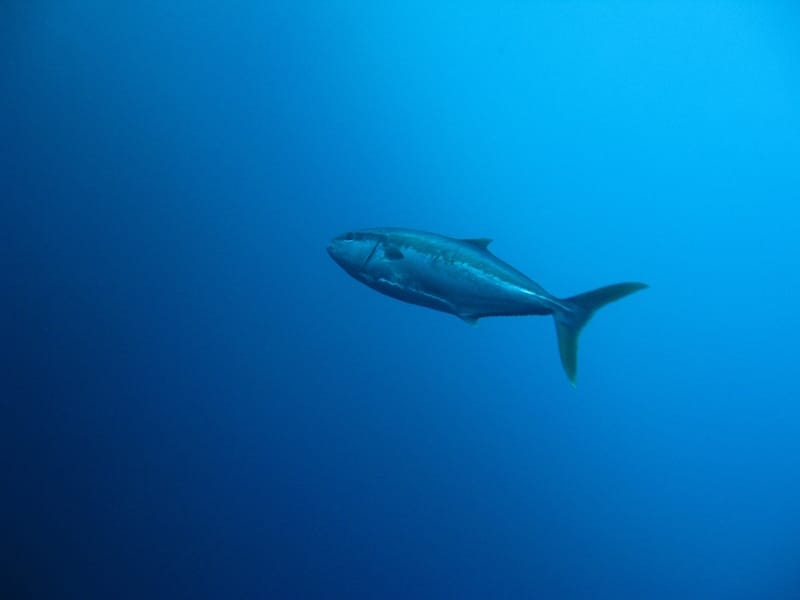
A new study has found yellowtail kingfish travel much further offshore than previously thought, with some fish migrating long distances and diving hundreds of metres below the surface. The project began as a collaboration between staff from Lord Howe Island Marine Park and researchers from the Sydney Institute of Marine Science.
Yellowtail kingfish, one of Australia’s most sought-after sport fish, are spending far more time in the open ocean than scientists previously realised, with some individuals travelling more than 4,000 kilometres and diving to depths approaching 500 metres.

The findings, published in the Canadian Journal of Fisheries and Aquatic Sciences, come from the largest satellite tracking study yet conducted on adult yellowtail kingfish (Seriola lalandi) in eastern Australia and New Zealand. Researchers fitted 50 mature kingfish with pop-up satellite tags and tracked them for a combined 3,159 days. This included 6 kingfish successfully tagged at Lord Howe Island and tracked them for 1,151 days. The results challenge the traditional view that kingfish are largely coastal animals.
Hidden lives in the open ocean
Nearly half of the kingfish tagged in coastal waters ventured beyond the continental shelf into oceanic habitats more than 200 metres deep. Overall, the fish spent more than half of the study period in offshore waters.
One fish travelled more than 4,100 kilometres in just over seven months, while another moved more than 500 kilometres in only 11 days.
The movements suggest adult kingfish are far less tied to reefs and coastal fishing grounds than previously believed. Earlier tagging studies relied mainly on conventional tags recovered by anglers, providing only release and recapture locations. Satellite tags offered a much more detailed picture, revealing that fish often returned close to where they were first caught after lengthy journeys.
Deep divers
Although kingfish spent most of their time within the upper 100 metres of the ocean, several individuals undertook remarkable dives.
Six fish descended beyond 200 metres, and one fish tagged in Victoria reached a depth of 475 metres, considerably deeper than previously documented for the species.
Fish tagged around Lord Howe Island tended to occupy deeper waters than those along the mainland coast, suggesting offshore habitats and seamounts may play an important role in their ecology.
Following the seasons
The study also showed that kingfish movements change with the seasons.
Fish tagged in Victoria moved north into New South Wales during winter, while some fish tagged in New South Wales headed south during summer.
These shifts appear to track the warm waters carried southward by the East Australian Current, which has strengthened as waters around southeastern Australia have warmed.
Scientists suggest this warming trend could continue pushing kingfish further south, with Tasmania likely to become increasingly suitable habitat in the future.
Searching for spawning grounds
The researchers found kingfish occupied waters ranging from 11°C to 27°C, although most preferred temperatures between 17°C and 21°C.
Those temperatures overlap with conditions known to trigger spawning in captive kingfish, suggesting that many of the offshore areas visited by tagged fish may also be important breeding grounds.
Previous studies have indicated that Lord Howe Island and nearby seamounts could be key spawning locations, and some fish in the new study made directed movements toward offshore features that may support reproduction.
Further work will be needed to confirm exactly where and when spawning occurs.
What this means for fisheries
The extensive movements uncovered by the study highlight the challenge of managing kingfish populations across multiple states and even national boundaries.
Fish routinely crossed between New South Wales, Victoria and Tasmania, indicating that Australia’s eastern kingfish stock is a shared resource that may benefit from coordinated management.
Understanding how the species responds to changing ocean conditions will become increasingly important as climate change reshapes marine ecosystems.
The findings provide valuable information about the temperature and depth preferences of kingfish, helping scientists predict how the species may respond to future warming and allowing fisheries managers to better prepare for changes in distribution.
The paper published by the Canadian Journal of Fisheries and Aquatic Sciences on 17 June, 2026, can be accessed at the following link: https://cdnsciencepub.com/doi/10.1139/cjfas-2025-0343.
This article appeared in The Lord Howe Island Signal, 30 June 2026.

