

Last week I wrote that Budget Number Ten would tell us everything we needed to know.
Well, now we know.
And it’s worse than expected.
For all the Government’s talk about farm resilience, diversification and food security, when it came time to fund the department that actually underpins those things, the treasure chest was empty. Not just empty — quietly looted and lowered over the side over the next four years.
You wouldn’t know it from the Minister’s office, of course.
No glossy announcements.
No triumphant press releases.
No grand unveiling of a new agricultural science fleet or a biosecurity armada ready to defend the coast.
Nothing.
Not even a ceremonial cannon blast.
What did Jackie Jarvis, the self-appointed Pirate Queen of DPIRD, actually bring back from Treasury after another budget raid? You would never know unless you locked yourself in the cabin and read the fine print buried deep in the budget papers.
There were no glossy brochures celebrating support for agriculture and fisheries.
No proud declarations about rebuilding regional science capability.
No vision.
No map.
No compass.
Just a tired old vessel drifting further into the fog while the crew quietly eye off the ships cutter.
Having spent 30 years reading state budget papers — particularly those involving agriculture and fisheries — I can safely say this Minister now captains one of the worst sets of forward estimates cuts most older departmental hands have seen in their working lives.
Not one major division of the department can look forward to calmer seas.
The total cost of services falls from $727 million to $467 million over the next four years.
Income from Government sinks from $577 million to $381 million.
Employee benefits slide from $290 million to $275 million — and once you factor in wage rises, that likely means more than 100 full-time positions quietly being marched to the plank.
First to walk it may well be some of the 557 biosecurity staff, with funding slashed from $143 million to $111 million.
Apparently the strategy for dealing with invasive pests and exotic diseases is now little more than “keep a weather eye out and hope for the best”.
The 353 people working in natural resource management will also be nervously checking whether their names are next on the manifest as funding drops from $110 million to $79 million.
And the few remaining agricultural scientists — already rarer than an honest pirate accountant — may soon be packing their sea chests, with the 433 staff in regional technical services staring down a brutal one-third cut from $108 million to $72 million.
Meanwhile, over on neighbouring vessels, life appears considerably more luxurious.
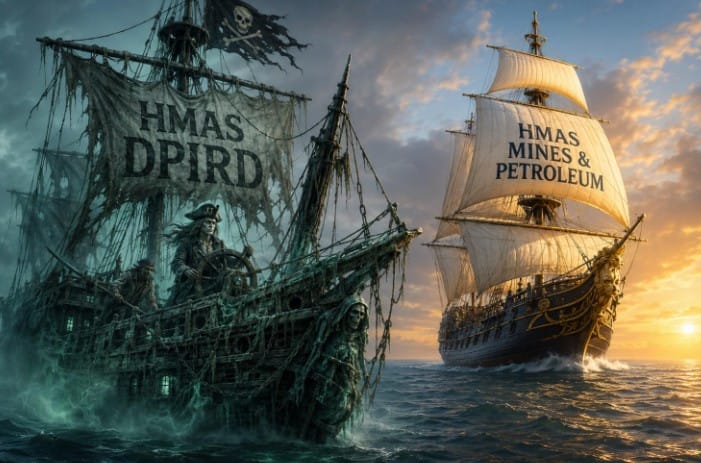
At the HMAS Department of Mines and Petroleum, the Minister has at least managed to hold the line, with employee benefits rising from $88 million to $92 million.
And over at His Majesty’s Biodiversity, Conservation and Attractions, the crew are positively feasting, with employee benefits climbing from $342 million to $366 million.
But the old hulk DPIRD?
DPIRD is becoming the ghost ship of Government.
A once-proud vessel now drifting through the policy doldrums under a captain who appears to have lost both the map and the will to sail.
Where are the bold Cabinet submissions?
Where is the world-class biosecurity research centre?
Where is the grand plan to rebuild horticulture?
Where was the fisheries rescue package when the fleet started taking on water?
Where was the push to drag a decent share of the billions in GRDC reserves back into WA through matched Treasury funding?
Nothing.
Not even a faint breeze stirring the sails.
Just Captain Jackie pacing the quarterdeck in a feathered hat marked “JJ”, peering through a brass telescope searching for another Welcome to Country ceremony while the lower decks quietly flood.
After ten years and two failed captains, the great DPIRD amalgamation experiment — once sold as a mighty flagship of agricultural efficiency — now resembles a patched-up pirate tub leaking from every seam.
And the longer this Government keeps the current captain at the helm, the more we can expect the same slow drift towards the reef.
What makes it worse is the state is hardly short of treasure.
After a decade of surpluses, Treasury’s vaults are overflowing.
This is not poverty.
It is priority.
And agriculture, fisheries and regional development now sit somewhere below interpretive dance grants and diversity deck-chair committees on the Government’s list of concerns.
DPIRD has effectively been relegated to drinking bilge water.
The upper decks still enjoy fresh rations and imported rum while crumbs drift down below to the remaining crew busy bailing the bildge.
The focus is no longer on discovery, innovation or planting the flag on new agricultural frontiers — it is simply managing decline while pretending the ship is still seaworthy.
It is survival.
Who will be the next experienced scientist, biosecurity officer or regional expert to quietly slip overboard at night and swim for a more competent vessel?
Meanwhile, farmers and regional communities stand on the shoreline watching in disbelief as this once-proud ship drifts past like a wreck of the Spanish Main — sails torn, crew mutinous and the captain insisting everything is “ship shape”.
It is as though the current officers have concluded there are no new worlds left to discover, no threats left to fight and no point investing in the future.
Just sit back, sip the taxpayer-funded rum and watch the vermin spread across the empire.
And as for the captain herself — what exactly will be her legacy?
What mark will she leave behind other than a trail of shrinking budgets, abandoned ports and a once-proud vessel left drifting through the fog?
Or perhaps that was never really the point.
Perhaps the real treasure was never rebuilding agriculture at all. Perhaps it was the captain’s hat, the taxpayer-funded trade voyages, the first-class cabins, the cabin boys and girls in the office forever scurrying about with cries of “Yes Minister!”, and the endless medal ceremonies aboard the good ship Equity and Inclusion, where every sailor receives a ribbon for attendance while the hull quietly slips beneath the waves.
So let’s call it exactly as it appears in the budget papers.
DPIRD is rapidly becoming a ghost ship.
And perhaps it is time for Captain Jarvis to surrender the wheel to someone who understands that running a ship requires more than diversity shanties and ceremonial deck inspections. It requires ideas, energy, calculated risk-taking and, above all else, a close friendship with the Treasurer — the grim keeper of the silver chest who decides which ships are repaired, and which are simply left to drift towards the rocks.
In the meantime just watch the next wave of sailors jump ship.