


As the country reaches a regional population milestone, Find a Mover’s decade of platform data shows what the diesel surge means for movers booking now — and what the structural floor reset means for the regional migration flow long-term.
The Regional Australia Institute’s confirmation last month that 10 million Australians now call the regions home was greeted, rightly, as a milestone. New ABS Estimated Regional Population data shows regional and remote Australia grew 1.1 per cent in 2025 to 10.02 million, up 6.3 per cent since 2020. RAI’s Regional Movers Index puts capital-to-regional migration at 11 per cent of all inter-LGA relocations in the final quarter of last year, outpacing the reverse flow by 31 per cent. The pandemic-era shift to regional living has not unwound.
What is changing is the cost of making that move.
The diesel surge that’s already feeding through
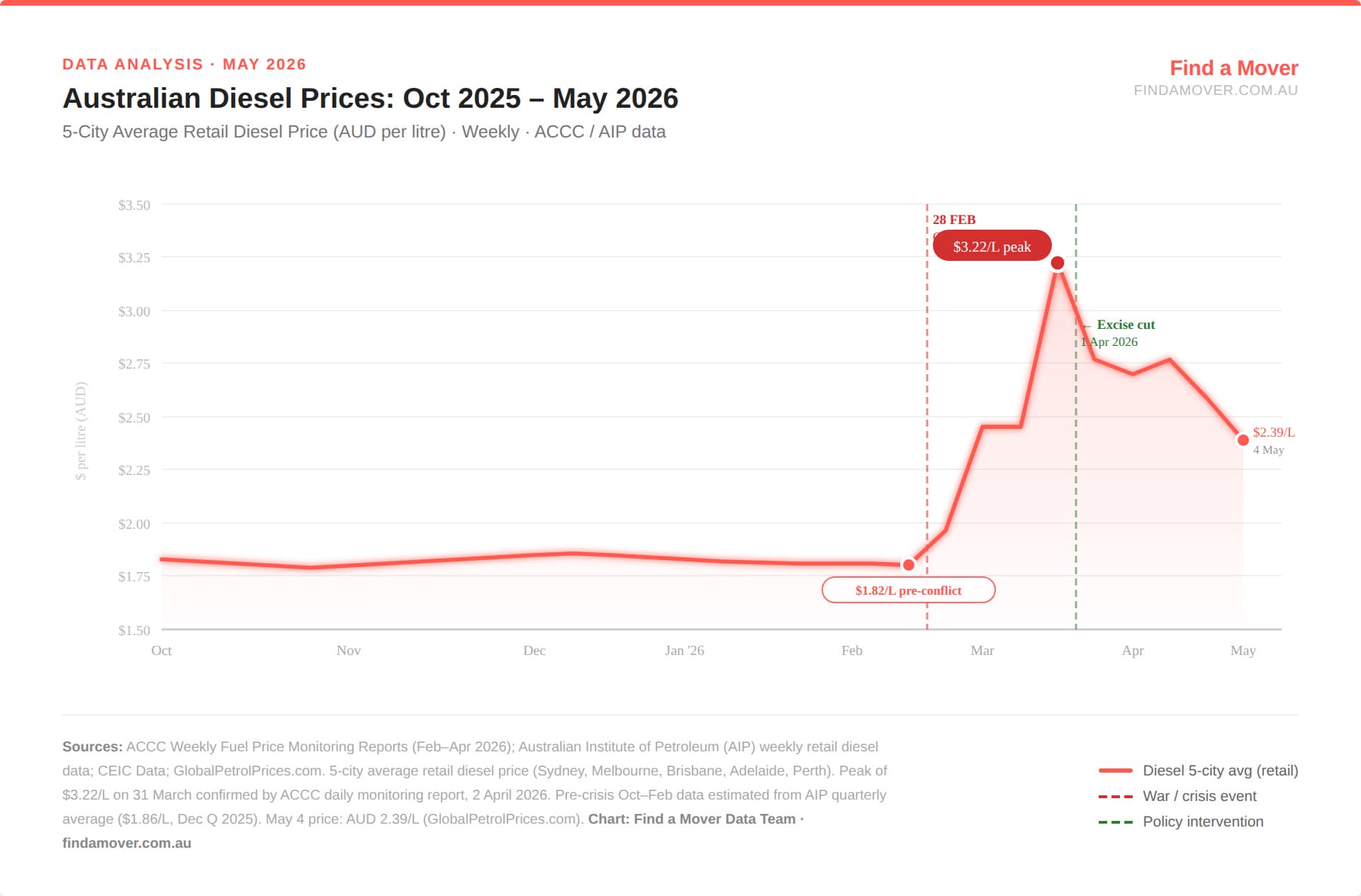
Australian diesel jumped from a national average of $1.82 a litre in early February to a 5-city retail peak of $3.22 per litre on 31 March, after the US-Israel-Iran escalation closed the Strait of Hormuz. Wholesale prices rose 91 per cent in five weeks, according to ACCC weekly monitoring data. The federal government halved the fuel excise on 1 April, knocking 26.3 cents off pump prices and pulling the national average back to $2.59 by 20 April. But the cut is temporary — it expires on 30 June 2026 — and global oil prices remain elevated. Without further intervention, pump prices automatically rise 26.3 cents on 1 July, regardless of what’s happening in the Middle East.
For Find a Mover, which has processed more than one million household moves across Australia since 2014, the impact on regional migration costs is already visible in platform data — and the bigger impact is yet to come.
Why regional moves feel it hardest
The reason regional migration is exposed to fuel shocks comes down to one variable: distance.
A loaded eight-tonne removalist truck consumes 30 to 40 litres of diesel per 100 kilometres. A typical Sydney-to-Newcastle relocation runs roughly 320 kilometres return — about 110 litres of diesel for the run alone. At 77 cents extra per litre (the current gap between pre-crisis pricing and today’s pump price), that’s an additional $85 per leg in pure fuel cost. Pass-through to the customer is typically closer to $300 once margin compression, equipment costs, and labour escalation are factored in.
The platform’s data shows the impact scaling sharply with corridor distance — and the longer the route, the larger the absolute increase. Under current diesel pricing, an Adelaide-to-Mount Gambier move costs an estimated $710 more than its pre-crisis baseline. A Perth-to-Geraldton move costs $690 more. Even on shorter routes within commuting distance of capitals, the impact is measurable, but the deeper into regional Australia a move goes, the heavier the fuel-shock load it carries.
Estimated regional move costs · long-distance corridors into regional Australia
| Corridor | 12-month avg | Current $2.59/L diesel | Projected $3.30/L diesel |
| Sydney – Coffs Harbour, 530km | $3,245 | $3,920 +$675 | $4,470 +$1,225 |
| Melbourne – Albury-Wodonga, 310km | $2,615 | $3,140 +$525 | $3,580 +$965 |
| Brisbane – Fraser Coast, 290km | $2,700 | $3,200 +$500 | $3,640 +$940 |
| Perth – Geraldton, 420km | $3,340 | $4,030 +$690 | $4,610 +$1,270 |
| Adelaide – Mount Gambier, 440km | $3,500 | $4,210 +$710 | $4,830 +$1,330 |
Source: decade of Australian removalist transaction data (median 3-bedroom house moves, past 12 months) plus diesel pass-through modelling. Current column reflects observed diesel pricing as of 4 May 2026. Projected column models sustained Hormuz disruption combined with excise cut expiry on 30 June 2026.
The 2022 precedent that matters
This isn’t speculative. Find a Mover’s data shows precisely what happened the last time global oil spiked. When Russia invaded Ukraine in February 2022 and oil hit US$130 a barrel, removalist rates jumped 9 to 27 per cent across Australian capitals within months. Brisbane local rates rose from $120 per hour in 2021 to $149 in 2022. Melbourne reset 27 per cent in a single year. Four years later, every city is still operating above its pre-2022 baseline.
Brad Johnston, data analyst at Find a Mover, puts it plainly: “The 2022 spike acted as a permanent reset of the floor price. Australian removalist costs don’t typically retreat once they rise. The current shock is now creating identical conditions — and is being partly masked by the temporary excise cut.”
What it means for anyone moving in the next 90 days
For movers planning regional relocations in the next 90 days, two dates matter. Removalist quotes typically lock for 7 to 14 days. Rates have historically repriced 4 to 8 weeks after a sustained fuel price increase. That window opened in early March.
Randee, a removalist operator, said the volatility had made quoting nearly impossible. “When diesel swings $1.40 a litre since February, it makes it almost impossible to hold a quote. By the time a customer books, the number has moved. The only thing we can do is pass that cost on.”
The 30 June excise expiry compounds the issue. Movers booking for July receive their quotes in late June, by which time operators pricing in the cliff will already have absorbed it into base rates. The window for current pricing closes in roughly six weeks. Anyone with a confirmed regional move scheduled for July is, by Find a Mover’s modelling, already exposed.
What it means for regional migration long-term
The implications for the regional migration flow itself are larger than the immediate impact on individual movers.
If the 2022 oil shock added an average 18 per cent to corridor pricing, and the 2026 shock adds another 12 to 15 per cent on top, the post-2026 baseline sits roughly 30 to 35 per cent above 2021 levels. That is a permanent shift in what it costs to move, not a temporary spike that will correct itself. It compounds with each future shock.
According to RAI’s research, 5.3 million metropolitan Australians are actively considering a regional move — including 49 per cent of Generation Z metro workers who cite cost-of-living as their primary motivator. For all of them, the rising cost of moving is now a real barrier to acting on that decision. A move that cost a flat $1,200 in 2018 sits at $1,500 to $1,800 today and is on track to a $1,800 to $2,400 floor by late 2027. Migration won’t stop. But the person whose decision comes down to cost — the one for whom an extra $500 makes the difference — may not make the move at all.
For families in Coffs Harbour, Albury, the Fraser Coast and Geraldton — the communities at the end of these corridors — the costs are real and immediate. A Sydney family moving to Coffs Harbour is now paying an estimated $675 more than they would have 12 months ago. If the excise cut expires on 30 June as scheduled, that figure climbs to $1,225.
The Strait of Hormuz situation will resolve, eventually. Australian moving costs, on the previous evidence, will not go back to where they were when it began. For the regional Australians making the move right now, the window to do it at anything close to last year’s price is closing fast.

