

Rabobank, Media Release, 29 April 2026
While headline annual inflation rose sharply in the March 2026 Consumer Price Index (CPI), the re-acceleration in inflation was not, at this point, food led, with food price inflation remaining similar to levels recorded since mid-2025.
The latest CPI data, released by the Australian Bureau of Statistics today, found headline inflation rose 4.6 per cent year-on-year in March 2026, accelerating sharply from 3.7 per cent in February and reaching its highest annual rate since September 2023.
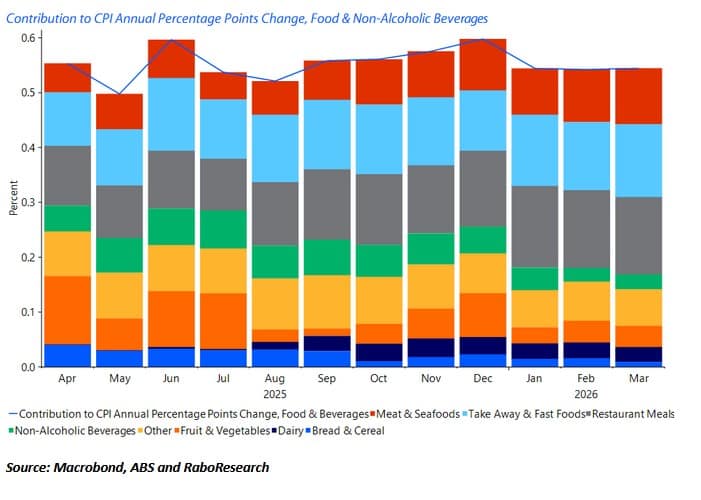
Food price inflation though was found to “remain entrenched” at slightly above 3 per cent, the same level it has held for 10 consecutive months, RaboResearch senior food retail analyst Michael Harvey said. However, further price inflation may be likely across several food categories in coming months, due to higher costs impacting the food supply chain from the Middle East conflict, he said.
The March CPI found food and non-alcoholic beverage prices rose 3.1 per cent year-on-year in March, unchanged from February and below headline CPI.
“Despite moderating from earlier peaks seen in late 2022 food inflation does remain a material contributor to household cost pressures due to its large CPI weight,” Mr Harvey said.
“Within the food basket, meat and out-of-home meals were the largest contributors to food price inflation in the latest data. Meat prices (notably beef and lamb) continued to run at double-digit inflation rates, supported by strong local livestock markets, he said.
Coffee prices surged 10.7 per cent year-on-year in March, reflecting the pass-through of global pricing pressures.
Fresh produce pricing remained mixed, the latest CPI data showed. Overall fruit and vegetable prices rose 1.8 per cent year-on-year.

“This was fruit driven, with prices in the fruit category up 4.3 per cent year-on-year in the latest data, with particular rises in particularly strawberries, blueberries and apples,” he said.
“Vegetable prices, on the other hand, recorded mild deflation (0.2 per cent year-on-year).”
Looking ahead, Mr Harvey said, “there is upside risk to vegetable prices, as rising input costs force some growers to scale back plantings, potentially tightening supply”.
Milk prices rose 4.0 per cent year-on-year in the March data, he said.
“Retailers have more recently (April 2026) lifted private-label milk prices, which is expected to flow through more fully in coming months, pointing to broader inflation across the dairy aisle,” Mr Harvey said.
Cheese prices showed deflation for a second consecutive month, driven by heightened promotional activity.
There was some relief for consumers too with cooking oil prices declining 0.8 per cent year-on-year, Mr Harvey said.
“After record high global olive oil prices in 2022–2023 driven by droughts in Spain and the Mediterranean, prices eased in late 2024 as production recovered,” he said. “Early 2026 has seen price firmness return, due to renewed weather stress in Southern Europe and low carry-over stocks, particularly in Spain. Olive oil is the largest cooking oil sold in local supermarkets and Australia’s heavy reliance on imports of olive oil leaves domestic prices exposed to these global dynamics.”
Mr Harvey said geopolitical risk remains a key watchpoint when it comes to food prices in Australia. And “Australian households are not out of the woods”, with further price inflation likely across several food categories in coming months.
“The Middle East conflict is pushing up fuel and fertiliser costs at farm level. These pressures are also lifting post-farmgate costs for food and beverage manufacturers via processing, distribution and packaging,” he said.
“Consumer resolve remains strained, with renewed pressure on discretionary spending continuing to shape food purchasing behaviour, he said.