

This article is a rerun of a piece I first published back in November 2023.
Note my current commentary in brackets.
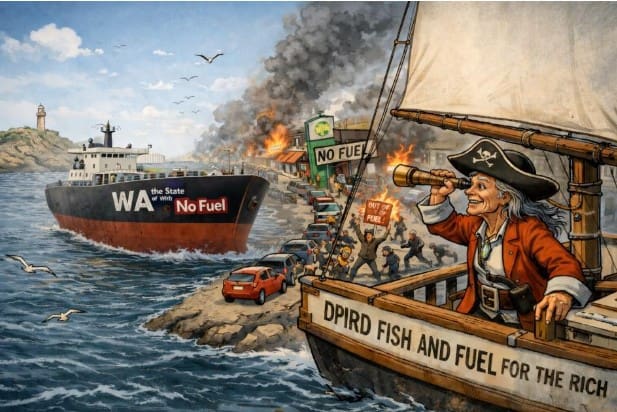
Readers may recall the strategic fuel debate that ran hot a few years ago when the BP refinery in Perth was about to close and Australia suddenly realised it only had a couple of weeks of fuel reserves.
The Morrison government, in a panic, announced a review – as governments tend to do when they have no clear idea what to do. The review eventually led to a new levy on fuel designed to subsidise the remaining refineries. At the time there were four. Today there are just two. Back in 2010 Australia had seven.
The government’s solution was to add another levy on crude imports to generate about $2.3 billion between now and 2030. Apparently, this would improve fuel security, with most of the money going to keep the last two refineries operating (that worked well !).
There was only one small problem. Australia has no secure supply of crude oil for those refineries.
We consume around one million barrels of oil a day but produce only about 400,000. That is why we regularly see large tankers steaming in from Singapore and the Middle East loaded with petrol and diesel.
Any shock to that system – say, for instance, a war in the Middle East or missiles being lobbed at tankers passing through the Gulf – could overnight lead to shortages as motorists rushed to fill their tanks.
Now this scenario may not worry all the teal-voting Tesla drivers or the vegan-fuelled push-bike riders. But it will certainly focus the minds of the rest of the community, not to mention farmers, particularly if fuel rationing ever becomes necessary.
In such a situation it is not hard to imagine diesel prices racing well past what Europeans currently pay. In parts of Europe diesel sits around €1.90 per litre – roughly $3 a litre in Australian money.
Imagine filling the farm fuel tanks during harvest or seeding if the price hit $3 or $4 a litre. Worse still, imagine being rationed to half the fuel you purchased the previous November or December because of a supply shock (ah now what has just happened).
It is not a far-fetched risk.
Three years ago I wrote that one solution would be to increase Australia’s domestic reserve storage of refined diesel and petrol by encouraging (subsidising) farmers and mining companies to maintain twelve months of fuel storage on their own properties.
If nothing else it would disperse the risk of terrorists blowing up a single strategic reserve.
Why build large tanks in a few centralised locations when there are privately owned fuel tanks spread across farms and mines from one side of the country to the other?
As usual with the many good ideas I forward to our political elite, nobody listened.
Instead the government opted to spend $200 million building new centralised storage tanks when it could just as easily have used that money to encourage farmers and miners to keep their tanks full as part of the nation’s strategic reserve (Kwinana 100 ML and Port Hedland 110ML).
It gets better.
The government also purchased US$93 million worth of crude oil to be stored in the United States Strategic Petroleum Reserve – a network of underground salt caverns in Texas and New Mexico.
I will not dwell too long on the obvious flaw of asking Uncle Sam to store our strategic reserve. But it is worth noting that President Biden, in an act of political desperation, sold down roughly half of the United States’ 700 million barrel strategic reserve to help keep fuel prices down for Billy Bob and Mary Lou at the bowser ahead of the mid-term elections. (Trump just authorised the sell down of another 172 m barrels of the 414m in the reserve).
Which means a portion of what was supposed to be Australia’s emergency oil reserve probably ended up powering an F-150 somewhere in Idaho or Utah rather than keeping an F-16 flying over Israel or Ukraine (or Iran today).
A good strategic decision for the Democrats perhaps (and now Trump).
Not so good for those interested in defence planning.
Strategic drawdowns from the US reserve were historically meant for genuine emergencies. Prior to the recent sell-off there had been only three such releases since the reserve was created: after Hurricane Katrina in 2005, during Operation Desert Storm in 1991, and in 2011 following production disruptions in Libya.
In 2020 President Trump went the other way, directing the Department of Energy to fill the reserve to maximum capacity to support domestic oil producers during the collapse in demand caused by Covid-19.
That proposal was blocked by the Democratic-controlled Congress.
As of October 2023 purchases to replenish the reserve were placed on hold. It is now estimated that rebuilding the reserve could take over a decade and billions of dollars, involving around 300 supertankers and carefully layering different grades of crude into the salt caverns over time.
Meanwhile Australia’s own fuel reserves remain remarkably thin.
Accessible stocks of petrol were expected to increase from about 24 days to 27 days. Diesel reserves were forecast to rise from around 20 days to 32 days. (as of March 4 2026 we had 34 days diesel in reserve, nowhere near enough to stop panic buying).
And that was considered progress.
What Australia should be doing instead is constructing its own strategic petroleum reserves – potentially in underground salt caverns in Queensland – while also ensuring the many thousands of fuel tanks already sitting on farms and mining operations across the country remain full.
Because sooner or later the Middle East will erupt into another regional conflict. (no who would have thought!)
And when that happens the queues will form very quickly at the bowser ( I rest my case).