

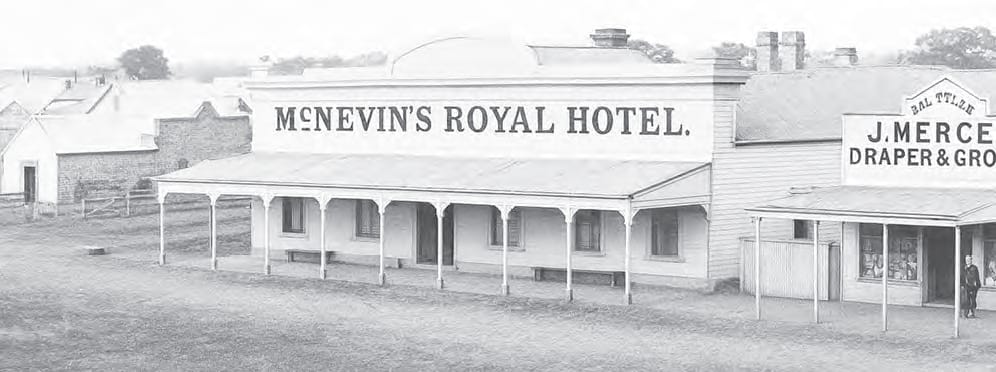
John Williams, Treasures of Nhill & District Facebook page, 29 January 2026, Nhill Free Press & Kaniva Times
Nhill’s Royal Hotel once claimed to have lost a talking black cockatoo a bird that supposedly said far more than “pretty cocky.” According to the tale, it could recite: “Jack Kierse’s drinks are the coolest and best at the Hotel Royal Nhill.”
A £100 reward was advertised in the Nhill Free Press for months in 1915. In today’s money, that’s roughly $12,000 an eye watering sum for a missing bird. It’s hard to avoid the conclusion that the whole thing was a clever piece of bait advertising designed to lure customers through the doors.
And the story frays even further under scrutiny: white cockatoos are generally the better talkers, far more capable of mimicking human speech than their black feathered cousins. A harmless scam, perhaps, and one that faded away without explanation.
What can be explained is why the Hotel Royal was also known as the Royal Hotel. It began life as the Royal Hotel, but after renovations and a change of ownership the name was reversed “Hotel Royal” sounding, to some ears, a little more refined, la-di-dah and distinctive.
The “Royal” branding was no accident. Hotels often adopted the name to evoke prestige, loyalty, and a whiff of British monarchy, all in the hope of attracting wealthier patrons. In Nhill, competition was fierce: the Commercial, the Union, Farmers Arms and New Treasury were all vying for the same clientele.
The Royal advertised itself as “the first house from the railway station” and held a special night licence to serve passengers arriving on the overnight express.
The hotel stood on the corner of Nelson and Clarence Streets, beside the future picture theatre. Today the site is home to Mr Le’s restaurant.
The Royal was the last hotel built in Nhill and the first to vanish. Tenders were called in March 1888, and the first publican was Joseph McNevin. He was followed by Ellen Westwood (1909), Helena Turton (1910), Thomas Baille (1911), Charles Johnson (1914) and finally Jack Kierse (1915). For much of its life the hotel was owned by Ballarat publican John Goller, who controlled 14 other hotels across Victoria.
The building survived Nhill’s 1897 tornado, though its verandas were torn away. But in 1919 its luck ran out. A spark from a fireplace ignited a blaze that gutted the 36 room establishment.
The Nhill Free Press urged the owners to rebuild, noting that accommodation in the town was already limited and calling for a “more commodious brick building… in keeping with the importance of the town.” But the Ballarat owners declined.
The empty block was snapped up by Fischer Brothers who erected a motor showroom. In 1931 it became Moran & Cato’s, then Permewan’s in 1969, Oldfields in 1973, and a succession of businesses since.
The hotel’s stables once stood on the opposite corner now the site of the Memorial Community Centre and picture theatre.
The Royal was once described as the most up to date establishment in the Wimmera and close by there were other alcohol-free establishments and more easily forgotten than the Royal. Floate’s Temperance Hotel in Clarence Street. At Skegg’s Temperence Hotel in Nelson Street The Sons of Temperance opened a Nhill division in 1887, the “Hope of Nhill”.
The Temperance Union of Victoria once claimed Nhill was “swimming in drink,” a charge the Lowan Council indignantly rejected as libellous.
And for the “last drinks” word…. Determined to keep trading after the Royal fire, Kierse set up a makeshift bar in one of the few rooms left intact on Clarence Street.
This article appeared in the Nhill Free Press & Kaniva Times, 25 February 2026.

