Stakeholders call for local government reforms.
Many local councils in the MacKillop electorate are facing serious financial strain, struggling to meet community demands while navigating complex partnerships with state and federal governments under the Local Government Act 1999.
With a shrinking ratepayer base to draw income from, MacKillop MP Nick McBride is asking how regional councils—like Naracoorte Lucindale—can realistically keep up with growing demands and operational expectations.
He raised concerns about whether the structure of the Local Government Act was unfairly favouring urban councils while putting smaller, rural councils in the South East at a disadvantage.
According to Mr McBride, current local government regulations were placing excessive demands on small councils—expecting levels of service delivery that far exceeded their financial capacity.
What’s really coming to light, McBride explained, was how local councils—regardless of size or budget—are lumped into the same category.
He said they were expected to handle everything from planning and infrastructure to community care and governance, whether they operated on a modest $3 million budget or a robust $200 million, like many urban councils.
Mr McBride said that difference simply wasn’t being acknowledged.
In this edition of Hard Talk, The [Naracoorte] News takes a closer look at the Local Government Act, speaking with various stakeholders (local council, government, opposition, and local member) to explore the challenges councils face in governance and day-to-day operations—and the shortcomings they see in the current legislation.

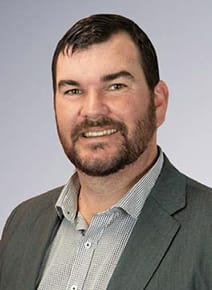
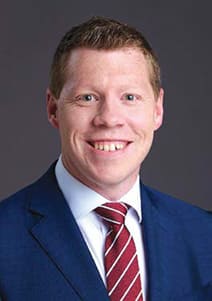
Independent member for MacKillop, Nick McBride; Shadow minister for Local Government, Sam Telfer; Minister for Local Government, Joe Szakacs. Photos courtesy The Naracoorte News, SA Liberal, SA Govt
The [Naracoorte] News asked:
- What is your perspective on the current Local Government Act?
- In your view, does the Act—and the administrative framework surrounding it—serve primarily as a practical guide for councils, or does it function more as a rigid rulebook?
- When it comes to the governance and daily operations of local councils, what drawbacks do you see in the current legislation?
- Do you believe the Act could potentially create opportunities for mismanagement within councils? If so, could you provide specific examples?
- The confidentiality clauses in the Act, which permit councils to make decisions behind closed doors, have faced criticism. What is your stance on this issue, and do you believe these provisions should be re-evaluated to promote greater transparency?
Councils are struggling, relying on grants
Mr McBride noted that several councils in his electorate were relying on grant opportunities as a vital means to fund essential projects and infrastructure upgrades.
He said as you look ahead, it was becoming increasingly clear that smaller councils within MacKillop were under pressure.
Councils are grappling with limited revenue streams while trying to meet the mounting expectations placed on them—not just by the Local Government Act, but also through their dealings with state and federal authorities, the MP told this newspaper.
“…and the lack of future financial sustainability—and what I mean by this is, and it’s really clear, and I have had a good talk with the mayor of the Southern Mallee District Council, and he is clearly showing, with their very few low rate base of a number of farmers, and the expectations of what is put on this council to meet the infrastructure they need to look after—roads, rates, and rubbish—and on top of that, the expectations around government infrastructure like halls, parks, playgrounds, and sporting grounds, and it’s becoming harder and harder for these smaller councils to meet these commitments.”
Mr McBride said what was actually happening was infrastructures such as medical and childcare centres were being added to the council’s pool of assets, adding to a level of depreciation, and then saying, “You need to finance and manage this infrastructure into the future, and their rate base will never cope with this.”
“That’s what is happening on the ground, and this is what I am seeing in smaller councils within my electorate.
“Then, when you look at the larger councils, they are looking at opportunities around where their skill base is, where they can work in infrastructure, around roads, repairs, new surfacing of roads, and whether they are capable of competing in the private sector and doing it better—that’s what’s happening in our region.”
Mr McBride said what he highlighted was the mounting challenges faced by smaller councils—but it was not limited to them.
He said even larger councils were under pressure to manage their finances responsibly, avoid excessive debt, and ensure long-term financial sustainability—not just for the current council term, but for the next 10 to 20 years.
Mr McBride said the core issue, though, lay in the stark difference between regional and urban councils.
Metropolitan councils—such as those in Adelaide, Mount Gambier, or Murray Bridge—typically operated with a much broader ratepayer base and greater capacity to generate revenue, managing budgets in the hundreds of millions annually, he said.
“In contrast, the smaller rural councils in my electorate are working with significantly tighter margins, relying on just $3 to $7 million in rate revenue. The financial gap is wide, yet the expectations placed on all councils remain largely the same.
“And that really is restrictive when you talk about wages, the cost of fulfilling the Act and the legislation requirement, and the like.
“What’s really being highlighted here is the fact that local councils and local governments are all being put into this one big sphere, and we are asking them to run, swim, dive, delve, build, create, and then look after, no matter what their budget spectrum is, $3 million being the lowest of levels over $200 million, and there is no recognition of that difference.
“I think this is where the regional councils are really struggling.”
Mr McBride said the amalgamation of councils, such as the Naracoorte Lucindale, did not solve the problem—it only created some efficiencies.
He said when you look at the Tatiara District Council, they covered Mundulla, Bordertown, and Keith and had been working well with the state and federal governments.
“…and they have found some real good conductivity and collaboration around housing, and they are looking at water security now.
“I see them as the silent successors of local government. They don’t do anything until they get the state government onboard.
“Coming to Naracoorte, they have a strong council for standing on their own two feet; they really are trying to manage things and stick to their knitting, but on the same side of the token, I saw them ignore a mobile telephone development that had local councils, state government, federal government, the forestry sector, and the local telco, Telstra—roll out 27 towers, and Naracoorte Lucindale Council decided this wasn’t their charter.”
So, he said Naracoorte Lucindale missed out on four towers; they got only two.
“All I would say to you is that it is a tough challenge for our councils to remain sustainable, not overspend, not go into too much debt, and work with all the infrastructure and maintenance that they have to work with, and then still Naracoorte Lucindale is considering a major sporting complex upgrade.
“This has been five years, and no one knows how to do it because it’s taking big leaps of money,” the MP said.
Local government reform needed
The state opposition believes that local councils need to always be aware of and responsive to the needs and perspectives of their local communities, not the government.
Shadow minister for Local Government Sam Telfer said proactive steps needed to be taken towards local government reforms in the state.
“We do believe there should always be proactive steps towards ongoing local government reforms and thus will be announcing a suite of local government policies closer to the next state election,” Mr Telfer said.
On the issue of the Act allowing local councils to consider certain items under confidentiality provisions, the shadow minister said greater transparency and accountability were needed.
“Although we understand the need for councils to consider certain items confidentially, they need to always carefully consider the thresholds that are clearly set out within the legislation to ensure that there is transparency and accountability back to their communities.
“We have been concerned that the Labor government has seemingly been ignoring the need for local government reforms, despite concerns from different aspects of the South Australian community, including the recent report of the Electoral Commissioner on the local government elections, which presented a number of different recommendations.
“There has also been no response from the Labor government on the issues highlighted by Essential Services Commission South Australia (ESCOSA) on the financial sustainability of a significant number of councils in the state,” he claimed.
Strong legislation enables great work
Minister for Local Government Joe Szakacs said the Act paved the way for community engagement.
“Giving local communities the ability to engage with their councils through public meetings and for the council to continue its important work in making communities stronger and safer is what underpins the Local Government Act 1999 (the Act),” Mr Szakacs said.
Without saying much about the Act, and the challenges around it, the minister focused on the highly criticised confidentiality provisions in the Act.
“It is clear in the Act that council meetings must be held in a place open to the public and that discussions on council matters and decisions must also be undertaken in public.
“All community members should be able to attend council meetings and hear what is discussed and how it is debated,” he said.
The minister said the Act also recognised that there were matters that are appropriately discussed confidentially and allowed for this to happen only in particular circumstances.
“Having strong legislation such as the Local Government Act 1999 gives councils the ability to continue doing the great work they do to improve their local communities,” he said.
Questions sent to Naracoorte Lucindale mayor Patrick Ross remained unanswered when this edition went to press.
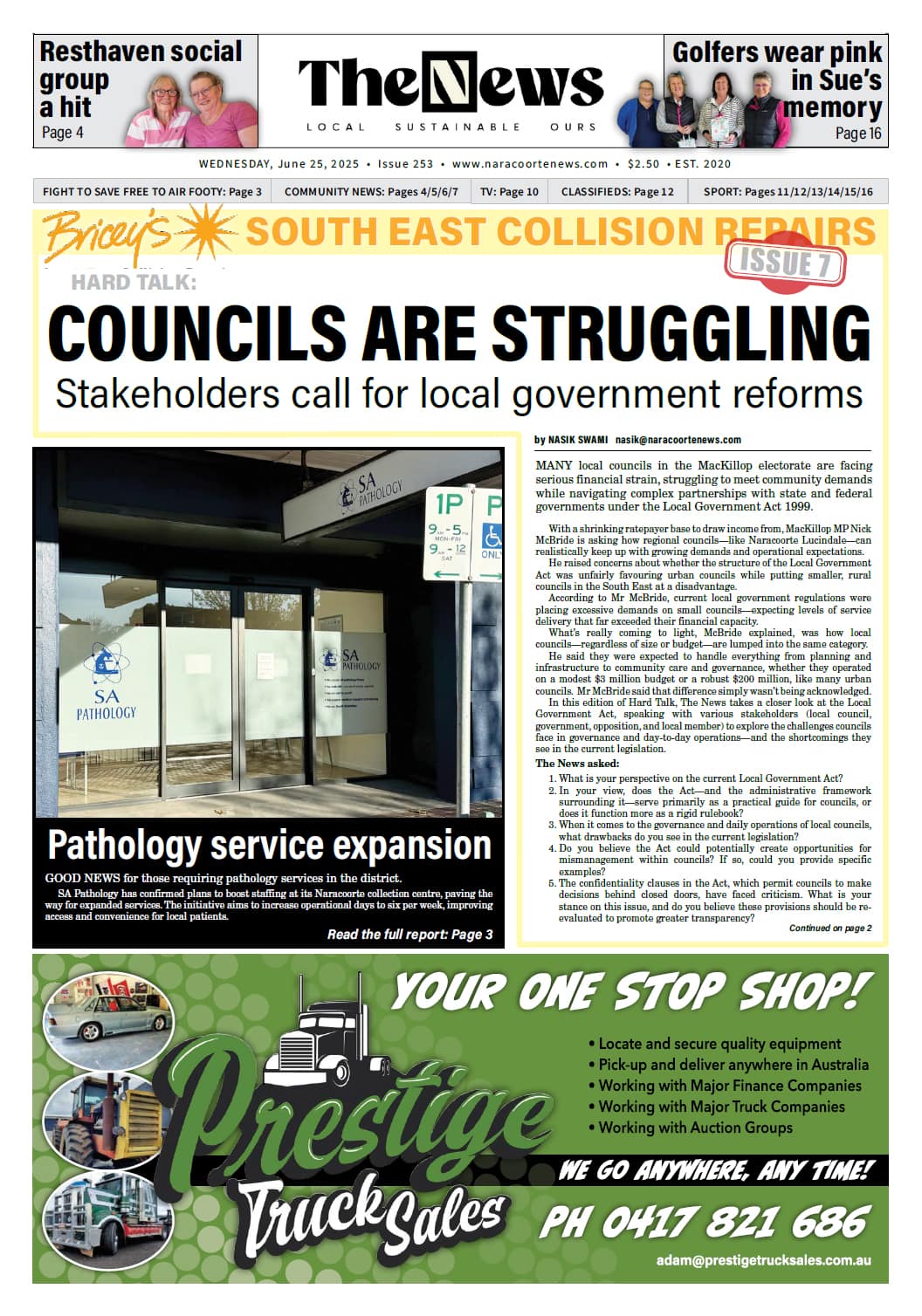
This article appeared in The Naracoorte News, 25 June 2025.