

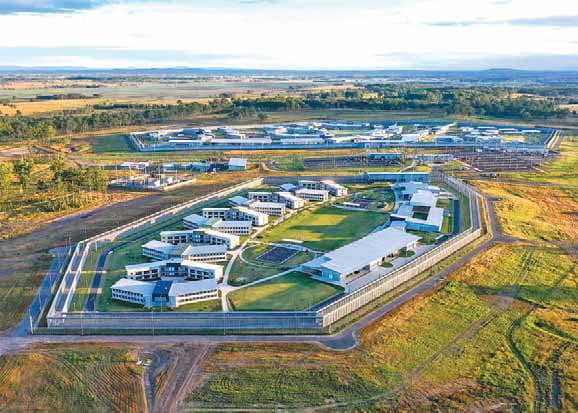
NSW Police Commissioner Karen Webb has spoken out about the number of inmates languishing in police cells due to jails being full – and the CV Independent can reveal there is a 400-bed facility locally that hasn’t been open since 2022 as it isn’t fit for purpose.
The $700 million dollar plus Clarence Correctional Centre, Australia’s largest prison located at Lanitza, which was built by the NSW Government and is managed by Serco, in partnership with Corrective Services NSW, opened in mid-2020.
When the CV Independent toured the impressive facility last month to highlight the fantastic work being done by inmates to build homes of the Aboriginal Housing Office, we travelled past a huge 400 bed minimum-security facility that was closed, one of 3 sections of the 195-hectare complex, of which 65 hectares are occupied by buildings.
Following the tour of the housing project with General Manager Scott Jacques, the Clarence Correctional Centre head of Security and Serco employees, security was evidently increased when we entered the maximum-security sections of the centre.
Digital fingerprints and iris recognition scans clearly demonstrate the increased levels of security required to enter the facility, before every single person can even enter.
Security is clearly stepped up in what is widely regarded as Australia’s most secure correctional facility, with more perimeter fences, before we travelled through what staff call the ‘Jurassic Park’ gates – huge electronically controlled and monitored gates that access the patrolled concrete path surrounding the maximum-security areas.
By comparison, the 400 bed, minimum security facility, which looks identical in design and construction to the maximum-security section, has lower levels of security as it was built to hold prisoners who have been assessed to pose a lower risk.
On Sunday, NSW Police Commissioner Karen Webb called an emergency meeting with the Commissioner of Corrective Services over inmates languishing in police cells, putting unprecedented strain on the front line.
Commissioner Webb says gridlock across the jail system is causing congestion leading to “cell ramping” with bail-refused inmates locked up in police stations for days.
She said the problem is a capacity issue; police stations are not designed to house prisoners for extended periods of time.
“Our job is to arrest and lock people up when they break the law, we are not an indefinite departure lounge for people in custody,” Commissioner Webb said.
“This bottleneck is consuming police time and resources which could otherwise service the community.
“We need a plan to allow officers to do their job and get back out on the street.”
In a statement, NSW Police said the issue has spiked following the introduction of centralised bail AVL in November last year.
“The changes associated to the centralised bail processes has seen an increase in delays to long-term intakes, due to corrections’ facilities stating they are at full capacity,” a NSW Police spokesperson said.
“This has ultimately led to cases where people have remained in police cells for extended periods, some up to several days.”
“This is not only a police resourcing issue, it’s a human rights issue,” Commissioner Webb said.
This article appeared in the Clarence Valley Independent, 26 February 2025.

