

Every generation has its automotive obsession, and for farmers, it often revolves around a ute. Farmers can almost be defined by the aspirational utes they dreamed about owning in high school—often working long hours to pay for their first one, then adding custom touches to make it their pride and joy. Later, during their midlife crisis or retirement, they often go hunting for a project car, reviving that first automotive love as a way to relive the thrill of their lost youth.
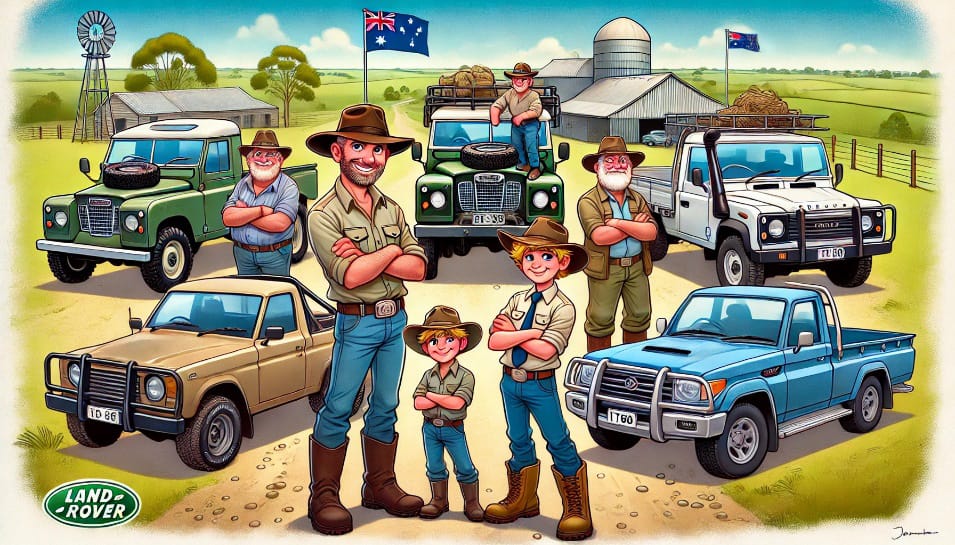
For the Silent Generation, who went through the war and saw the first four-wheel drives in the form of Willys Jeeps, the ultimate set of off road wheels was the Series 1 Land Rover (1948-1958), a rugged yet notoriously unreliable choice. Alternatively, they could hold out for the Holden FX ute (1951), the Ford Mainline (1952), or even the imported Ford F100 (1955).
Then came the Baby Boomers (1946-1964), who came of age right as the V8 muscle car era revved up. This was the golden age of competition between Holden and Ford, with icons like the Kingswood HQ and Falcon XY defining Australian roads while adding muscle to the classic ute lineup.
While Boomer farm boys (and girls) were doing circle work at the B and S in their two-wheel drives, Japanese automakers were quietly designing vehicles that would capture the imagination of Generation X (1965-1980). The first of which was the Land Cruiser 40 Series which arrived on our shores in 1967. By 1970, this was followed by the quirky Suzuki 4×4, then the Datsun 1200 ute 1971 and the Subaru Brumby 1974. These early entries signaled a shift, though it would take time before the mainstream Australian market took them seriously.
The real game-changer was the third-generation HiLux, which arrived in 1981—the same year that the first Generation Ys (1981-1996) were born. This model marked the dawn of the twin-cab, diesel-powered ute revolution, and the beginning of the end for Australia’s homemade icons.
Things slowed down for Generation Z (1997-2012), who grew up in an era when the first Korean and Chinese utes made their debuts. The SsangYong Musso and Great Wall Wingle 3 were total flops, but their presence hinted at an inevitable shift in the market.
Now, Generation Alpha (2013-2025) is arriving alongside models like the LDV T60, Foton Tunland, and JAC T9—utes no doubt the older generation dismiss, but for many Gen Alphas, these brands could become the icons of their youth.
Finally we have the yet to be born Generation Beta (2025-2040) who just may be the last to drive “real” utes as we know them. With electric vehicles on the horizon, we may be seeing the final years of the traditional farm ute, though perhaps they’ll still find a way to keep the Aussie spirit alive in the vehicles of the future.