

John Williams, Treasures of Nhill & District Facebook page, Nhill Free Press & Kaniva Times
Foaming horses galloping four-in-hands over the West Wimmera tracks, day and night, in burning sun or drenching rain; washing down damper and salt meat with pannikins of strong tea”¦.this was the lot of Nhill Cobb and Co driver William Nesbitt.
Despite this strenuous life, Bill had a romance for the open road, and for many years drove the coach between Bordertown and Nhill with a reputation for being a gentleman and obliging to his many passengers.
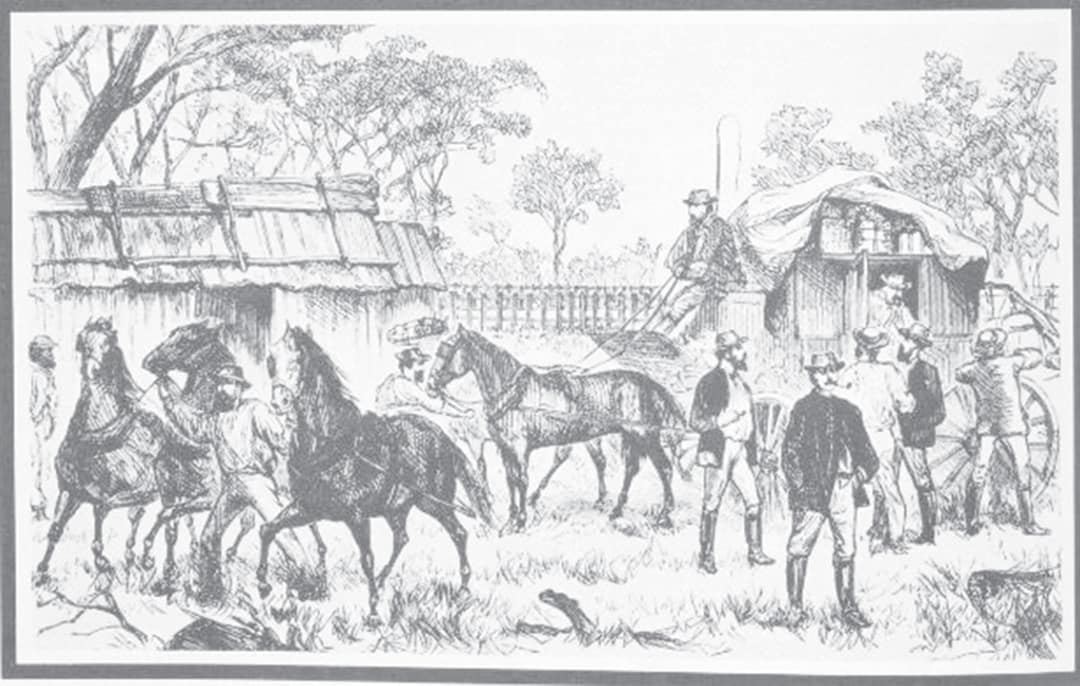
He was a favourite on the line and in 1885 a collection was taken up in Bordertown, Lillimur, Kaniva and Nhill to provide him with a souvenir of his days on the road.
The retiring driver was going to set himself up in business at the Commercial Hotel stables in Nhill offering a livery service and horse training. Another local coach driver of the day was Henry Marsden known as “Flash Harry” who was buried in Nhill cemetery in 1906.
2024 is the Centenary of the last Cobb & Co stage coach mail run which took place in the Maranoa region of Queensland in August 1924 and the event has been recognised this year by Australia Post and the Mint.
Wind back more than 40 years from that date and Cobb and Co was making a regular mail run between Bordertown to Dimboola stopping in Kaniva and overnight in Nhill.
The original Cobb & Co was established in Melbourne during the gold rush and first traded as the “American Telegraph Line of Coaches”, a name that emphasised speed and progressiveness, but more often than not the coaches ran on rough tracks beside the telegraph wires.
Cobb and Co purchased The Bordertown – Dimboola mail run from Grace Brothers in 1883.
It is noted in Nhill Free Press Advertising that the coach line was advertised as The Telegraph Line of Coaches until it changed to “Cobb and Co” in 1885.
In Victoria coaches carrying the iconic name were operated by four local coaching firms running particular routes by mutual agreement and cooperation and in the West Wimmera it was Robertson and Wagner.
In 1882 the Agricultural editor of the Adelaide Observer newspaper wrote of his coach journey through Kaniva and Nhill”¦…
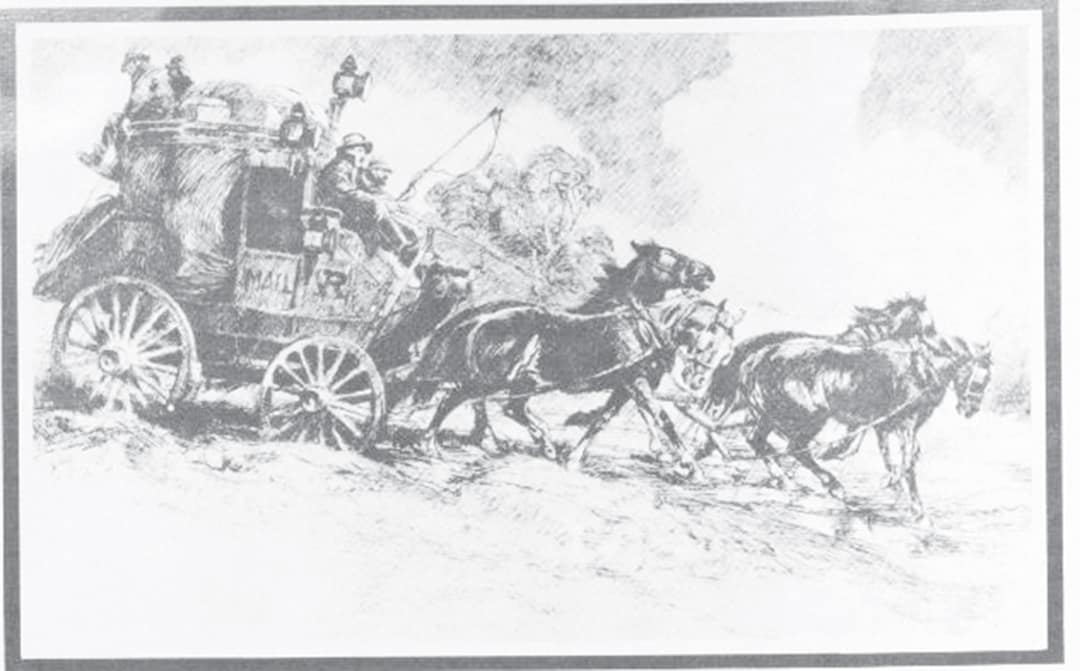
“At Bordertown our coach is loaded inside and out with commercial traveller’s packages and the portmanteaus (a large travelling bag, opening into two equal parts) belonging to the passengers; and as it is a four-wheeled covered coach, it can be easily imagined that there was not much room to spare.
The space in front intended to accommodate the feet and legs of the passengers was occupied with a miscellaneous assortment of hand bags, mail bags, portmanteaus, cloaks etc.
We felt quite relieved when a stoppage was made now and then to be able to get out and straighten our nether limbs.
On our arrival in Kaniva, we found two public houses —’ hotels’— built of matchboard, and with rather rough accommodation for ‘hotels.’
The town is quite new, having sprung up, like some of the American cities, almost in a night. It has a butcher’s shop, a smithy, a branch of the Commercial Bank, a Telegraph and Post Office, three general stores, a large flourmill, butcher, three blacksmiths, bootmaker, tinsmith, carpenter, painter, and several private dwellings.
The water for the whole township is obtained from Fry & Co.’s well, which is 140 feet deep, and gives on abundant supply, of good quality.
At Kaniva I saw what they locally call Egyptian brick houses very much like the cement blocks used in Adelaide. They certainly look more comfortable than the wooden structures, cooler, more substantial, and less likely to take fire.
Outside the stores and in the streets were lying tons of goods in original packages, the stores being unable to hold them, and the storekeepers being too busy to open them.
Before these are cleared out of the road the carriers bring in fresh loads, and the store keepers are obliged to seize every opportunity and every slack moment to open packages and arrange their goods for the next rush.
During the few hours I remained at Kaniva I saw quite enough to convince me that it was an important and progressive township.
From Kaniva to Lawloit is thirteen miles, over very rough Bay of Biscay land, except when crossing the rises, when the soil changes from the characteristic black clay of the ‘’ crabholes’ to a chocolate soil, and even rather sandy towards the top. The trees are still bull oaks and large peppermints.
Lawloit is a post town of two or three private dwellings, a store, and an ‘hotel,’ combined with a post-office. There is a population of forty, but some of their dwellings must be at the back somewhere.
The town is on the main road to Adelaide, and used to be a camping-place for the gold escort.
Our coach arrived in Nhill a little after 6 p.m., passing some fenced paddocks and just at the entrance, there was a kind of blind creek leading down into a dried-up swamp. At the back of the township of Nhill is a large sandhill, with a good number of native pines.
Nhill is a township of very considerable pretensions, although only two years old, the buildings being invariably of wood. There are three ‘hotels,’ all capable of accommodating a fairly large number of guests, but the ‘Commercial,’ kept by a lady who is at present a widow, and named Bicknell, is a commodious place boasting of twenty rooms, with extensive wooden stables and a large yard for cattle.
There are five large general stores, two saddlers, two smithies, one implement factory and foundry, a flourmill, a tailor, a barber, two bootmakers, a watchmaker, a printer publishing a newspaper called the Nhill Free Press, two Banks, a tobacconist, a cordial factory, fruit shop, commission agent, Institute, two Churches, public school, Telegraph and Post Office, receipt and Government pay office for rents, a doctor, Police Station, temperance boarding-house, two Chinese gardens, and a large number of private dwellings. There are about 375 inhabitants in the town.
Those who wish to travel by coach from Nhill to Dimboola must settle up all accounts overnight and be prepared to get up at 4 o’clock next morning.
The coach driver calls his passengers by knocking at the windows from the outside, having previously been instructed as to the numbers of the rooms in which they sleep – or try to sleep as the walls are paper thin.
At that hour it was out of the question to provide an early cup of coffee as a preparation for our journey, and we have to go on until nearly 10 a.m. before we breakfast at Dimboola.”
The coach bounced and rocked along the twenty-five miles in drizzling rain on a track marked by telegraph poles.
The first scheduled stop with, the sound of a bugle to alert the grooms, was at Gerang Gerung, roughly the half way point.
The coach was coming in fast to a changing station or a stage in the journey, hence the name stage coach.
Horses would be changed and passengers could “stretch their legs” for a few moments, shake off the dust and spend a penny.
Some would be grateful that the ride had stopped, albeit briefly as some might have experienced motion sicknesses.
The Adelaide newspaperman had been joined on the trip with a rollicking Irishman who sang songs and told anecdotes much to the delight of a lady passenger who screeched with laughter.
After about 90 verses of Home Sweet Home the Cobb and Co coach passed the intercolonial railway “survey” camp near the Wimmera River which was in a way signalling ahead that an end to coach travel was looming.
It was in February in 1885 as the railway line was advancing from Dimboola to Nhill when the horses of a Cobb and Co coach shied after catching site of a steam locomotive”¦the “iron horse” was a very unaccustomed sight. The pole to the horse team was broken and the coach overturned with passengers and driver thrown to the road, but fortunately no one was seriously hurt.
Back to 1882, and the newspaper man’s Bordertown to Dimboola romance with the open road was fast coming to an end in a cloud of dust in Lloyd Street.
As the grit settled the Royal Mail was unloaded and only then were the hapless passengers allowed to alight, observed by a small crowd of onlookers because the arrival and departure of a stage coach was often the chief event in a country town.
Footnote: An authentic Cobb and Co coach was last seen in Nhill in 1975 when it was used as a collection point for Apex “Foundation 41”. The driver was Ben Hall, a descendant of Ben Hall the bushranger.
See all the pictures in the issue.
This article appeared in the Nhill Free Press & Kaniva Times, 6 November 2024.

