


Canberra is a very strange place. The nation’s purpose-built capital has been the subject of debate and controversy since its conception. Chosen in 1908 as a compromise between Sydney and Melbourne, it had to be in New South Wales but far enough from Sydney to stop the Sydneysiders from complaining, and for defence reasons, it couldn’t be near the coast. Fair enough. But did they need to pick such a remote location, far from the beaches where people prefer to live, or even the regional centres that support our farming and mining communities?
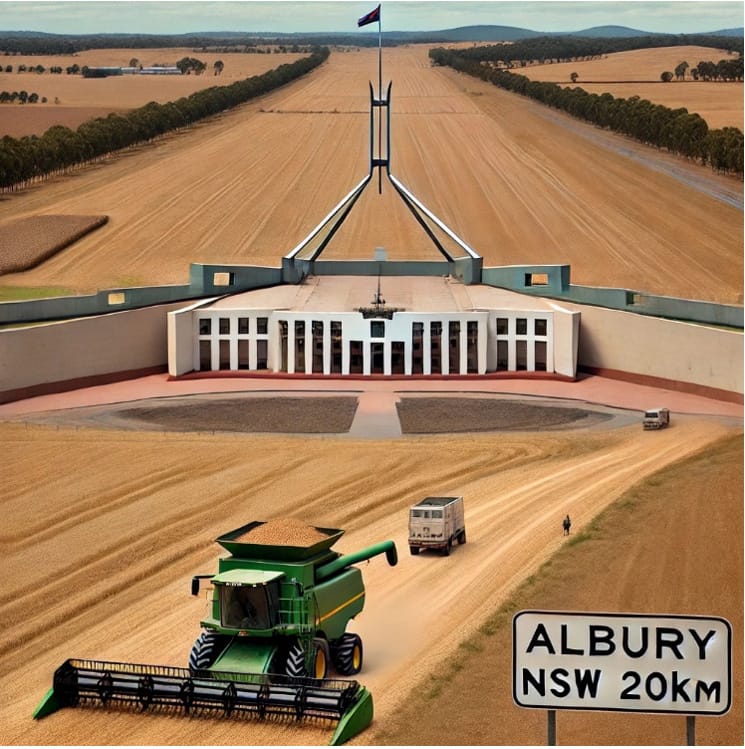
I suspect the real reason the final location was selected, was that the bureaucrats and politicians of yesteryear were very climate aware, not global warming aware, rather aware of the need to stay cool in those pre-air conditioning days, so much so they headed for the hills to make sure if they had to do any work in summer they wouldn’t break into a sweat.
In total, seven locations were considered including Canberra, Albury, Armidale, Bombala, Orange, Bathurst, and Dalgety. Dalgety – that sounds familiar doesn’t it? Dalgety, population 252, nestled in Man from Snowy River country, is not linked to Elders Dalgety & Company Limited. The town was named after Dalgety Bay in Scotland, reflecting the Scottish heritage of early European settlers in the area. In fact, Dalgety nearly became the new capital city as it was selected back in 1904 before Parliament realised it was so remote it was a non starter.
So, the politicians of the day ended up settling on Canberra. Which, let’s face it, wasn’t much better than Dalgety—at the time it was a 32,000-acre sheep station called Duntroon (now home to the military college) with nothing more than a church in the locality being the little St John the Baptist Anglican Church (1854).
The name Canberra—a local Indigenous name meaning “meeting place” was selected over and above other suggestions including Austral, Federal City, Shakespeare, Symonston, and my personal favorite Kangarella. Unfortunately, it has not become a meeting place where there is a meeting of minds, certainly not if you listen to question time in Parliament House.
The only meeting of minds in our “inland island” seems to be that between the bureaucrats and elites who live in a city completely disconnected from the rural and farming communities surrounding it.
This is despite Canberra being in the middle of southern New South Wales, surrounded by windswept pastoral country with barely a tractor in sight. The ACT is about as agriculturally significant as a pot plant, actually a lot of pot is grown in the hills but that’s not part of official statistics. Sure, there are a few hobby farms for the bureaucrats to retreat to but no serious farming? For that you’ll need to head down to the Riverina or Murray districts to see any real sign of broadacre farming, with the give away being the existence of big machinery dealerships that signal a real farming community.
Frankly, Albury should have been the capital. It already had the infrastructure and was and remains a major farming and irrigation hub—a place that actually produces food rather than the odd jumbuck. But no, instead we’ve got Canberra, a town that can’t even lay claim to real primary or secondary industries like mining or food processing, and it shows. This place churns out policies that seem designed to strangle the very industries that keep our regions and the nation alive.
In fact, Canberra’s feels like a mining town without a mine—just a fly-in, fly-out zone for politicians and public servants. They don’t engage with rural and regional Australia because they’re too busy sipping their chardonnay in the business lounge at Canberra airport or gazing down at the lights of the tractors working at night as they retreat back to the big coastal cities. In fact their self imposed isolation means they have successfully ensured that they remain miles away from understanding the sweat, grit, and diesel that keep the country’s heartland pumping.
For all the efforts on design and location we have ended up with a capital city where government has itself become the biggest industry, it exists to keep itself in existence. If and when it thinks about agriculture, most of the discussions that happen inside the Canberra bubble seem to focus on climate change, aboriginal agriculture, and sustainability—whatever that buzzword means this week. Meanwhile, the realities of farming, like rising costs, regulation overload, and market pressures, are nowhere to be found. It’s no wonder we get mad policy gems like the live export ban or a push to phase out paraquat, while farmers and regions cry out for practical policies or simply to be left alone.
Take the recent forum I attended in Canberra run by the Australian Farming Institute—a think tank that used to tackle real agricultural issues, but seems to be morphing into a factory for progressive thought pieces. You won’t hear them critiquing the regulatory avalanche burying farmers alive. Instead, it’s all about how them there farmers need to do more to keep their social licence—because apparently, the people buying our produce care more about carbon credits than price tags.
Where are the alternative voices? The ones who’ll tell the elites that international markets are driven by price, not platitudes. That most consumers aren’t willing to shell out extra for organic, free-range, or carbon-neutral eggs? And that meeting Europe’s endless demands is just a game of ever-shifting goalposts? Where are the thinkers that are prepared to burst the bubble and run arguments to just say “no” to the next global agreement and instead focus instead on cutting costs instead of chasing global approvals?
This kind of straight talk is absent in the Canberra echo chamber. Politicians are only hearing one side, largely because no one’s challenging the narrative. Even our peak agricultural bodies have been sucked into the progressive undertow, signing on to causes like carbon neutrality by 2030 and Indigenous engagement. There’s no robust debate, just an endless round of forums and conventions where the same elites stand up and reinforce the growing culture of compliance.
The real issues—the red, green and black tape are drowned out in the noise of buzzwords and feel-good initiatives. So maybe it’s time for a new farming think tank—one based in a place like Albury, where decisions from Canberra hit the ground hard and the pushback comes from the ground up.
A think tank that dares to be the contrarian, one brave enough to tell the chattering elites in Canberra when enough is enough. Because until someone bursts that bubble, the policies coming out of this inland island will keep floating further and further from the paddocks and people that actually feed the nation.
Related story: Inland islands of elites: The strangely secluded capitals of the world.


Sorry, there is active mining in the ACT, they mine us for the big taxes we pay.