


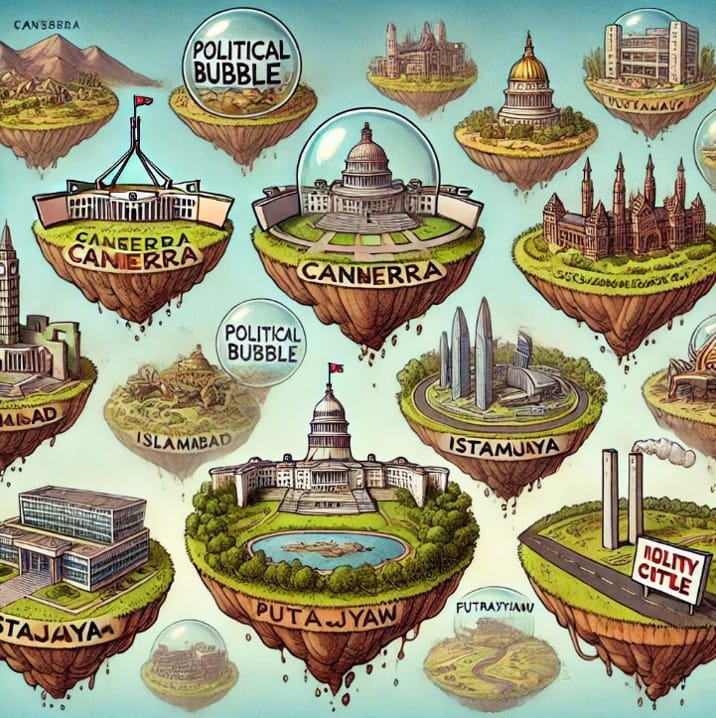
I’ve already outlined Canberra, our very own isolated political bubble in the bush, but make no mistake—there’s a whole global club of purpose-built capitals that decided to swap sense for seclusion. These cities, built from scratch, aimed to be the shining beacons of national pride, but somehow all have ended up as bubbles of bureaucrats, completely detached from the real world. Let’s take a whistle-stop tour of the world’s most bizarre capitals—each one stranger than the last.
Washington, D.C., USA (1790). The original purpose-built capital. Today, it’s the land of billion-dollar lobbying firms, never-ending think tanks, and the world’s most recognised house. While D.C.’s the capital city of the land of the free it’s not always been instrumental in democracy in other peoples’ lands.
BrasÃlia, Brazil (1960). Brazil’s ode to sci-fi design, created in 1960 to move the government out of Rio’s bustling chaos closer to the Amazon, is most commonly compared to Canberra. Its design is about as bizarre as the one put up by Burley Griffiths except that their government buildings sit miles apart, making the bureaucrats as remote from each other as they are from the rest of the nation. Another big farming nation, their elites, while sited deep inland, suffer from being about as remote as ours from their massive farming and mining industry.
Islamabad, Pakistan (1960s). Pakistan’s leafy retreat in the mountains. Built in the 1960s to replace Karachi (too noisy, too hot), Islamabad is a peaceful haven for Pakistan’s elites when they are not in London or Dubai or Gaol. The only problem? It seems to nurture more dictatorships than democratic governments.
Putrajaya, Malaysia (1990s). Not to be outdone, Putrajaya, a city so pristine it’s as if someone built a model, forgot to add people, and called it a day. Designed to ease congestion in Kuala Lumpur, it’s now an eerily quiet administrative capital that no one has ever heard of and where no one wants to live.
Naypyidaw, Myanmar (2005). If you thought Putrajaya was strange, wait until you hear about Naypyidaw, Myanmar’s capital built in 2005. Its 12-lane highways are legendary—for their complete lack of traffic. Selected by the military generals to be, like Canberra, far from the coast, for defence reasons, its final location was made with the help of astrologers making its existance even more like a cosmic prank.
Astana (Nur-Sultan-Astana Again), Kazakhstan (1997). Astana—or is it Nur-Sultan? Never mind, it’s back to Astana now. This Kazakhstan capital was plonked down in the middle of the freezing steppes in 1997, clearly designed by someone who thought “What if we made a capital for Bond villains?” With its futuristic skyline, Astana doesn’t feel like it’s part of Kazakhstan so much as some dystopian movie set.
Dodoma, Tanzania (1973). Tanzania’s official capital since 1973. The idea was to replace Dar es Salaam, but nearly half a century later, most of the action still happens in the old capital because the bureaucrats and politicians have both refused to move.
Belmopan, Belize (1970). Belize’s teeny-tiny capital, built after a hurricane wrecked Belize City. It’s best known for being small—really small. In fact, it’s one of the tiniest capitals in the world by both population and excitement. Again dropped in the middle of the country to keep it in touch with the people, except the people live mostly in the rebuilt Belize City on the coast.
Yamoussoukro, Ivory Coast (1983). Named the capital in 1983, it’s more famous for having the largest basilica in the world than for any governmental importance. It’s a ghost town with a cathedral bigger than the Vatican. It reminds me of Canberra’s Parliament House, a building that is supposed to be a light on the hill but, like all grand buildings built by politicians, lacks soul.
Nusantara, Indonesia (under construction). Finally, we come to the latest member of the “capital cities that make no sense” club: Nusantara. Indonesia is building this new capital to replace Jakarta, a city that’s not just sinking—it’s suffocating under the weight of its own overcrowded chaos. You can almost hear the pitch: “Let’s move everything important to the middle of nowhere, because what could possibly go wrong?”
And there you have it: a roll call of capitals that prove when governments decide to go off into the wilderness, they tend to stay there—mentally as well as physically. These purpose-built capitals were supposed to unite nations, show progress, and bring countries into the future. Instead, like Canberra, they’ve become fortresses of isolation, where elites rule from afar, blissfully detached from the gritty realities of the people they govern. All I can say to Egypt, Equatorial Guinea and Honduras who are all planning new capital cities, good luck with keeping the bureaucracy outside the bubble.
Related story: Canberra: A capital blunder

