Maureen Donnellon, The Buloke Times
Do you notice trees and wonder about their history, as I do?
Trees can tell us so much about the early settlers, early buildings, the little schools, former church and hall sites, where the original homes were, the sites of the oldest houses, where the birds nest, the best shade.
Poets and artists have spent their careers extolling the virtues and showing the most beautiful and colourful trees in all the seasons of the year while a famous poet, Joyce Kilmer, wrote in the 1880s . . . “ I think that I shall never see a poem lovely as a tree!”
Birchip has many significant trees in and around the district, while sadly some have disappeared in the pursuit of progress, I suppose, or because they become too big, were planted in the wrong place, the roots interfered with the buildings etc.
We all have those trees, many planted in haste without realising that as living things, they too need sufficient water, space and conditions which can cause problems.
But a lot of trees are amazing homes for wildlife too, havens for birds, bees and insects and they provide the shade we so often search for in our hot weather.
The pioneers knew that the big gum trees grew along the natural water course from the Marlbed area towards Lake Buloke, and the local history books and pioneers knew that the local Chinese market gardens were planted where natural water could be accessed, where natural water soaks and swamps occurred.
Although only a few of these big trees remain, some poor decisions have been made by not noting their whereabouts, and therefore building on flood prone areas has occurred.
Our modern engineers have made some mistakes by not considering the natural signs. Market gardens once existed at Marlbed and also close to the present big water tank near the Birchip reservoir. Underground water has been sourced from Marlbed through to the water tank and beyond, flowing under the main street shops. The early homes in Duncan Street were all built with cellars and in wet weather, some probably still find water. It has caused plenty of problems along Cumming Avenue.
But do you ever wonder what stories they can tell us? Here are my first Significant Tree Stories.
First instalment will concentrate on the various big gum trees whose history I have sourced.
The cartwright oval gum tree
When I came in 1968, that tree was a very big tree and used as a place to meet to hear our positions for hockey. There wasn’t a Leisure Centre, just the old Birchip Swans Footy sheds and the Ballapur Hall which had been recently moved to near the RV dump toilet block. Netball was played inside the gates not far from the goal posts. The hockey ground was on part of the Leisure Centre area and the present netball court area and car park. There were dozens of tree stumps, many with shoots which appeared after rain, so hammers were part of the hockey practice equipment.
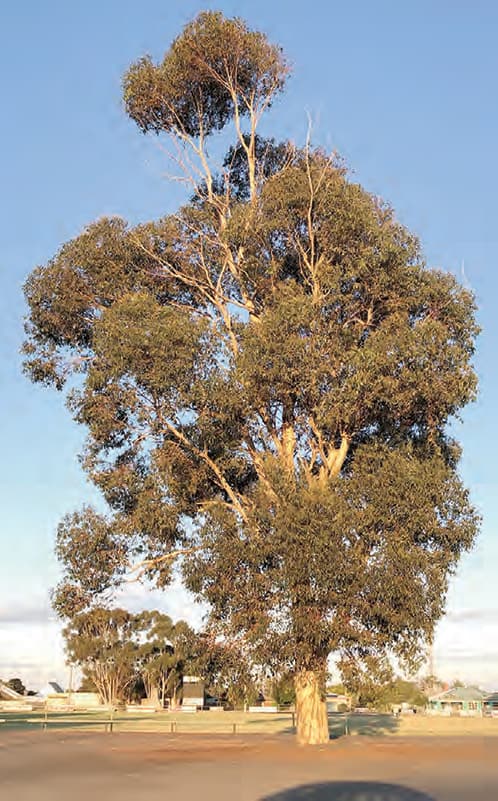
It was a reclaimed swamp area and not really suitable for a playing area and so the ground was moved eventually to its present area. As a former swamp it will always pose problems with ground movement, but there aren’t any Chinese market gardeners or many “old timers” around to confirm it. The big tree was one of several that had grown in the area and was there for shade for horses as well as a turning area.
How many Birchip Agricultural Shows did it witness? Over 100? How many Show Girl competitions were held under its shade and the girls assembled on the back of a truck for judging, while we watched in anticipation?
How many joyful Premierships from various sports and how many grieving losses? How many barbeques set up there, or drinks tents, lolly stalls? How many circus elephants have been tethered to it? I can remember taking a class of children there twice in the late 1960s early ’70s, and that was where the elephant was. The circuses were held in several different places around Birchip, but trees were always sought for shade for animals, and big trees highly prized.
That big tree watched over school sports and still does, from St Patrick’s Day Sports in the very early days of the town in the 1890s, and weddings, balls, parties and reunions in the various buildings that the area has housed. It has welcomed families from funerals and watched over many generations of people who have come to the area for meetings, seminars and displays of all kinds.
It is the link between our past and our future and needs to be a part of the plans for any future development.
It has had a few branches trimmed from time to time and needs a bit of attention every few years, but is a sign of the growth of our town and its dependence on community co-operation and sport.
The Joseph Lockwood lemon-scented gum
(Behind the former Lockwood home adjacent to Birchip Hotel)
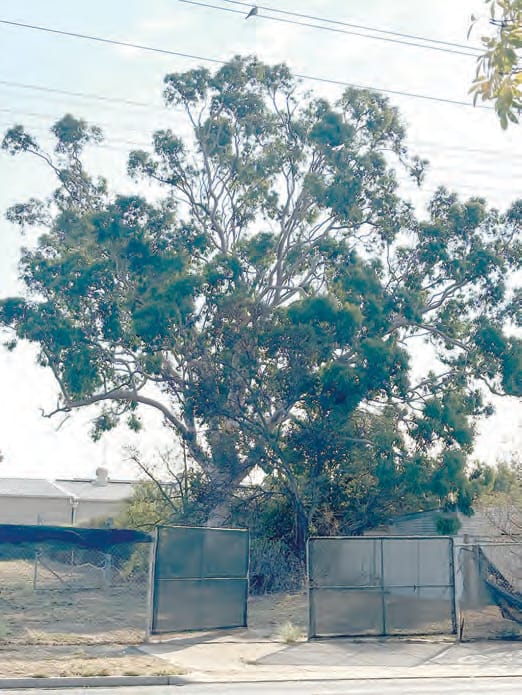
This beautiful tree once shaded the Lockwood service station-run by Bob Lockwood. It is of great significance to the former Birchip Shire, as was Joseph Lockwood. The tree was planted in 1895 by the late Miss Mary Lockwood, when her brother Councillor Joseph Lockwood was a founding member of the Birchip Shire Council in that year and became the longest serving Councillor in the known world, by serving for over 60 years. He received the OBE after 50 years and some hinted that he could retire, but he died in Office after 60 years on the Shire in 1955. In 1954, he met Queen Elizabeth who complimented him on his service. Little did anyone know that she would continue to serve and also die in office after 70 years.
There have been thousands of trees planted in her honour. Let’s hope that most have lived and their plaques been treated with respect as several planted by dignitaries in Birchip have not been so lucky, nor their plaques. The Lockwood tree has been standing watching over the town for 129 years. What tales it could tell of the hotel patrons, the traffic problems, the horses and carts which have transitioned to massive transports which continue to try to hurtle at breakneck speed around that corner.
In the minute book of 40 years ago of the Birchip Historical Society, a motion had been put to the Shire Council to place a plaque near the tree and possibly fence it off for safety from development. The resident Lockwood family of that time, Miss Laura Lockwood and her brother were tragically killed in an accident before the wording on the plaque could be finalised and the Shire did not go on with the task. Young Laura, as a child, used to make perfume from the leaves which she sold to other children. Mary Lockwood, moved to Melbourne and became a Grey Sister, a missionary who dispensed welfare to the needy, while Laura was Birchip’s first Girl Guides Leader and in later years ran a Girls’ Club with craft and reading, poems and activities for 25 years, for which the Shire of Birchip honoured her with a Civic Reception.
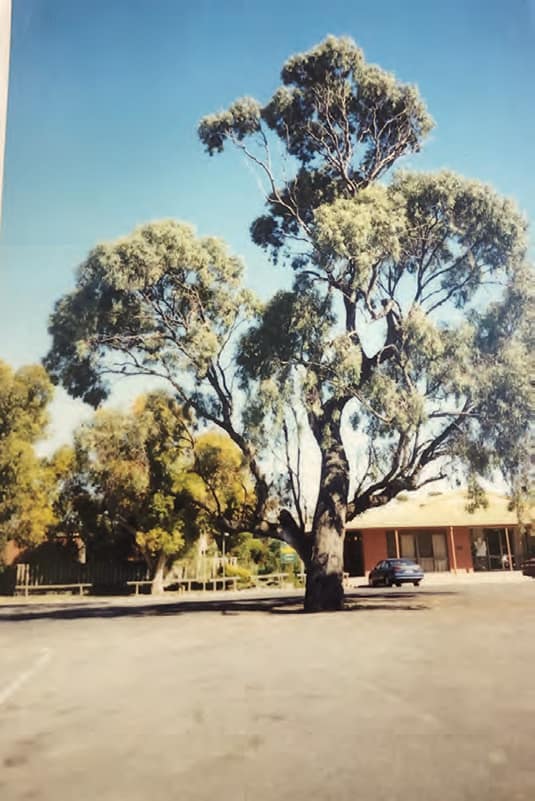
The Buloke Shire has been made aware of the tree’s significance and we wait in hope of an appropriate marker as its safety is not looking so secure these days with some plans afoot for that block which won’t be safe for man, beast or tree, in my opinion.
Birchip P-12 School car park gum tree
This tree was once happily enjoying life in farmland long before plans for a school were being made over 100 years ago. It isn’t known how old it is but according to a former student, Rob Sanders, who was one of the first students at the Higher Elementary School in 1924, it was “always there” when he was a child. It was once a lot larger and has had several branches removed, has housed many varieties of parrots in hollow places, attracted many bee hives and been the overseer of hundreds of children and parents over the 100 years the school has been there in farm land. And then the area had Fraser Street carved out of it and George Street where the school buses pull up.
It has seen myriad families obtain valuable years of education and also now the Early Learning Centre has joined the ranks.
It has a special plaque embedded in its trunk to acknowledge the bicentenary in 1988. All school children received a medal in a little folder to commemorate that milestone. What an imposing landmark watching over all who attend the school precinct.
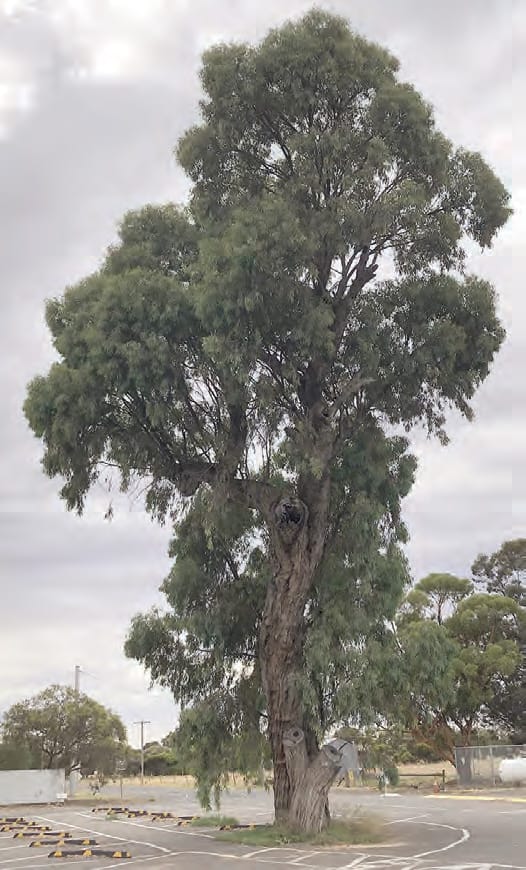
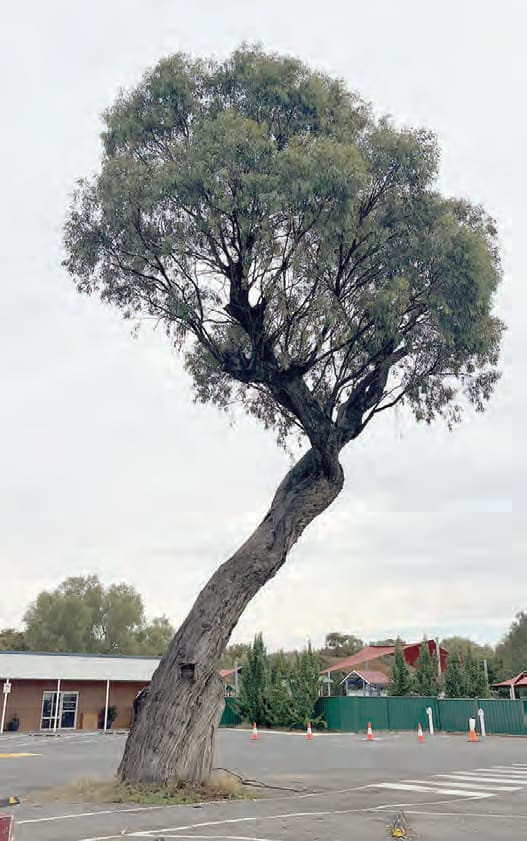
L-R: The Birchip P12 School gum tree in 2022; The Birchip P12 gum tree after some drastic pruning in April 2024. Photos courtesy The Buloke Times.
The immaculate heart of mary gum tree and the Birchip Hotel gum tree
There were two more significant big gum trees which have both been removed in the last 30 years. One was at the rear of the Birchip Hotel, once also farmland, and the other was in the area behind the former Convent of Mercy in the area which once bordered the IHOM oval and cricket pitch. It was there when there was a tennis court close to the little triangular “Horse Paddock” which has been home to many horses since the area was fenced for the railway line. That land originally belonged to Mrs Blencowe, who donated land for all the churches in Birchip and was part of the original Campbell property, marked by Campbell Street and Campbell’s Tank.
The Hotel tree had part of the trunk lying on the ground with some graffiti for many years after it was cut down, but the Convent tree once had an elaborate tyre swing nailed on to a big convenient branch and that caused the branch to leak sap and the branch eventually died. The swing was dismantled, but the branch fell on some station wagon parked under the tree on a Saturday morning while cricket was being played on the oval. Of course the tree got the blame, not the driver who didn’t check before parking and the whole tree was removed, courtesy of the Sister in charge at the time. There will still be several local fishermen around who remember that tree and the amazing number of bardi grubs they collected from around its base each year. Both trees were once part of the “skyline” of the town, and also followed the path of underground water.
Part 2 will concentrate on the palm trees which are also found where the older homes are situated and of course our main street, Cumming Avenue, which are a distinctive landmark in our town.
Part 3 will mention other significant trees with stories to tell which include some pine trees, peppercorn trees, mulberry trees, farm trees and the oldest, significant building in town which is made of wood.
I would be very interested to hear the history of any more of the trees in our district which have stories to tell.

This article appeared in The Buloke Times, 3 May 2024.