


Adelaide University, Media Release, 10 June 2026
Adelaide University research into the complexity of plant exo-hydrolytic enzyme could have multiple benefits for medical, pharmaceutical, chemical and biotechnology industries.
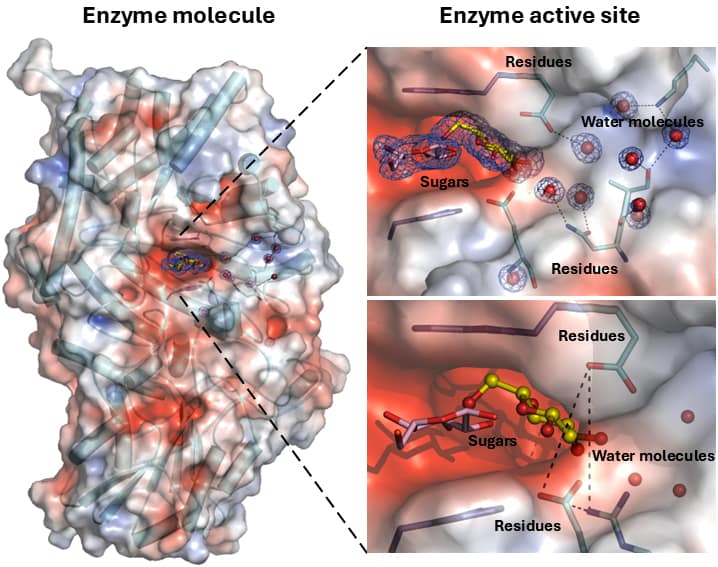
For more than a decade, Professor Maria Hrmova, School of Agriculture, Food and Wine, and a team of around 30 experts have been exploring the fundamental catalytic properties of plant exo-hydrolytic enzymes.
The latest findings have been published in the journal Biochimica et Biophysica Acta.
Through a systematic approach, Professor Hrmova and team revealed it takes 50 crystal structures to understand the function of an enzyme in plant life.
“There are up to 80,000 fundamental-to-life enzymes, upon which almost all biochemical reactions depend,” said Professor Hrmova.
“Enzymes carry out fundamental chemical reactions, the products of which serve as building blocks and metabolites, or as energy sources, in living systems.
“The largest contribution to the enzyme’s catalytic power stems from the active site’s electrostatic environment, which functions like a miniature oven, lowering the energy barriers of reactants.”
Professor Hrmova said plant exo-hydrolytic enzymes, such as glycoside hydrolases, play a key role in biochemical reactions, like supporting plant nutrition, seed germination, primary root extension and pollination.
“We sought to understand how enzyme catalysis and substrate specificity are linked to their atomic structures, including those of active sites, which can be acquired through X-ray or neutron macromolecular crystallography and associated biophysical approaches,” she said.
“Macromolecular crystallography has been at the cornerstone of structural biology and remains the technique of choice for atomic resolution.
“This approach, combined with kinetics, mass spectrometry, nuclear magnetic resonance spectroscopy, and multi-scale 3D molecular modelling, explains the complexity of an enzyme molecular mechanism at super-fast rates with high precision.”
Professor Hrmova’s group demonstrated that the enzyme adopts a previously unknown catalytic mechanism – fundamental to plant life – termed substrate-product-assisted processivity.
“Here, the enzyme maintains contact with a substrate and transforms it into the product through a hydrolytic reaction with high precision. However, these reactions proceed at super-fast rates, which cannot be captured by traditional methods,” she said.
“Therefore, we applied computational approaches to capture the nanoscale reactant movements of the enzyme. We were able to define reactant trajectories critical to the conformational behaviour of isomeric B-Dglucoside substrates.
“Further, our computational models defined the dynamics of water molecule flux, which correlated with the high catalytic efficiency of the enzyme.
“Finally, we revealed the evolvability of structural elements of these enzymes, which are subject to selection pressures.”
The findings, Professor Hrmova concluded, could lead to significant improvements in catalytic rates, stability, and product inhibition in these enzymes.
“These findings are applicable to biotechnologies for manufacturing and developing new products through novel forms of bioengineered enzymes that are applied outside of biological systems,” she said.


[…] article, click HERE. Also picked up and reported on in Australia Rural & Regional News, click HERE to […]