

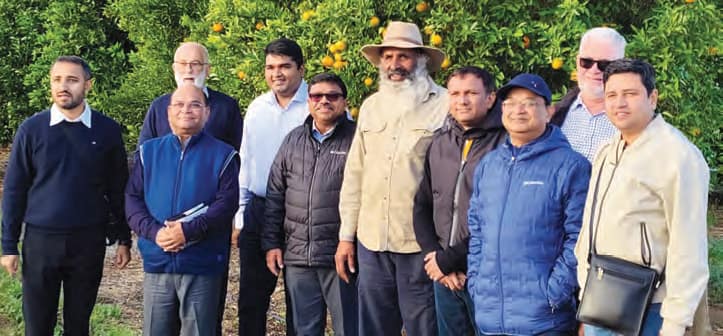
International attention has turned to the Riverland’s irrigation industry, with senior Indian government officials visiting the region to study how growers are adapting to changing markets through crop diversification and agricultural transformation.
Senior government officials from India’s Madhya Pradesh state recently visited the region through a tour supported by the Asian Development Bank, with the delegation exploring how the Riverland has adapted to ongoing horticultural challenges.
The visit was facilitated by RMCG, with CCW Co-operative Limited hosting the delegation across several sites connected to the PIRSA-funded Transforming the Riverland Project.
The delegation included senior officials responsible for horticulture and water resources in Madhya Pradesh, along with an Asian Development Bank water resources specialist.
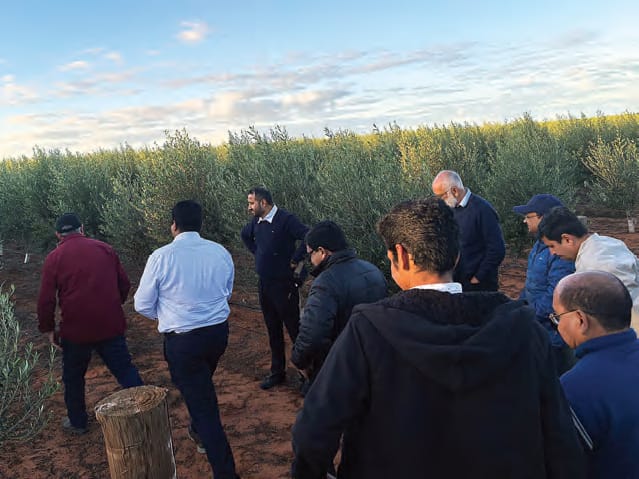
During the visit, delegates toured properties where growers have transitioned from wine grapes into alternative crops including olives, citrus and avocados.
Attention was given to the Riverland’s growing adoption of super high-density olive production systems, which allow growers to repurpose existing vineyard infrastructure such as trellis systems, drip irrigation and harvesting equipment.
Project representatives explained the approach had helped reduce transition costs for growers while creating new opportunities for higher-value production.
Delegates also visited properties operating diversified citrus and avocado plantings, reflecting efforts to build greater resilience through multiple crop systems rather than relying on a single commodity.
Growers involved in the transformation project spoke directly with the delegation about the challenges and opportunities involved in changing production systems, including planning, infrastructure adaptation, market development and long-term sustainability.
The visitors were also shown how co-operative support structures and market connections had helped provide confidence for growers undertaking major changes within their businesses.
Several aspects of the Riverland model attracted strong interest from the delegation, particularly the reuse of existing infrastructure, the dual-crop diversification strategy and the importance of securing markets before establishing new plantings.
Delegates reportedly expressed interest in establishing similar demonstration areas within their own region to help encourage grower participation and confidence in agricultural transition programs.
The visiting officials said the Riverland experience closely aligned with transformation goals currently being explored within Madhya Pradesh, particularly around higher-value irrigated horticulture and export-focused agriculture.
The visit was seen as significant recognition of the work undertaken across the Riverland through the Transforming the Riverland Project, with local growers, industry representatives and project leaders contributing to discussions that may help shape future agricultural programs overseas.
The Transforming the Riverland Project has been supported through funding from Primary Industries and Regions South Australia as part of broader efforts to support long-term sustainability and diversification across the region’s irrigation industries.

This article appeared in Murray Pioneer, 10 June 2026.

