Caitlin Menadue, Yorke Peninsula Country Times
Algal bloom levels are shifting along northern Yorke Peninsula, with concerns growing for local marine life — including the region’s well-known stingrays.
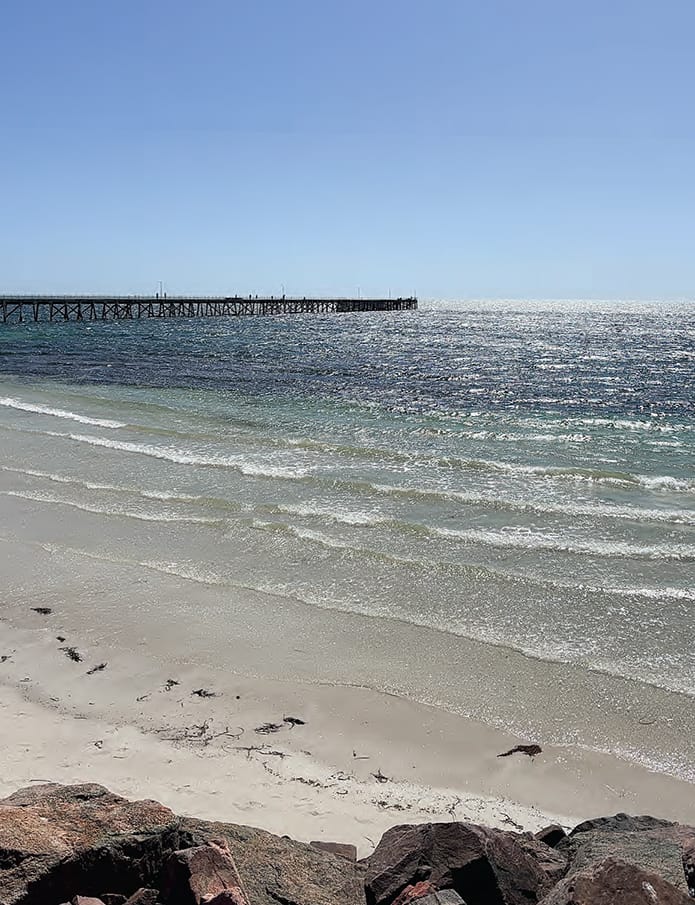
Recent footage captured in Moonta Bay showed a large fever of rays moving through shallow waters late last month, with locals suggesting they may be trying to escape the bloom.
At Point Turton, Sally — a well-known resident ray — has not been seen for weeks, raising concerns among locals and visitors about her fate.
The latest state government algal bloom update, issued on April 6, showed elevated Karenia levels at Port Hughes, recorded at 16,850 cells per litre.
Levels at Moonta have dropped from 5650 to 1650 cells per litre.
Low levels were detected at Wallaroo, Port Victoria, Port Rickaby and West Cape, while no presence was recorded at Hardwicke Bay, Point Turton jetty, Corny Point, Browns Beach, Shell Beach, West Bay, Chinamans, Little Emu Beach, Coobowie, Stansbury, Port Vincent and Ardrossan.
At the start of March, Point Turton recorded about 510,000 cells per litre, with levels now significantly lower along the west coast.
Sea life disappearing
Filmmaker and Great Southern Reef Foundation creative director Stefan Andrews recently shared footage showing the impact of the bloom at Port Hughes.
The Ardrossan local compared underwater scenes from early and late March.
“Until recently, things were looking okay, but there were signs of impact,” he said.
“Razor fish seemed sluggish and the hydroids on the pylons went from healthy to suddenly not.”
Mr Andrews said conditions worsened significantly by March 29.
“That’s when things really took a turn for the worse,” he said.
“There were many dead octopus and squid on the ocean floor, which quickly disappear as they are consumed.
“The sponges and colonial ascidians on the pylons are showing clear signs of decay, although some species are still holding on.”
He said some marine life remained, but signs of stress were evident.
“I did see a blue-ringed octopus moving around and some fish still present.
“I also saw a Port Jackson shark with very rapid gill movements, looking quite thin, and a boarfish with visible damage.”
Mr Andrews said impacts can escalate quickly depending on how long bloom conditions persist.
“The longer the bloom lingers, the worse the impacts appear to be,” he said.
“We can only hope conditions improve and avoid widespread damage to what is an incredible marine system.
Related stories: Algae
This article appeared in Yorke Peninsula Country Times, 14 April 2026.