Caitlin Menadue, Yorke Peninsula Country Times
Yorke Peninsula farmers, businesses and residents are grappling with the ongoing fuel crisis, as prices soar, independent retailers start to run dry and there’s no visible end in sight.
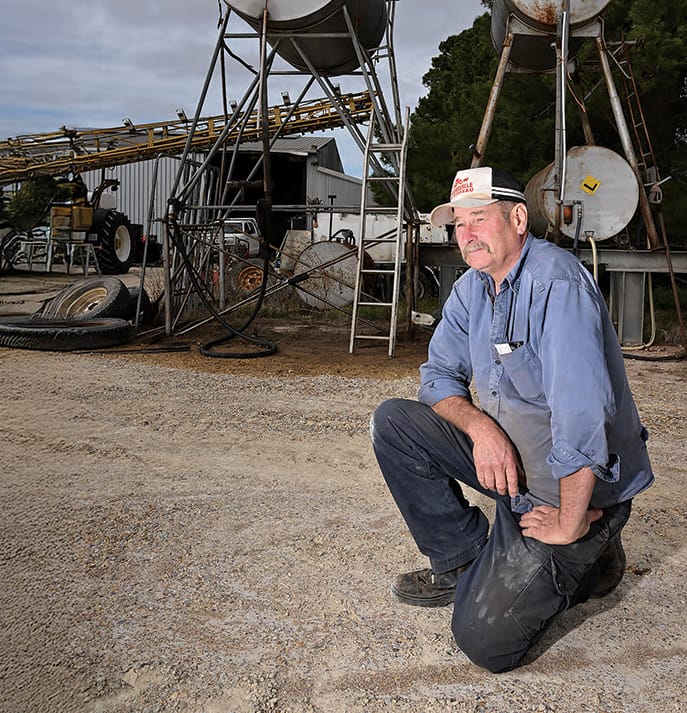
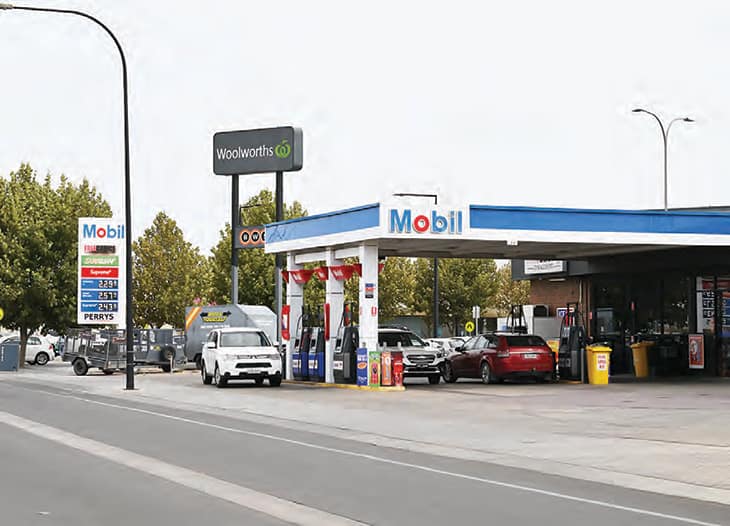
Unleaded 91 fuel has reached an average $2.29 per litre on YP while diesel prices have sky-rocketed to almost $3 per litre, according to RAA’s fuel map on Monday, March 16.
Prices have increased drastically since the war in the Middle East began three weeks ago and Iran closed the narrow Strait of Hormuz between the Persian Gulf and the Gulf of Oman, one of the world’s most strategically important passages for shipping.
Independent fuel retailers on southern YP, including the Corny Point General Store, The Pines Roadhouse, SYP Motors and YP AG Curramulka had zero supply of both unleaded 91 and diesel, as of yesterday, Monday, March 16.
YP AG Curramulka announced on Facebook on March 11 it had ran out of diesel and only had a short supply of unleaded petrol left, and their supplier was also empty.
“Unfortunately, we cannot be topped up until March 20 at the earliest,” they said.
“After many attempts of trying to source fuel elsewhere we have had no luck.
“We are certainly not alone and expect a lot more bowers to empty across the nation soon enough.
The Minimum Stockholding Obligation for petrol and diesel has been reduced by the federal government, allowing additional fuel supplies to flow to regions experiencing shortages.
The government indicated the temporary change would allow companies to release up to 762 million litres of petrol and diesel from Australia’s domestic reserves, with supply prioritised for regional communities and industries experiencing shortages.
Grain Producers SA chief executive Brad Perry said the government’s decision was the first step in recognising the challenges grain producers were facing in accessing diesel to spray weeds and prepare for seeding.
“Diesel is the lifeblood of today’s grain production, without it everything grinds to a halt,” Mr Perry said.
“Tractors, sprayers, seeders and trucks all rely on diesel to operate, and with seeding approaching it is essential that grain producers can access reliable fuel supplies.”
The release of additional diesel supplies would help ease pressure in regional fuel markets where many distributors relied on the wholesale spot market.
A GPSA survey found nearly half of respondents were concerned panic buying could disrupt diesel supply needed for seeding.
The survey of 638 grain producers found 49 per cent had significant concerns about diesel supply due to panic buying, with 32 per cent reporting difficulty securing diesel.
State primary industries spokesperson Nicola Centofanti said farmers and growers were facing some of the toughest global conditions in years, with the Middle East conflict also causing interruptions to fertiliser supply.
“Fuel and fertiliser shortages have the potential to derail this year’s harvest at a time when our farming communities are trying to recover from a generational drought,” Dr Centofanti said.
“We need reliable supply chains for both fuel and fertiliser, because without it, our food security, our economy and our regional livelihoods are at risk.”
State opposition Liberal leader Ashton Hurn has pledged to work in a bipartisan way with all levels of government to ensure an even distribution of fuel to keep Australia moving.
“We need to work together to ensure strategies are in place to manage even distribution of fuel and make sure there are sufficient stocks setaside for emergency services, critical transport operators and agriculture industries,” Mrs Hurn said.
Aussies urged to check petrol apps
South Australians are being urged to check real-time petrol pricing apps before heading out to fill the tank.
Consumer affairs commissioner Brett Humphrey said the apps were an invaluable source of up-to-date information on petrol pricing and availability.
“By law, petrol stations are required to update their information within 30 minutes of any change — that include a change of price and a change in availability,” he said.
Since the Middle East conflict began, Consumer and Business Services had received more than 100 complaints — compared to less than 20 for the whole of February.
To find out more about the real time petrol price monitoring scheme — or to report a discrepancy, visit cbs.sa.gov.au/campaigns/find-the-cheapest-fuel
Roundtable chaired by Premier
Premier Peter Malinauskas chaired a fuel distribution roundtable on rising fuel prices across the state yesterday, Monday March 16, with key agencies and industry leaders invited to attend, including those from the grain industry.
Speaking afterwards, he said there were 1.6 billion litres of petrol left in the nation, equating to 37 days left in the reserves, while there were 2.7bn litres of diesel, a total of 30 days’ supply.
A 29-day supply of jet fuel remained with only 800 million litres left.
“What we see currently in the country, and South Australian regional communities are no exception, is principally driven out of demand, not out of a supply orientated issue,” Mr Malinauskas said.
Alternatives offered for community to ease pressures
As fuel concerns spread and some services stations on YP run low, Lisa Hendry of Memory Lane Café has worked with team members to ensure participants do not have to give up their monthly get together.
A café was to be held in Maitland today, Tuesday March 17, followed by Ardrossan next week, both focusing on dementia and depression.
“If this (fuel) is a concern for you and is going to influence whether you come or not, then please contact a team member urgently,” Ms Hendry wrote in an email.
“We are looking at carpooling and also a bus so that people can still attend comfortably.”
Ms Hendry can be contacted on 0416 172 973 for more information.
Port Hughes historic truck rally postponed
The South Australian branch of the Historic Commercial Vehicles Club of Australia has made the difficult decision to postpone a rally which was to be held at Port Hughes on Saturday, March 21.
Member Dianne Correll said the event would be rescheduled, depending on how the fuel situation panned out.
Another HCVC member, Graham Correll, said the club had been expecting about 60 people to take part but there had been some cancellations.
“It’s not a good look if we are burning fuel and the last thing we want is to ruin our public image,” he said.
“There’s nothing we can do about it — it’s out of our control.”
Double whammy as costs climb
The rising costs of fuel and fertiliser could make some farmers reconsider putting a crop in this year, says Agricultural Bureau of South Australia chair Bevan Oster, who farms at Dowlingville.
He said as autumn seeding approached; farmers were very angry about the prospect of paying high prices for fuel and fertilisers as a result of the war in the Middle East and the closure of shipping through the Strait of Hormuz.
“There could be a switch in people’s planting programs and if you come from a marginal area, I think they might drop off cropping altogether,” he said.
“If you’re going to lose $100,000 or more in your cropping program, you’re better to pull up now.
“It’s looking like the inputs will be far greater than the returns.
“Last year was a catch-up year for farmers but the year before they had losses from those other dry years.
He said was now paying $2.70 per litre for diesel now, compared with $1.60 before the war began.
And he said some of the fuel retailers in smaller centres on the east coast of Yorke Peninsula and Southern Yorke Peninsula were running out of supplies.
“I don’t believe it’s a genuine shortage, it’s just a market distortion, like the toilet paper crisis during Covid,” he said.
“Farmers are angry with the Federal Government for not taking action to prevent price gouging.”
In addition to bumping up the cost of running vehicles and tractors, Mr Oster said higher fuel prices would also affect the cost of freighting inputs and agricultural produce such as grain and livestock.
Mr Oster said higher fuel prices would affect everyone by pushing up the cost of all consumer goods and would have a negative impact on YP communities that rely on tourism.
He said many growers would be thinking about growing lentils rather than other crops, as lentils are legumes which fix nitrogen in the soil and do not require the application of nitrogen in fertilisers, or might consider grazing sheep instead of sowing crops.
Grain Central reported in early March prices for urea had jumped by around A$150 a tonne in response to the Middle East conflict and available supplies in Australia were likely to cost at least $1000t, up from around $850t in late February.
Mr Oster said he was quoted $1150t for urea yesterday, March 16, and it was expected to go higher.
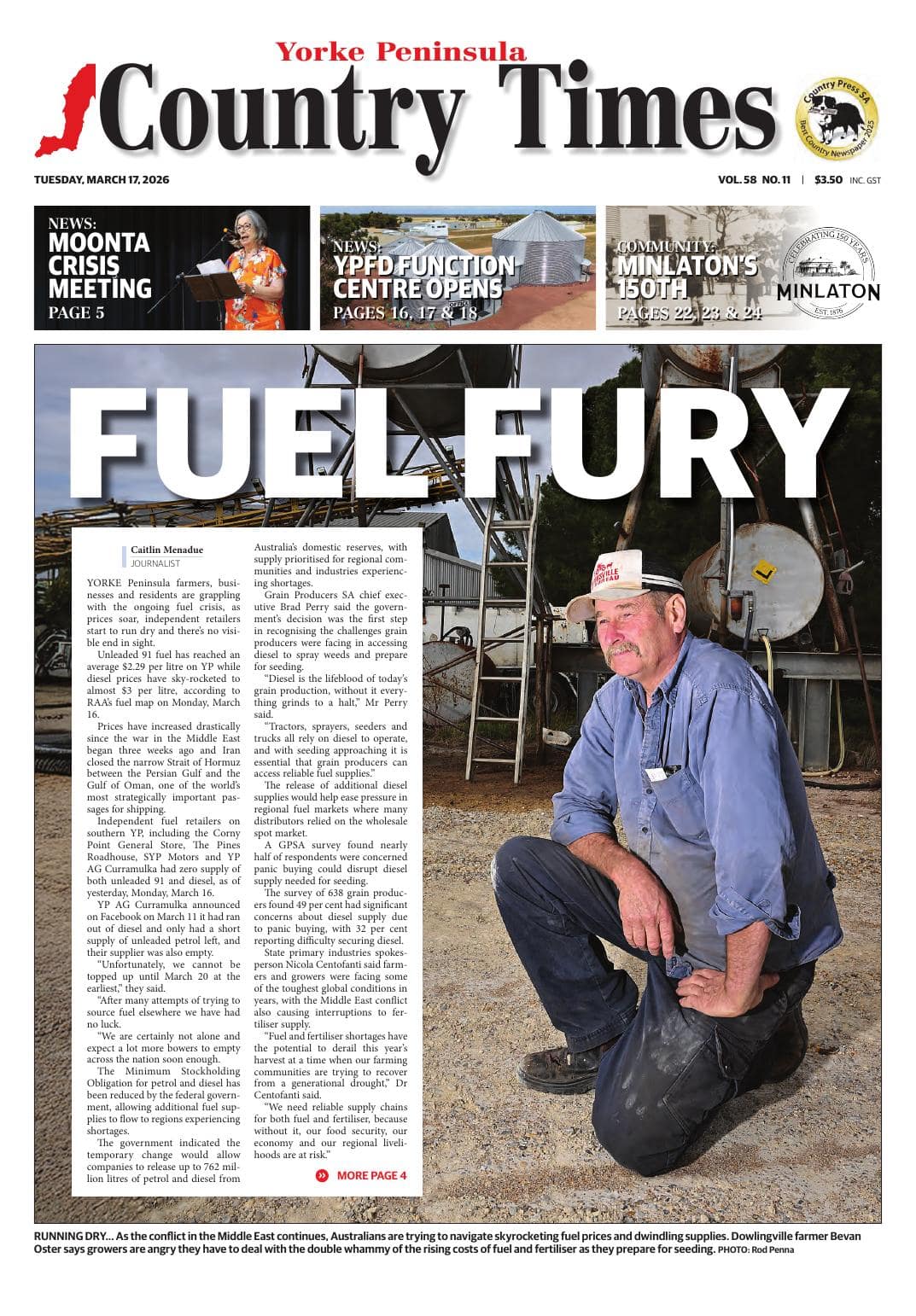
This article appeared in Yorke Peninsula Country Times, 17 March 2026.