


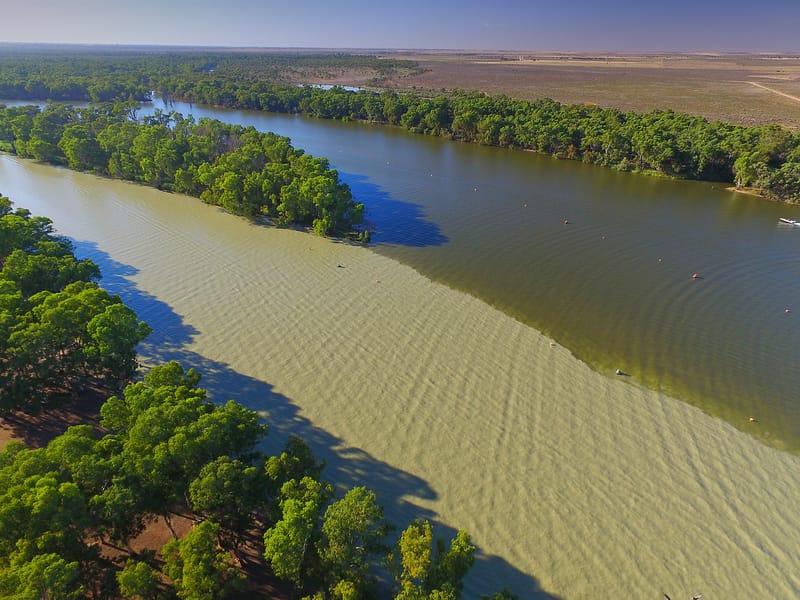
Photo: David Hancock.
Murray–Darling Basin Authority (MDBA), Media Release, 12 March 2026
There’s been spirited debate and productive discussion about the Murray–Darling Basin Plan Review (the Review) at the 2026 Basin Leadership Summit.
Nearly 200 senior leaders from across communities, agriculture and tourism industries, environmental groups, First Nations, government and science converged in Brisbane over two days to discuss the future management of the Murray–Darling Basin.
Murray–Darling Basin Authority (MDBA) Chief Executive Andrew McConville said the Summit achieved exactly what it set out to do.
“The Summit was designed to bring people together to create some colliding perspectives and spark new ideas,” Mr McConville said.
“The future of the Basin is going to be realised through a mosaic of ideas and approaches that ultimately deliver us rivers, for generations.”
This year’s Summit focused on supporting Basin leaders to engage confidently and constructively with their communities to ensure that a diversity of perspectives and lived experiences are represented in discussions about the Basin’s future.
“If we can facilitate a process like this, we get people to understand that holding tension and feeling uncomfortable is ok, because ultimately you will get a better breakthrough,” Mr McConville said.
Key themes to emerge over the two-day event include the importance of recognising the contribution of all groups to the Basin and the need for everyone to compromise to achieve a shared goal of healthy rivers and waterways.
“What’s clear to me is that there’s more that unites us than divides us. So we need to leverage that in developing a Basin Plan that’s going to be different from where we’ve come but sets us up for a future which is going to be much more uncertain.”
The Review is seeking community input on the future of the Basin Plan including better use of water for the environment, stronger participation of First Nations peoples, river connectivity and adapting to climate change.
Michael Murray, General Manager, Cotton Australia
“Obviously for the cotton industry, access to water and irrigation is absolutely critical. Our cotton growers are members of Basin communities; this is just about our lifeblood and the communities that we live in. These events are always very broad ranging, and you hear a lot of things that you agree with and you hear a lot of things that you disagree with and there’s plenty of things that you probably violently disagree with. But look, it’s always good to hear. It’s always, and it does remind me that when you get down to things, there’s probably more things that we can agree on than we can disagree on.”
Vanessa Cook, First Nations Representative of the Northern and Southern Basin, South Australia
“I would love for First Nations to be in the Water Act, to be partnered into there. I can’t stress enough for people to think, to remember and think this is all connectivity. So you can’t fix the land without the water and you can’t fix the water without the land. So each, and everything, connects. The mother is the land. We, the people, are the heart that has to keep the veins (the rivers) pumping continuously.”
Zara Lowien, CEO National Irrigators Council
“This is a once in a decade chance to have feedback on how governments may make decisions that will affect your community. So you need to get involved, you might not understand it all but even just sending in a message about how having a strong, vibrant economy is important to you that is critical for the MDBA to understand.”
Kate McBride, Basin Community Committee Member from Menindee
“I think there’s a long history with a bit of a lack of transparency and I think we’re certainly moving in the right direction. I think from a community perspective there’s goodwill at the moment, but we need to make sure that we’re seeing action, not just more pages of reports or anything like that.”
Simon Banks, Commonwealth Environment Water Holder
“I’ve got a strong interest in how we get the best out of the Commonwealth’s environmental water, so having some conversations about that has been really good to get different perspectives from different members of the community about how we’re travelling with the use of the Commonwealth’s water but also what the future looks like and how we can get the best out of it.”
Mark Lamb, CEO Murray Darling Association
“I think this is a really critical time in basin history because what we talk about now really forms the basis of the next basin [plan]. So, I think these kinds of discussions, especially during this consultation period, is absolutely critical.”
“Sometimes in the formal room you discuss certain ideas and then you take it outside over dinner, over a coffee and you start to socialise and normalise those discussions.”
I think one key thing that I believe in the Basin, that we are more like than unlike. So really, it’s about unification, we are all in this together we all have the same greater good at heart.”
Terry Korn, LifeBlood Alliance
“It’s very important for us to ensure that the environment is well catered for in this whole debate. We still feel the environment has been short changed, and we think with the SDLs we think it’s important they be really thoroughly examined and improved in some rivers, so we’ve all got a healthy river for the future of our grandchildren.”
“The future of the Basin is still in the balance, but I’m a half glass full person I’d say don’t give up, we’ve got to keep fighting for this, so we have healthy rivers, healthy communities.”
Professor Jamie Pittock, Australian National University
“What we would like to see in the next version of the Basin Plan is actual outcome targets that are linked to the health of flora and fauna that are easier to measure that demonstrate to everybody that all of this environmental water that has been so hard won is actually delivering a healthier river system.”

