

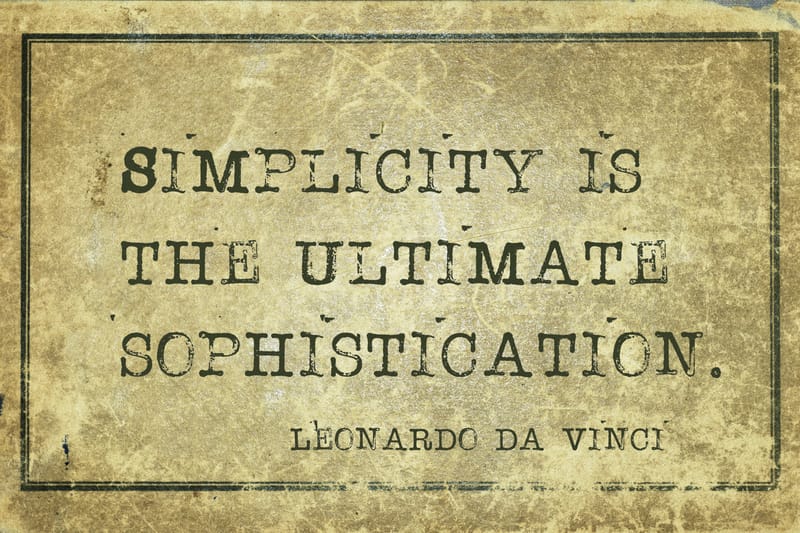
While this timeless adage is often attributed to the Renaissance master Leonardo da Vinci, representing his belief that true mastery lies in distilling complex ideas into clear, elegant, and functional forms, it serves as a profound, perhaps even more relevant, mantra for modern leadership in an increasingly complicated world.
The “badge of honour” fallacy. Good luck changing your details on a bank, government, council or utilities website! Nowhere is the burden of complexity more evident than in our dealings with the government. Too often, departments seem to treat convoluted procedures, labyrinthine websites, and high barriers to entry as a “badge of honour.”Whether it is applying for a regional grant, navigating zoning laws, or simply trying to find a clear answer on a government portal, the “red tape” has become a thicket that stifles innovation and infuriates us all. When processes are designed for the convenience of the bureaucracy rather than the citizen, the result is a stifling of the very “ease of doing business” that drives our economy.
“Simplicity is the ultimate sophistication.” Leaders must be the antidote to this complexity trend. We are duty-bound to ensure our organisations don’t replicate the same barriers we find so frustrating elsewhere. For regional leaders, this is a critical competitive advantage.
There is always a cost to complexity. The psychological reality is straightforward. If it is too complex, people give up. In business, complexity is a silent killer of customer conversion and loyalty. If your customers cannot navigate your systems with ease, they will seek the path of least resistance elsewhere. Complexity creates friction, and friction creates fatigue.
Simplicity is a leadership duty. Leadership is not about showing how much you know; it is about how much your team understands. Leaders have a moral and operational responsibility to strip away the “noise.” When a process is simple, it becomes:
- Memorable: Easy to recall and repeat.
- Empowering: People feel confident taking action when they aren’t afraid of making a technical error.
- Applied: Simple instructions are followed; complex ones are ignored.
- Committed: Understanding breeds buy-in. You cannot commit to what you do not understand.
By simplifying workflow, a leader fosters an environment where empowerment isn’t just a buzzword, it’s a daily reality.
Simplicity resonates deeply with the regional way of life. In our rural communities, people value authenticity and directness. Life in rural Australia strips away the unnecessary. It prioritises community over clutter and presence over prestige. When we apply this “rural lens” to our leadership, prioritising the essential and discarding the ornamental, we create businesses and communities that are not only more productive but more liveable.
Complexity kills, simplicity wins.
If it is simple, it is memorable. Simple messaging, straightforward products, and intuitive user experiences build trust and loyalty. Simplicity is also a competitive advantage. It takes courage to choose less, to push back against “feature creep” and unnecessary meetings. It takes deep understanding to take a complex problem and offer a simple solution.
Leaders have a responsibility to provide a team with a clear, compelling and concise vision. This is key to enable and empower people to act and make decisions confidently. When procedures are simple, and the organisational purpose clear, understanding increases, allowing for faster decision making, local application and, above all, higher commitment.
The rural advantage of simplicity and liveability. In the bush, people understand the value of a straight answer and a handshake. There is a reason why so many people are choosing to trade the frantic, cluttered lifestyle of the “big smoke” for the simplicity of regional living. In the country, simplicity leads directly to contentment and fulfilment.
Take the simplicity audit: Use this checklist to identify where complexity is hiding and where you can reclaim your competitive advantage.
- Is your website focused on a great customer experience? Use 5-second test: Can a stranger land on your homepage and know exactly what you do and who you serve within five seconds? Are your directions clear (e.g., “Book Now”, “Download Guide”). The 3-Click Rule: Can users find any critical piece of information (pricing, contact, services) in three clicks or less?
- Vision & strategy on a page: Do you have a One-Page Vision: Is your entire business strategy clearly displayed on a single page, or is it buried in a 50-page document?
- The rule of three: Have you identified the 3 strategic priorities for the next quarter? If everything is a priority, nothing is.
- Do you challenge your procedures & processes? When was the last time you asked your team, “Which of our internal processes is the most frustrating or redundant?” Can you identify the 20% of your processes that generate 80% of your value, and then simplify the rest?
- Staff engagement & culture. Can a new employee access knowledge and find the information they need to do their job without having to ask someone every time? Does your culture value emotional safety and simplicity where straight-talking is valued over “playing the game”? Do your procedures reflect a trust in your employees’ judgment, or are they designed to prevent the one-in-a-million mistake?
Leonardo da Vinci was right: Simplicity is not the absence of sophistication; it is the ultimate form of it. As leaders, we must stop confusing busyness with progress. Rather, embrace the responsibility of making things simple, creating a competitive advantage that also creates a more fulfilling, sustainable, and liveable way of life.
Leadership Lesson
The world will only continue to get noisier. As the landscape grows more cluttered, the leader who can offer a clear, simple path forward will always be the one people choose to follow.
Facta Non-Verba – Deeds Not Words