


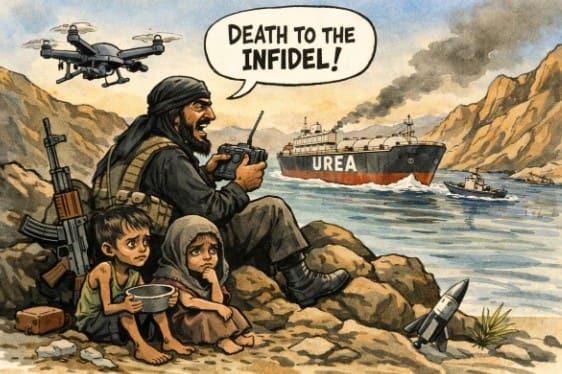
I’m continually amazed how many people can fly to Bali yet couldn’t point to it on a map. Ask them to name the countries that sit north of Indonesia and you’ll usually get a blank look. Yet geography still matters. In fact, it quietly dictates how the global economy works.
Most farmers understand this instinctively. Not because they follow geopolitics for entertainment, but because they know their businesses depend on ships moving safely across oceans. Australian agriculture sits at the far end of long supply chains, and those supply chains run through sea lanes.
The fuel, fertiliser and chemicals that keep a modern cropping program running don’t magically appear at the local depot. They travel thousands of kilometres across oceans and pass through a handful of narrow maritime choke points that quietly control the flow of global trade.
Anyone interested in geopolitics — or agricultural economics — should recognise a few key places on the map: the Dardanelles, the Strait of Hormuz, the Strait of Malacca and the Bab el-Mandeb. These are narrow stretches of water where enormous volumes of global trade are funnelled through corridors only a few kilometres wide. When one of them becomes unstable, the consequences don’t stay in the Middle East or the Red Sea. They eventually arrive neatly itemised on a farmer’s input bill.
Right now the choke point that matters most is the Strait of Hormuz.
For those whose interest in geography was thoroughly destroyed by Qantas and the ABC’s enthusiasm for redrawing Australia into a patchwork of Indigenous nations, the Strait of Hormuz is the narrow passage between Iran and Oman that connects the Persian Gulf to the open ocean. If you prefer Australian reference points, it sits just to the left of India on the map and is roughly as wide as the stretch of water between Perth and Rottnest Island.
On a good day—when no one is firing missiles—around 20 million barrels of oil pass through Hormuz every day, roughly one-fifth of global petroleum consumption. In tanker terms that’s the equivalent of about 20 large oil tankers a day sliding through a corridor narrow enough to make any nervous ship captain pay attention.
But it isn’t just oil moving through that gap.
Natural gas, petrochemicals and—most relevant to farmers—nitrogen fertiliser all depend on the same route. Nitrogen fertiliser is essentially natural gas with a chemistry degree. When gas prices move, fertiliser prices eventually follow.
Or to put it more bluntly: when the gas market sneezes, urea gets pneumonia.
That’s why a shooting match in the Gulf doesn’t just move oil markets. Shipping insurance jumps, cargoes stall, traders pull their offers and buyers scramble for supply. Economists call this “uncertainty”. Farmers tend to call it a good opportunity to blame their agronomist, their spouse, the kids or the dog for not locking in the fertiliser earlier.
The Gulf matters because it isn’t just an oil corridor—it is also one of the world’s key fertiliser corridors. Around one-third of global seaborne urea trade originates from Gulf producers, with major exporters such as Qatar, Saudi Arabia, Oman and the United Arab Emirates sending their product through the Strait of Hormuz. Add Iran’s exports and roughly 16–21 million tonnes of urea passes through that narrow gap every year.
For countries like Australia, which import large volumes of nitrogen fertiliser, that represents a fairly uncomfortable reliance on a shipping lane that can be clearly seen on a school atlas.
Iran understands this leverage perfectly well. Sitting on the northern shore of the Strait gives Tehran the ability to rattle markets without necessarily firing a shot. A few drones, a couple of Revolutionary Guard speedboats doing lazy laps around supertankers with .50 cals mounted on the bow, and suddenly shipowners and insurers start behaving like farmers who just heard the forecast of 50mm for April 1 — only to discover it was the Bureau of Meteorology’s idea of an April Fool’s joke.
But Iran has its own geographic problem: it needs the Strait open too. The country produces roughly 3–4 million barrels of oil a day, exporting around half of it, and about 90 per cent of those exports leave through Hormuz. Blocking the passage might sound blood-curdling when delivered by a newly promoted Ayatollah from somewhere deep inside a bunker, but it also assumes the locals won’t eventually come knocking on his door to explain their displeasure at the prices in the local markets.
It’s the geopolitical equivalent of padlocking your own sheep yards during shearing just to prove to the shearers who’s boss.
So Tehran tends to play a careful game—threaten disruption, create tension and remind everyone who controls the coastline—while stopping short of actually blocking the artery that feeds its own economy.
History gives us a preview of how this kind of strategy works. Look at Yemen and the Bab el-Mandeb, the southern gateway to the Red Sea. The Houthis occasionally take pot shots at shipping heading toward the Suez Canal, and suddenly vessels start detouring around the Cape of Good Hope, adding thousands of kilometres to voyages and pushing freight rates higher.
The rebels get attention, the world gets delays, and the global supply chain quietly becomes more expensive. But eventually the rebels get frustrated with waiting for the next aid ship to arrive with a cargo of wheat or sheep, and return to shooting at each other instead of shipping.
Hormuz works the same way—only bigger and faster. If that strait becomes messy for any length of time, fertiliser markets tighten almost immediately. Tankers wait, traders start going long, and importers bid up the price on any product that emerged out of the ground.
Which raises the question economists always ask: who benefits?
Global urea exports are dominated by a small group of gas-rich countries. Russia exports around 7–9 million tonnes annually, while China ships roughly 5–7 million tonnes when it allows exports at all. Gulf producers—Qatar (5–6 million tonnes), Saudi Arabia (4–5 million tonnes), and Oman and the UAE (3–4 million tonnes each)—supply a large share of global trade.
Take the largest exporter, Russia. In theory it is the logical back-up supplier if Middle Eastern fertiliser flows are disrupted. But Russian exports face a geographic bottleneck of their own. Much of its Black Sea trade must squeeze through the Turkish Straits — the Bosporus and the Dardanelles — before reaching global markets.
Anyone with even a passing familiarity with ANZAC history will recognise the Dardanelles as the narrow waterway where the Allies discovered in 1915 that geography can be brutally unforgiving. These days the threat isn’t Ottoman artillery on the cliffs but Ukrainian naval drones, which have periodically harassed Russian shipping in the Black Sea.
Which brings us back to the map. The global fertiliser trade, like the oil trade, runs through a handful of narrow waterways. Hormuz, the Dardanelles, Malacca—close one of them and the price signals travel remarkably quickly from a missile launch to a farmer’s fertiliser bill.
And the map doesn’t stop there. Look further north and the same logic applies around China, another major player in global nitrogen markets locked in by choke points, the Taiwan Strait, the Luzon Strait and the Strait of Malacca leading into the South China Sea. If tensions in that region ever spilled into shipping lanes, the disruption would ripple through global trade just as quickly as anything happening in the Persian Gulf.
China matters because it remains one of the world’s largest urea producers and a swing exporter in years when Beijing allows exports. When Chinese authorities restrict exports—as they have done repeatedly during periods of domestic fertiliser shortages—the effect on global markets can be immediate. Prices lift as importing countries scramble for alternative supply from the Middle East, Russia or North Africa. In other words, even when missiles aren’t flying, a policy decision in Beijing can tighten global nitrogen markets almost as effectively as a blockade in Hormuz.
Put it all on a map and the conclusion becomes obvious: the fertiliser market that feeds global agriculture depends on a surprisingly small number of narrow waterways and political decisions. When the dogs of war—or the autocrats—start barking around those choke points, urea traders tend to listen.
Once the barking starts, farmers know how quickly these markets can move. A useful way to see the pattern is to compare the three major fertiliser shocks of the past generation — 1990, 2008 and 2021–22.
During the 1990–91 Gulf War, urea prices rose from roughly US$90–$110 a tonne to around US$130–$150, an increase of about 30–40 per cent, before falling back once Gulf shipping stabilised.
The 2007–08 commodity boom was far more dramatic: strong grain prices, tight gas supply and export restrictions pushed urea from about US$250 a tonne to roughly US$850–$900, more than tripling in less than a year, before collapsing back toward US$300–$350 as the global financial crisis reduced demand.
The most recent shock came during the 2021–22 energy crisis, when post-Covid demand, European gas shortages and the Russia–Ukraine war sent urea prices from roughly US$300 a tonne to above US$1,000 in under twelve months. Prices later retreated to around US$350–$450, still higher than the pre-crisis baseline.
The lesson across all three episodes is consistent: fertiliser markets react violently to geopolitical shocks and energy disruptions. Prices spike rapidly during the uncertainty and, while they usually fall once supply stabilises, they tend to settle at a new equilibrium slightly above where they started.
The early signs of that pattern are already visible. Since the latest Iran-related conflict began in late February 2026, oil and gas markets have reacted almost immediately. Brent crude rose roughly 10–13 per cent within days, climbing from about US$70 to more than US$85 per barrel, while diesel prices surged as traders worried about supply moving through the Gulf.
Fertiliser markets have begun to follow. Urea prices have already risen US$60–$80 per tonne, or roughly 10–15 per cent, as suppliers delay shipments and traders cash in on old stock while they watch events unfold.
These early moves are typical. The question is when—and at what level—prices will fall back to equilibrium.
For farmers watching both the map and the fertiliser quotes, the rule of thumb is simple:
Wars push prices up quickly. Peace usually brings them down—just not quite as fast.
The only question is whether they fall quickly enough for those who haven’t already locked in their post emergent nitrogen, and whether they fall back to where they were at the end of 2025.
My guess is the war will be over in days, allowing all concerned to claim victory. Urea and diesel prices will have dropped back by May when the first of the crop is up and they need a dose of N — but the market will likely have settled on a new, slightly higher floor.
But then again, what would I know?
I studied history and geography.

