


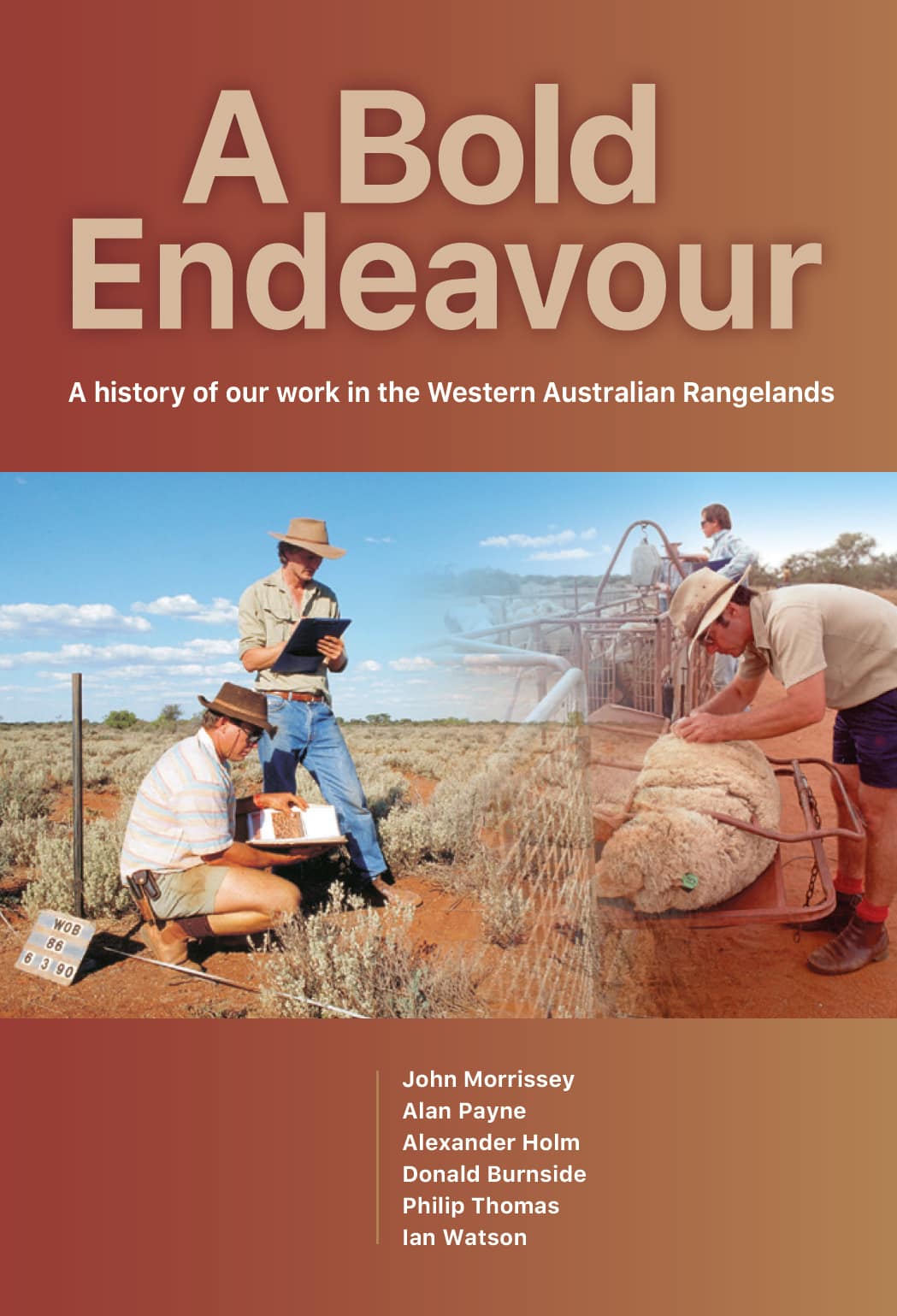
A Bold Endeavour – a history of our work in the Western Australian rangelands is a terrific book. I read it from cover to cover and then went back and read some parts again. The authors are six agricultural scientists and their ‘office’ was the immense WA outback beyond the narrow bounds of coastal cities and developed farmlands … in other words, the rangelands. They stretch from the Kimberley in the north, down through the Pilbara, the Gascoyne, the Murchison, the Goldfields, and out onto the Nullarbor, 2.3 million square km, 87 per cent of the Western Australian land area.
This is hard, often unforgiving, tough country; but it is also the denizen of hard, tough and often unforgiving men and women – the pastoralists, on their immense sheep and cattle stations whom the officers of the Department of Agriculture’s Rangeland Management Branch (RMB) sought to advise and assist, but with whom they sometimes locked horns.
Background
Pastoralism has a long history in WA. Beyond the closely settled farmland, in the more arid lands bordering the southern deserts and in the sub-tropical north, by the time of World War I, most of the area in which ‘bush grazing’ could be done was being grazed. However, over-optimistic assessments of the land’s capacity resulted in too many sheep and cattle being carried regardless of seasonal conditions. By the 1940s and 1950s, the unintended consequences of this approach were becoming apparent; there were many parts of the WA pastoral rangelands that were degrading, and productivity was declining. As described in the book, governments and landholders decided something needed to be done.
Enter the Rangeland Management Branch
At this time a bold decision was made by government: to create a Rangeland Management Branch within the Department of Agriculture, the role of which would be to carry out research into the pastoral industry and to help to mitigate its impacts and repair its damage, while at the same time ensuring that the industry survived, and if possible prospered. The Rangeland Management Branch (RMB) recruited its staff from (mostly young) agricultural scientists working for the Department of Agriculture, men who were prepared to take on a new profession and to work in remote areas under harsh and often primitive conditions. A Bold Endeavour is the story of over 300 men and women who worked in the Branch from the late 1940s up until the early 2000s.
This is book about people as much as it is about an industry, a landscape, the bush and a passion. The book is well-written, full of humour and of breathtaking honesty – we read of their failures and mistakes, as well as their triumphs and achievements.
Building a new science and practice
The first professionals to start work in the rangelands started with almost nothing. There was no established science, and only the most scratchy knowledge of regional botanies, ecology, and soils. The stories about how knowledge was accumulated and passed on to pastoralists and others make intriguing, and often exciting reading, as staff developed an understanding of how the country ‘worked’, how enlightened management could help both productivity and conservation, and how areas of serious degradation could be rehabilitated.
Significant successes
The authors describe many successes, and lasting legacies. For me the outstanding achievements were firstly the mapping and describing of the land systems in the rangelands, resulting in a ‘world’s best’-documentation of the bio-physical resources and their condition. The authors are justifiably very proud of this achievement.
Secondly, the rehabilitation of the massively degraded Ord River cattle leases – the catchments of the Ord River dam – was an immense undertaking, helped by the decision of the WA Government to resume one million hectares of degraded land. As far as I am aware this was the only instance of a WA government ever taking firm action to enable effective rangeland rehabilitation.
Thirdly, a commitment to measure change in the rangeland resource resulted in the Western Australian Rangeland Monitoring System. This comprises 1,600 permanent sites installed across the pastoral regions, with regular assessment of each plot according to measurable criteria that could be used to identify trends in land and vegetation condition. This system is unique in Australia, indeed in the world, in terms of its scope and outcomes, and the resultant data set is a priceless asset.
While some pastoralists rejected the advice of the RMB, others embraced it, and the result is that there are now many pastoral stations where the transition has been made from land exploitation to sustainable production.
Finally, in my view, perhaps the most critical outcome of the work of the RMB was demonstrating that well-managed pastoralism is environmentally benign – domestic stock and native vegetation could happily coexist with no ecological or economic penalty. The converse, poorly managed pastoralism will lead to land degradation, thus requiring active regulation by the landlord, being the WA population.
Significant failures
It turned out that the real problems faced by the RMB were not scientific, but political and institutional. Firstly, they lacked political backing and support from their own department and their sister agencies; and secondly, attempts to fix degraded areas were resisted or undermined by many pastoralists, the very people it was hoped would benefit. What was even more of a problem, there was no way good management could be enforced. The RMB had no regulatory powers. The Pastoral Land Board and the Soil Conservation Service, which could have regulated pastoral activities, took little interest in management, while other agencies relied on education and encouragement, which sadly was not enough.
And in the future?
On the other hand, if the political will for action ever arises, best-practice land management systems for the WA rangelands are now known and understood, and could be implemented across the rangelands tomorrow. This situation can be attributed to the work of that small band of tough, dedicated scientists of the Rangeland Management Branch during its short, but dramatic history.
I especially commend this book to anyone embarking on a career in rangeland management, and to those already in that domain. To them, and to anyone interested in the Australian outback, I say: please read this book!

