

TasFarmers, Media Release, 18 December 2025
The peak body for Tasmanian farmers, TasFarmers, is today calling for an inquiry and full analysis of Australia’s food supply chain, from farm gate to supermarket shelf, after revealing that fresh produce is now cheaper in London than in Launceston.
TasFarmers has compared the cost of a small basket of goods at Australian supermarkets with prices at Tesco in the UK, and the result is startling: basic groceries are more expensive in Australia, despite the UK importing a far greater share of its food to feed its population.
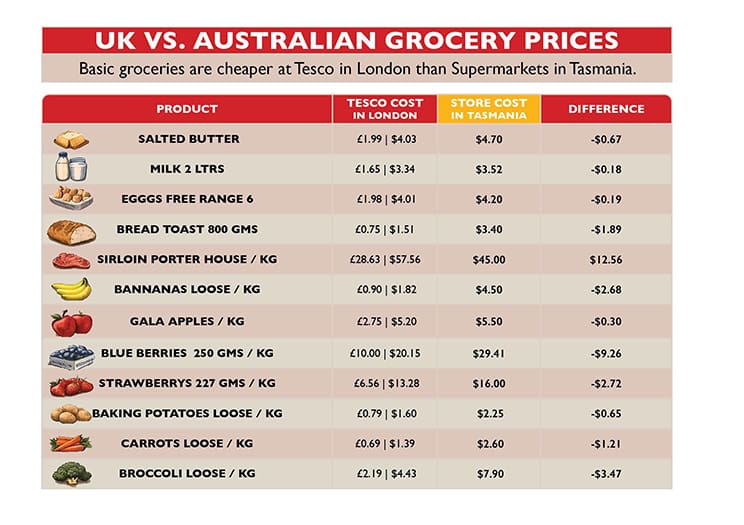
President of TasFarmers, Ian Sauer, said it would come as a surprise to many that it’s actually cheaper to buy fruit and vegetables in the UK than in Australia. With Christmas approaching and cost-of-living pressures biting, he said the figures speak for themselves.
“A look at the numbers tells a staggering story, Australian households are being slugged more for everyday basics than shoppers in the UK, and not just by a little,” Mr Sauer said.
“We’ve found that basic staples like bread, butter, milk and eggs are all cheaper at Tesco in London than at our local supermarkets, less than 25 kilometres from a farm gate in Tasmania.
“The price gap on bread alone is $1.89. Free-range eggs and milk are also noticeably more expensive here.”
When digging deeper into fresh produce, the differences become even harder to ignore. Bananas are $2.68/kg cheaper in London, carrots are $1.21/kg less, and broccoli is $3.47/kg under what Tasmanians are paying. The biggest blowout? Blueberries – $9.26 more at our supermarkets for the same quantity.
“Our fresh produce is nowhere near as affordable. For all the food miles and supply chain spin, consumers are being taken for a ride, and our farmers aren’t seeing the benefits. It’s time for a forensic look at the problem, because the numbers just don’t add up.”
Farmers have long argued that costs are being added at unknown points in the supply chain, from the farm gate to the retail shelf, and there is not enough transparency.
Mr Sauer said at the same time the freight equalisation subsidies rose, almost within the same month, so did freight costs, proving that cost pressure isn’t coming from farmers, who remain extremely efficient despite rising input costs.
“Farmers feel isolated and frustrated by having no say in how prices are set along the supply chain, and in many cases, they’re the ones subsidising it.
“By the time a product hits the supermarket shelf, the price farmers receive isn’t within a bull’s roar of what retailers charge. Take McDonald’s chips, for example: farmers make just 11 cents on a $5 serve. Someone else is clipping the ticket beyond the farm gate, and it’s not just the supermarkets.”
Transparency is needed across the full supply chain, especially on freight, logistics, and retail margins. With supermarkets claiming they only make $2.60 profit for every $100 spent, Mr Sauer says the figures deserve real scrutiny.
“It’s the old adage: we don’t know what we don’t know. Our farmers are efficient, our vegetable processors are highly cost-effective, so why aren’t we cost-competitive with India, or price-competitive with the UK at the checkout?”
TasFarmers is calling for a genuine parliamentary inquiry and an independent economic analysis of the food supply chain to find out who is really driving up consumer prices.
“Consumers deserve to know who’s profiting, where inefficiencies lie, and who’s using their influence unfairly,” Mr Sauer said.
“This is about calling out the absurd. How can food be cheaper in London than in Launceston? We’ve got no clear picture of what happens to prices from paddock to plate—and that’s the problem.
“If Coles and Woolworths are confident in their margins, they shouldn’t fear scrutiny. It’s time for a proper economic analysis of the Tasmanian food supply chain. And in the meantime, Tasmanians should back their own by buying local first.”
TasFarmers is challenging local consumers to choose in-season Tasmanian produce because it’s among the best in the world.
“Tasmania is known for producing some of the cleanest, tastiest food in the world. If we’re going to fix the system, it starts with consumers actively seeking out and choosing in-season Tasmanian food. Our supermarkets should have nothing to hide, and fresh, local produce should be front and centre in every store, because shoppers are demanding it.”