

Rising from his first task as a livestock buyer on the walkway of the Naracoorte saleyards with Ian Perryman, Darren Thomas has piloted Thomas Foods International (TFI) into a global company with a $3 billion turnover.
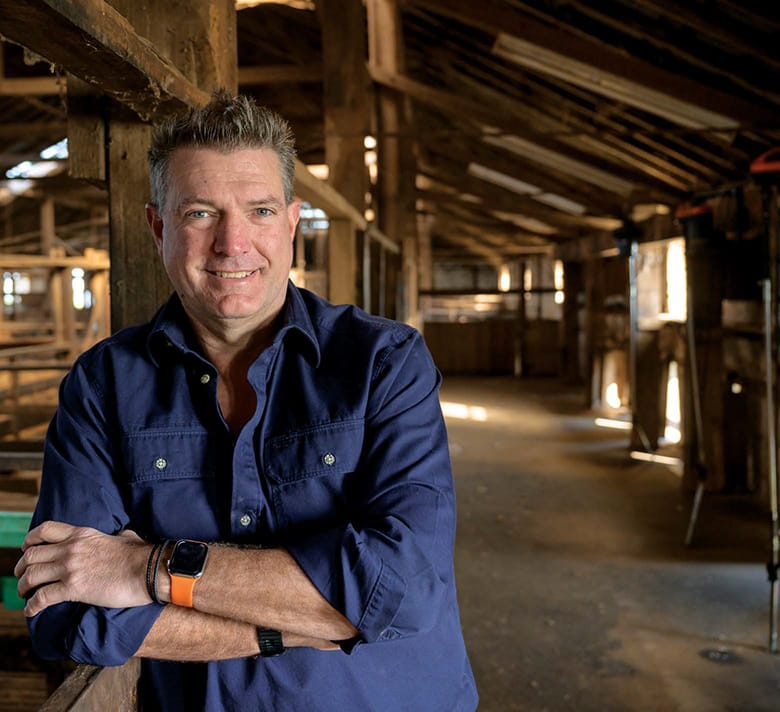
For 15 years he drove to work throughout the South East, but now Mr Thomas flies to work around the globe where he has customers in 85 countries and offices in nine.
The TFI managing director, accompanied by company founder and father Chris, and mother Libby, was a guest speaker at Naracoorte’s recent gala night fundraiser, organised by the Longridge Ladies Auxiliary.
Welcomed by MC Richard Harvie of PPHS, Mr Thomas stepped up to the podium, and 125 people hushed.
Mr Thomas talked about the importance of family, longevity and staff, friends and teamwork.
About how important it was to be present and connected to employees and customers, ensuring they were included.
Additionally, Mr Thomas explained how valuable it was to always be asking questions, listening and learning.
Along with gut feelings rather than corporate advisers, those were some of the things which helped to create Australia’s largest family-owned red meat company.
Today, TFI delivers 170,000 tonnes of product to customers in 85 countries, including the supply of meat to every port for the cruise boat industry.
It has offices and/or processing facilities in nine countries – Australia, the US, Canada, China, Japan, Netherlands, the Middle East (Dubai), Singapore and the UK.
But its heartbeat is fixed in South Australia, with a passion for farmland in the SE.
“We’re a family business, and it’s something that we are really, really proud of,” said Mr Thomas, looking around the Naracoorte Football Netball Clubrooms at friends, familiar faces and suppliers.
Today, of the nation’s top five meat processors, only TFI is Australian owned. Regarding food security he described that as “scary”.
“When I started in the game, this is where I came first of all, to Naracoorte,” Mr Thomas said.
“I was told by (father) Chris to go and find a bloke called Ian Perryman…he’s a bit of a character.”
And so began the long drives involved with being a respected meat buyer.
“I was in my early 20s. I wanted to be a physio when I left school and thank God I didn’t get enough marks to get in there,” he said.
“I often say to people the 10-15 years I spent down here (in the SE) were some of my most enjoyable times.”
He was employed by T&R. Starting up in 1988, T&R represented his father Chris Thomas and Chris’s mate, Bob Rowe. They had one employee Peter Bond.
“We started as a very small company, (as livestock) traders,” Mr Thomas said.
“We never used to own our own meatworks when I came down here, we just used other people’s meatworks.
“I was always a bit in awe (of other buyers), you felt like – a bit second rate. You had to use your rat cunning to be able to compete with them.”
Mr Thomas showed a picture of three men in an Atco hut a young Bob Rowe (deceased 2013), his father Chris and teenage employee, Peter Bond.
“One of the successes of the business has been longevity. Peter used to babysit me as a kid and he’s still with us today. He runs all our beef (operations),” Mr Thomas said.
“How we got into the sheep and lamb industry was all around the flick of a coin.
“Dad lost the toss, and that’s how we started the sheep business. And that’s what we’re like. We’re not necessarily the most, I don’t want to say strategic. But you can get all these corporate advisers and that. But for Dad and Bob especially, a lot of that stuff was done on gut feel.”
The company bought the Murray Bridge meatworks in 1999. Seven years ago a fire reduced it to a twisted ruin.
But with a lot of time, effort, support and financial acumen, a new $300 million state-of-the art facility has replaced it.
The high tech facility is currently processing around 5000 head of cattle a week.
“We provide meals for everyone every day, just to look after our workforce,” Mr Thomas said.
He praised his insurance company, those who had stuck by TFI, and the Murray Bridge community.
In addition to Murray Bridge, TFI also has abattoirs at Lobethal, Tamworth, Stawell and a goat abattoir in Burke.
The facilities are continuously being upgraded, utilising the latest technology, including robots.
“We process 160,000 head (of sheep, lambs and goats) a week. So that’s double our next competitor,” Mr Thomas said.
“We still buy 75 per cent of our stock from the paddock (through) agents or farmers.
“So, we really invest in our relationship with the farmers – it’s a lot of stock. As Richard (Harvie) would know, right now it’s very challenging (to source stock).”
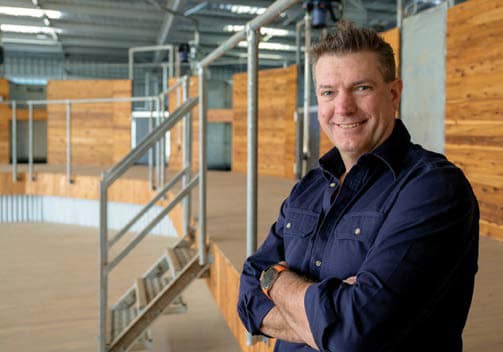
Mr Thomas recalled being in his 20s and telling his father about the beautiful farms he had visited to buy stock. They were “like Disneyland” and he remembered telling him “if only we could ever (buy) a farm like that”.
The family has since bought some of those farms at Millicent and Mount Gambier, including the iconic Mount Schank property.
“To be able to invest in this area and the country we love…I miss (the farms) a lot these days. I spend a lot of time on an aeroplane.”
But he believed staying in touch with the rural community was an integral part of the TFI business.
“Because without farmers, we don’t have a business. It’s just that simple,” Mr Thomas said.
The company also bought a feedlot at Tintinara which now employs 50 people. At the completion of a stage three expansion, it will house 40,000 cattle up from 2000 around 10 years ago. Mr Thomas explained the development and growth of TFI’s business overseas – offices and/or processing facilities in nine countries.
“We process in three plants in South America, and, by far Canada and the US are our biggest operations. This year, our US business has actually overtaken the size of the Australian office.”
Mr Thomas highlighted the importance of being present and connected to employees and customers.
“There’s a reason behind all of these offices…trying to get as close to the consumer (as possible)”.
He said the business relied on farmers for supply.
“We don’t want to do that, but if we can try and be everything in between and then sell to the end user, we should, in theory, be able to pay people more money for their livestock and be of more value to our customers.”
“So, there is a bit of method in our madness.”
He said China was currently a very fast growing market.
“So fundamentally, we have our production, our farms, our processing, our value adding all around the world, and our distribution (under numerous brands),” he said.
“And the SE is a big part of that.”
Mr Thomas said that having an Australian company being the dominant value adding company in America “is pretty cool.”
“Everyone says ‘No one’s eating meat’ and that couldn’t be further from the truth,” he said.
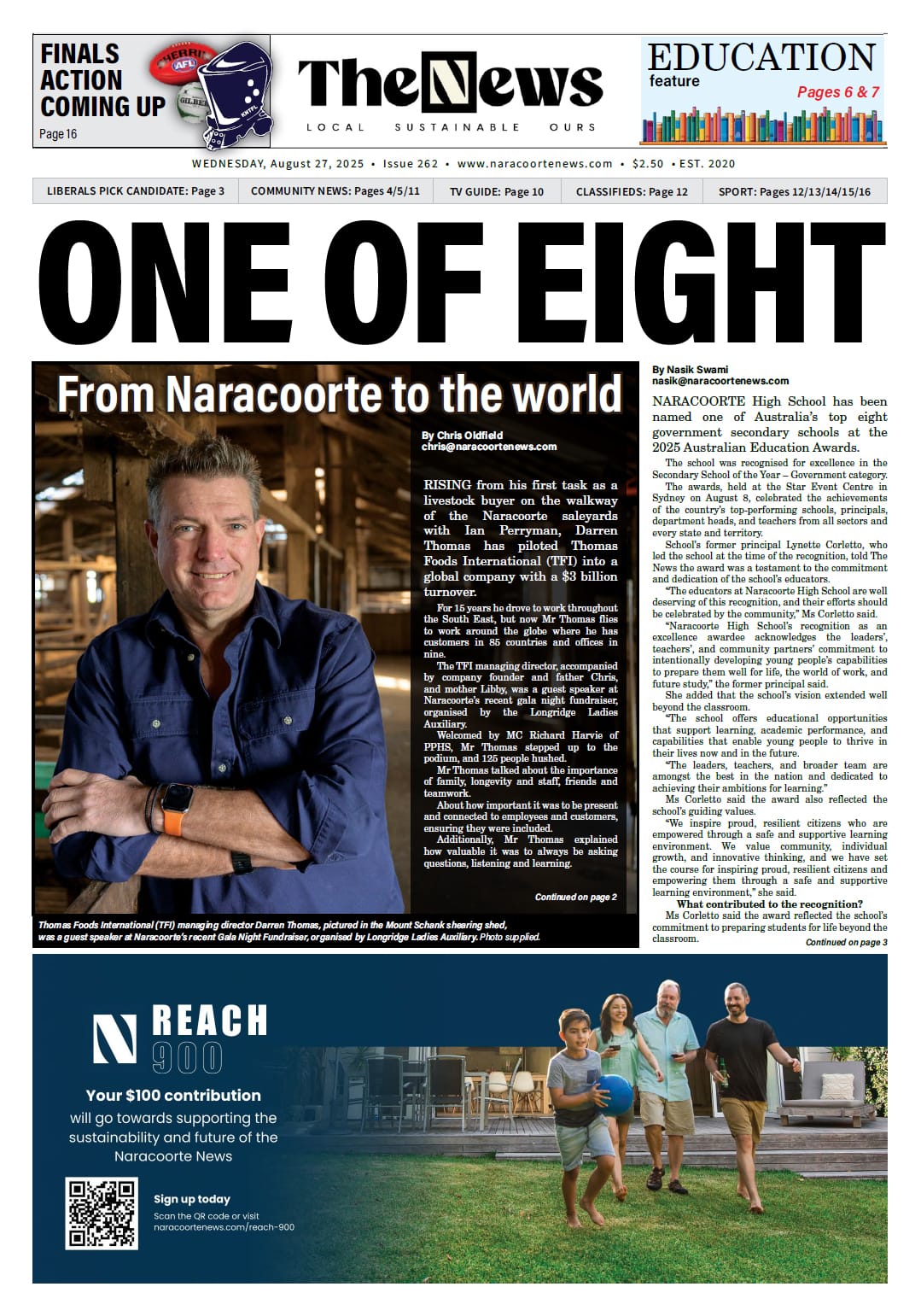
This article appeared in The Naracoorte News, 27 August 2025.

