

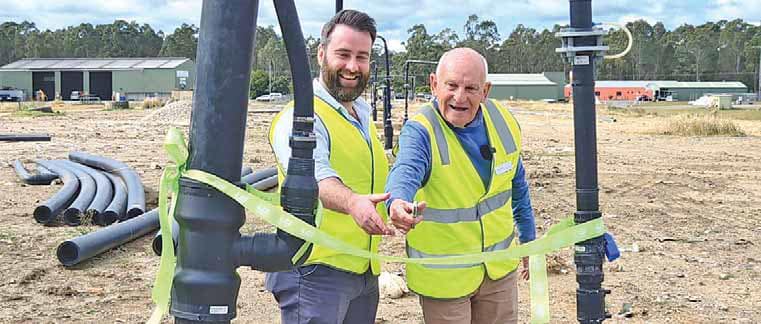
A major upgrade at the Grafton Regional Landfill is helping Clarence Valley Council (CVC) reduce their carbon footprint while delivering sustainable results for the environment and economic benefits for the local community.
Aimed at capturing harmful methane (CH4) gas emissions which are byproducts of the decomposing waste buried underground, 12 vertical gas extraction wells which extend 40m below the surface, along with five gas collection lines and close to 1km of underground pipes which are used to transport the captured CH4 to an enclosed flaring unit on site where it is converted to carbon dioxide (CO2), have recently been installed by LGI Limited (LGI), an Australian based and operated leader in carbon abatement who specialise in extracting and combusting landfill biogas.
Commissioned by CVC, the project, which began in 2015, has been delivered at minimal cost to ratepayers and has been described by CVC Mayor Ray Smith as a big step forward towards achieving Council’s long-term net zero goal.
Speaking highly of Council’s 10 year partnership with LGI as he toured the Grafton Regional Landfill site at Elland on July 31, Mayor Smith said along with reducing methane gas emissions which he stated is “a win for the environment and the Clarence Valley community”, he also revealed LGI has covered the costs to install, operate, and expand the gas extraction system which has saved Council “hundreds of thousands of dollars”.
“That means this is an even better outcome for the local community,” he said.
“This project at the Grafton Regional Landfill is a strong example of Council’s commitment to a more sustainable future.”
A potent greenhouse gas, the process of capturing CH4 and converting it to CO2 on site, is a measurable, immediate, and irreversible methane abatement approach which allows Council and ratepayers to receive a share of the Australian Carbon Credit Units (ACCUs) which is generated by the project.
Over the past 10 years, LGI has abated close to 180000 tonnes of CO2e for Council, which is equivalent to planting almost three million seedlings for the next decade, and 19 million m3 of biogas has been successfully captured at the Grafton Regional Landfill.
One of the biggest carbon emission sources for Council, biogas from landfills accounts for approximately 65 percent of emissions.
While Council receives a royalty share of ACCUs through the project, the local government body also has the option to sell them to create addition revenue or use them to offset emissions.
With close to 30 vertical gas extraction wells currently located at the Grafton Regional Landfill, 100 percent more of the methane gas emissions produced below the ground are being captured as a result of the major upgrade.
“It’s a very exciting project,” the Mayor said.
“To be here to see all the infrastructure that is now in place, and to see and learn about how the project is operating, how we’re capturing and burning the methane gas emissions which is creating carbon credits that we (Council) will receive a share of through LGI and provide us with an income, this project isn’t just about the economics, its also about the social and environmental benefits that are accruing.
“Council has a long-term goal of reaching net zero emissions, and the recent upgrades which have been competed as part of this project at the Grafton Regional Landfill in partnership with LGI have brought us closer to achieving it.”
Through partnerships with multiple councils across the state, LGI has been able to reduce CO2e emissions by more than 1.7 million tonnes, which is equivalent to planting 28.5 million seedlings for the next decade.
Over 180 million m3 of biogas has been captured at 11 different sites operated by LGI in NSW, with 296000 ACCUs created.
Tom O’Connor, National Operations Manager for LGI, said the 12 new gas extraction wells at the Grafton Regional Landfill are extracting harmful methane gas emissions from older parts of the location which have not previously been tapped, effectively doubling extraction figures over the last few months.
“We’re aiming to create a good carbon abatement outcome, which is destruction of the CH4 in the landfill gas,” he explained.
“The idea is once it has been captured, effectively vacuumed out of the ground and transported to the flaring unit and burned, it transforms into CO2 which is 28 times less harmful when omitted.
“Along with decreasing odour omissions, it also improves air quality.
“By removing the harmful gasses which are omitted from landfills, we’re creating economic sustainability for councils we work in partnership with, and as well as helping them reduce their carbon footprint, these projects are incentivised as well through carbon credits, so we share the revenue of what is generated from the destruction of the CH4 which helps ratepayers.”
Data released by LGI revealed landfills are responsible for approximately 11 percent of the world’s CH4 emissions, however, this figure is set to skyrocket to 70 percent by 2050 as the global population climbs.
Mr O’Connor said LGI will continue to operate, maintain, and expand the project at the Grafton Regional Landfill while delivering optimal gas extraction and carbon abatement.

He said LGI is open to creating further partnerships with other councils in NSW.
- Australian Carbon Credit Units (ACCUs) are issued by the Australian Government through a regulatory framework established under the Carbon Credit (Carbon Farming Initiative) Act 2011 (the CFI Act). The Clean Energy Regulator (CER) has primary responsibility for administering the ACCU scheme. For additional information, please scan the QR code:
This article appeared in the Clarence Valley Independent, 6 August 2025.

