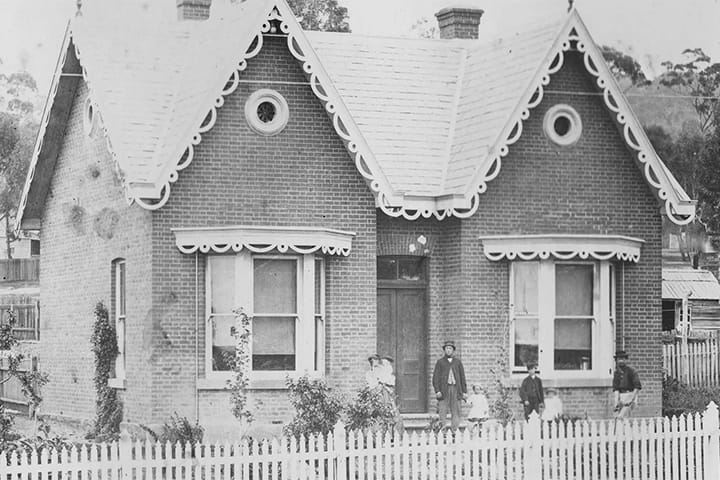
Tony Kane, Maldon Museum and Archives, Tarrangower Times
Maldon has many examples of Gothic architecture. The earliest example is Holy Trinity Church opened in 1861 and designed in the Early English Gothic style by architect David Drape. The Church’s stained glass windows are fine examples of the Gothic tradition, particularly its grand west window, the work of John Lyon. Apart from several other Maldon buildings, Drape also designed the Beehive Chimney. An early description of the chimney said it was topped by ‘a gothic block cornice and an embattled parapet’. Unfortunately, these features were destroyed when the chimney was struck by lightning in 1923.
The Fountain Street Wesleyan Church, now Cascade Art Gallery, is a fine example of 19th-century Gothic revival. Built in 1863 it was designed by Melbourne architects Thomas Crouch and Ralph Wilson. Methodists had only recently begun to adopt the Gothic revival. In 1860, Crouch and Wilson had designed the Gothic Primitive Methodist Church at Chewton. In earlier years, Methodists would probably have condemned these examples of Gothic architecture as “popery”. When the Fountain Street Church was renovated in 1915, a Gothic communion rail and matching panelling were installed.
The Maldon Railway Station, with its pointed arched windows and clustered chimney stacks, is another example of Gothic Revival. Built in 1888 it was a distinct departure from earlier classically derived station architecture. This new approach became known as the “Maldon” style.
Gothic features such as tall brick chimneys, castellated chimney pots, projecting front gables and elaborate fretted bargeboards can be found in older Maldon houses. One of the finest examples is John Robinson’s House in High Street, which was built about 1866. The house features intersecting gables and delicate timber barge boards.
Later, what is now known as Federation architecture included many elements of the Gothic Revival. In Maldon the best example of this is style of Federation architecture is Minilya at the corner of Chapel and Adair Streets. Minilya was designed in 1900 by Louis Boldini for Charles and Mary Calder and has been referred to as rustic Gothic. Boldini was an Italian architect who came to Maldon in his later years after a successful career in Dunedin, New Zealand. Braemar House on Mount Macedon is another example of his Gothic architecture.
Later, two further Maldon churches were built in the Gothic style. These were St Brigid’s Catholic Church, built in 1891 and the Presbyterian Church, now the Neighbourhood Centre, built in 1906. Louis Boldini described his design of the Presbyterian Church as “Lombard-Gothic”, and his original plans included an imposing tower. Cost prevented the tower being built.
Maldon’s earliest connection to the Gothic precedes this architecture. The oldest is the Gothic script used since 1858 in the masthead of the Tarrangower Times.
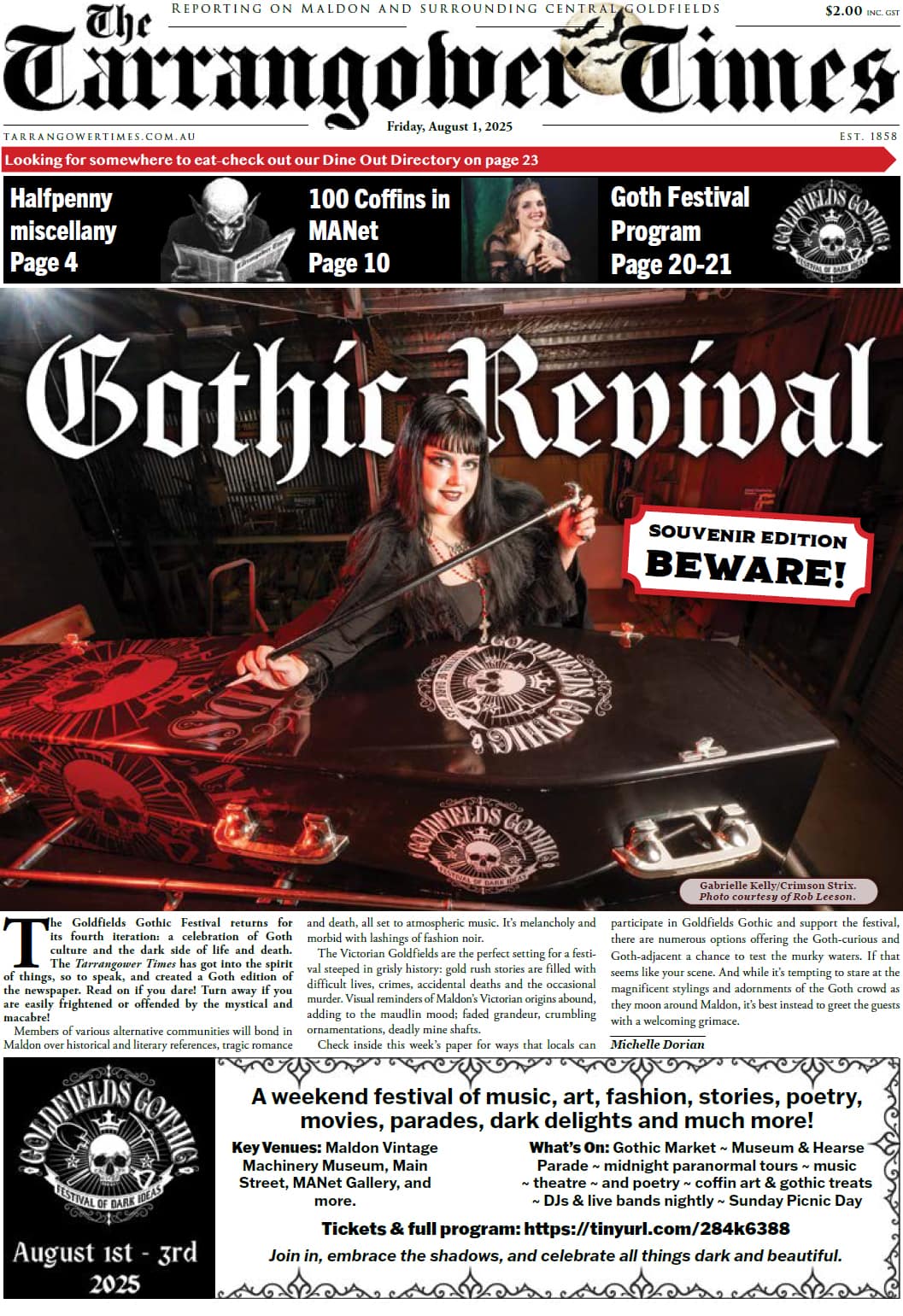
This article appeared in Tarrangower Times, 1 August 2025.