

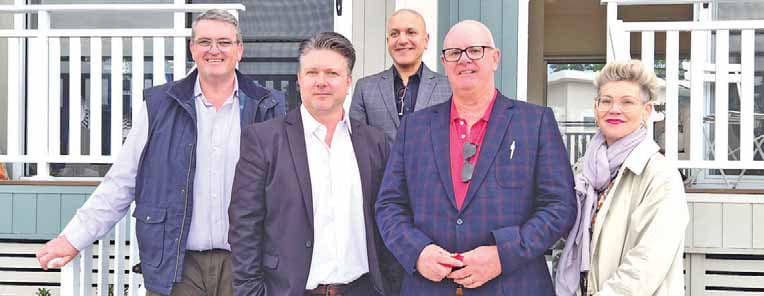
The official opening of 24 new affordable dwellings in South Grafton earlier this month has given a number of Clarence Valley residents a much longed for place to call home.
Located on a hillside in Bimble Avenue, the 12 two-bedroom and 12 single bedroom houses are part of a $9 million project funded by the NSW Government’s Social Housing Accelerator Fund (SHAF) and form an historic development which has been delivered on budget and on time.
Prefabricated off-site at a location on the Central Coast, the high-quality low-maintenance homes, all dedicated to social housing and low-income earners, were delivered by MOOV Modular, a modular homes company.
The unique components of the design and construction of the dwellings allowed the project to be completed within a quicker timeframe compared to the logistics associated with a traditional build, with civil works done in parallel with the offsite construction enabling the project to be finalised within six months.
With over 500 households presently on the social housing waitlist in the Clarence Valley and rental vacancies sitting below 0.9 percent, the development, which is also a joint initiative by Anglicare North Coast and Northern Rivers Housing, is the biggest affordable housing delivery in the region so far in 2025.
And CEO of Anglicare North Coast Mark McNamara has revealed they want to do a lot more.
“To do this as an in situ build would take between two and three years, and it would expose those involved with the project to risks such as builders going broke to material prices increasing during the process, so this delivery method has really derisked the delivery phase,” he explained.
“We have a massive undersupply of social housing, and we need to do much more and do it quickly.
“We think this is an important part of the solution, it’s not the only part of the solution, but we’re very excited and encouraged to be able to replicate this many more times.”
Mr McNamara also confirmed Anglicare North Coast, the social justice and welfare arm of the Anglican Diocese of Grafton, are acquiring land on the private market and exploring options to identify vacant land through the church and other partners and local government authorities to get development applications in place to enable projects similar to the one in Bimble Avenue to go ahead.
With a 10-year waiting list for social housing, Mr McNamara said the new homes in South Grafton received no shortage of applicants, adding “24 lucky families and individuals now have long term, secure, low-cost housing for the rest of their lives if they want it.”
“We think there are 16000 more of these required just in our region, and it is a many hands problem that needs to be solved, but we’re trying to do our bit.”
CEO of Northern Rivers Housing Craig Brennan said the project is the largest modular development which has been completed to date.
“With different thinking and different methods in place, we’ve been able to provide high-quality affordable living for people in need,” he said.
“These are homes for people who would otherwise find it very difficult to find accommodation.
“This project has given them a new home, security, safety, and we’re thrilled by that.
“It does take a collective group with a real, keen focus on delivering an outcome to get these sorts of things happening, and I just want to acknowledge Anglicare North Coast, MOOV Modular, and our local and state government officials for their input and support.
“This vision came to life off the back of a joint venture, and we couldn’t be prouder of what has been achieved on this once vacant paddock.”
Mr Brennan said the project showcases the achievable ability of delivering high-quality houses within a short period of time, adding there is a need for these types of houses within the local community.
“Northern Rivers Housing has a number of developments in the pipeline at the moment of a similar build, and we hope over the next 18 months or so to deliver a number of new homes across the region.
“We’re doing a 16-unit development just around the corner, and we hope to have residents in by Christmas.”

This article appeared in the Clarence Valley Independent, 30 July 2025.

