Earlier this year when reports about the disappearance of magpies started to surface it got me thinking about one of my own experiences with the Australian bird.
In the 1990s a group of magpies made up of about a dozen or more birds of varying ages were frequent visitors to my Yanchep property.
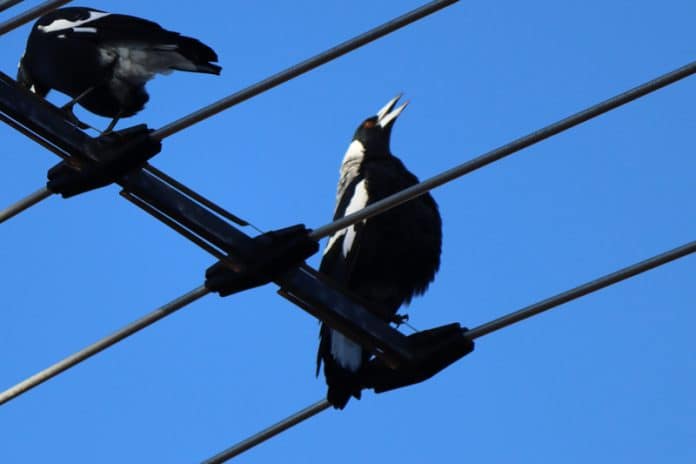
I remember the time my sons found a young magpie on the ground that could not fly and I came home to find them slicing up a leg of lamb they had taken out of the freezer.
In the following days it became apparent the magpie group had left without the youngster.
This had me worried as I kept having memories of a squeamish me slicing up frozen mice I had to buy specifically for a young kookaburra my sons had rescued on Gingin Brook Rd a year or so before.
My sons were happy to have a slice or two of lamb missing from their next roast dinner but when we found out to keep the young kookaburra, who had a deformed wing, in good health it was necessary to feed him some chopped up mouse on a regular basis they were always busy doing other things when it was time to prepare his dinner.
Apparently when kept in captivity birds such as kookaburras and magpies become susceptible to metabolic bone disease, a serious condition brought about by not enough calcium, if they don’t get some chopped up mouse.
Anyway one morning before I had time to go down to a city pet store and buy a couple of frozen mice for the young magpie I heard his family calling out in the front garden and he soon started calling back to them.
He had been doing his best to exercise his wings while kept safe in a bird cage so I hoped he had just fallen out of the tree and was close to flying.
I decided it was worthwhile taking him out the front in the hope he would be reunited with his family.
One of the birds immediately rushed over to him and then started foraging in the grass for insects.
I didn’t see him get up a tree to safety or anything like that but the group hung around for some days before disappearing for a few weeks like they always did so I’ve always hoped he was able to fly away with them.
I always thought people might think this story was a bit far-fetched as country people always say – usually correctly in my experience – that wild animals are reluctant to take back their young once they have been in contact with humans.
I kept that belief until WA Wildlife chief executive officer Dean Huxley told The Sunday Times on May 11 that it was essential that magpies are released into the same spot they came from as they are very territorial.
Mr Huxley was reported as saying that when the rescued birds were released in that same spot they fly up into a tree and start singing and their tribe comes and starts singing with them.
Our magpies continued to visit regularly but then the ravens moved into Yanchep residential areas and in my experience over the years magpie numbers have continued to decline and now just one or two occasionally visit my property.
A Field Guide to the Birds of Australia, William Collins Sons & Co, 1980 describes the diet of the Australian magpie as small mammals, small birds, eggs and young, small reptiles, insects and their larvae, other invertebrates and fruits and berries.
The book says their habitat is almost wherever there are trees and open areas of bare ground or grass, orchards, golf courses, playing fields, suburban areas and gardens.
This article appeared on Yanchep News Online on 27 July 2025.
Related story: Have you noticed any sick magpies?