

It wasn’t so long ago that every farm group in Australia was racing to outbid each other on climate targets. The mania for net zero swept across the country like a green gold rush, with grains, wool, dairy, beef and sheep all falling over themselves to sign up. Not to be outdone, every other industry – mining, aviation, transport – also jumped aboard, egged on by the government dream of becoming a clean energy superpower.
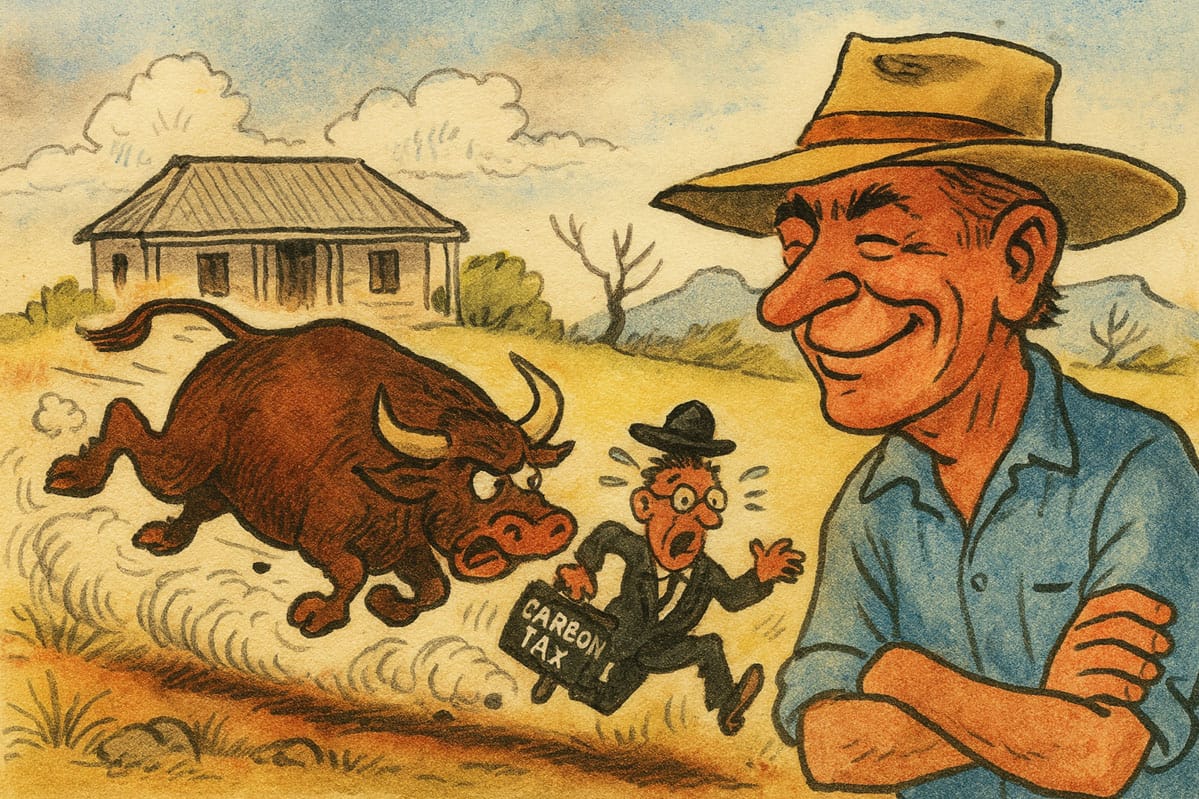
But that was then. Come 2025, after a couple of wars, a new US president, a cost of living crisis, power blackouts and the hard economics finally catching up to lofty promises, the world seems to have quietly lost interest in the net zero game. Great power politics is back, trade wars are back, and so too is the traditional recipe of corruption, incompetence and bloated bureaucracy running national economies into the ground. And amid this sober reassessment, guess who’s leading the back-out? The same people who first charged in: Australia’s farmers.
Just this week, the Red Meat Advisory Council formally dumped its 2030 carbon neutral target, swiftly followed by Meat & Livestock Australia. It’s a momentous decision, not just because of what it says about the beef and sheep sectors, but because it sends a clear message to every other commodity group still clinging to the old slogans. The experiment is over.
As RMAC chairman John McKillop bluntly put it, “we just, quite frankly, realised we’re not going to get to carbon neutral by 2030.”
That’s a polite way of saying the industry had been staring down the barrel of being left holding the bag for a climate plan that’s coming apart at the seams. Chris Bowen’s much-hyped dreams of hydrogen hubs and solar wonders have already started to unravel. The electricity sector can’t carry the whole burden. And with agriculture accounting for roughly 16 per cent of Australia’s emissions, you can be sure farmers were next in the crosshairs.
If the cattle and sheep industries hadn’t moved first, they were effectively inviting the federal government to step in and impose mandatory cuts. The result? Fewer livestock, more compliance costs, and potentially a legislated future where a steak or lamb is a once-a-week luxury.
That’s not hyperbole. Climate activists have made no secret of wanting to slash red meat consumption. The science on methane – from burping cows – has been pushed to extremes, while the counter-argument that pasture regrowth actually offsets livestock emissions is waved away. Meanwhile, the global push to police “Scope 3” emissions means farmers risk being caught in a tangled web where they’re blamed not just for their own direct emissions but for everything down the supply chain.
Australia’s farmers were early adopters. They signed up in good faith, looking for market access, higher prices, social licence and the chance to prove themselves clean and green. But they’re not fools. They can see when the game is rigged against them. And increasingly, they’re starting to look across the ditch.
In New Zealand, the new conservative government has torn up their on-farm emissions targets, clearing the decks for agriculture. Why? Because they realised what we risk learning too late: you can’t tax the carbon out of fertiliser, diesel and cows and expect to still have a farming sector left.
It’s a global rethink. According to the Wall Street Journal, corporate America’s love affair with net zero is cooling fast. In just a year, mentions of “net zero” in US corporate proxy statements dropped 32 per cent, “carbon neutral” fell 30 per cent, and references to Scope 1, 2 or 3 emissions slid 24 per cent. Sustainability executives are getting spooked or retrenched, with those left now admitting they’re scared talking about climate goals could trigger a backlash.
But here’s the kicker: it’s not just happening in Australia. Around the world, we’re seeing the same grand retreat from climate commitments that just a few years ago were hailed as the only moral course of action.
Take Turkey. In September last year, the Erdogan government quietly kicked its net-zero target down the road from 2053 to 2070, citing economic pressures and energy security. And in the same breath, they approved five new coal-fired power plants — despite earlier pledges to eliminate coal by 2030. That’s what happens when energy reality collides with climate fantasy.
Or look at the United States. Under the newly returned administration of Donald Trump, America formally withdrew from the Paris Agreement in January this year. That single act pulled the rug out from under global climate diplomacy. It also laid bare just how vulnerable these multi-decade net-zero pledges are to domestic politics.
Even in the United Kingdom, once the global poster child for climate ambition, there’s been a sea change. The surge of the Reform Party in local elections has put enormous pressure on the Conservatives to water down climate targets. Senior Tory Kemi Badenoch has bluntly called the 2050 net-zero goal an “abstract fantasy” that risks bankrupting Britain. Expect more backflips as the electoral costs become clearer.
Meanwhile, on Wall Street, the financial sector is quietly walking away from its climate virtue-signalling. Some of the biggest banks in the world — Morgan Stanley, Goldman Sachs, Citigroup, Bank of America and Wells Fargo — have exited the UN-backed Net-Zero Banking Alliance under pressure from both shareholders and politicians. Turns out trying to embed complex carbon accounting into every loan and investment is a lot less appealing when recession fears start to bite.
Then there’s the energy majors. BP, once the darling of corporate climate activism, has slashed its renewable energy spending by 70 per cent and is pouring money back into oil and gas. Their rationale? The world still runs on hydrocarbons, energy security matters, and the real cost of wind and solar have been proven to be anything but cheap.
Here in Australia, the shift is only beginning. The beef industry has shown the way. Now it’s time for the grains, wool and dairy industries – not to mention the National Farmers’ Federation itself – to take a long hard look at what they’ve signed their members up to. Because make no mistake: while individual commodity groups can walk back self-imposed targets, the Albanese government has locked Australia into some of the most aggressive climate laws in the developed world.
Our 43 per cent emissions cut by 2030 is now legislated, alongside safeguard mechanism reforms that ratchet up penalties on emitters and effectively embed carbon pricing into the economy. Four separate pieces of legislation have cemented Australia’s path to what is almost certain economic ruin if left unchecked. Farmers, with their vast landholdings and biological emissions, are in the firing line.
The only way out is to start rolling back these domestic targets, just as industry groups are beginning to roll back their own. That means the coalition needs to face reality and formally abandon its support for net zero by 2050. It also means calling time on the idea that Australia can “lead the world” on climate – a strategy that’s already cost Europe dearly and left countries like China and India chuckling on the sidelines.
Will the government see sense? Or will Chris Bowen press ahead regardless, determined to carve his legacy into the annals of green folly, even if it means gutting Australia’s competitive advantages in food and fibre?
We’re about to find out. In the meantime, hats off to the red meat industry. They were the first through the gate on net zero, eager to show they could be part of the solution. Now, with tough lessons learned, they’re the first to flatten the fence and say enough is enough.