


Australian Bureau of Agricultural and Resource Economics and Sciences (ABARES), Media Release, 3 July 2025
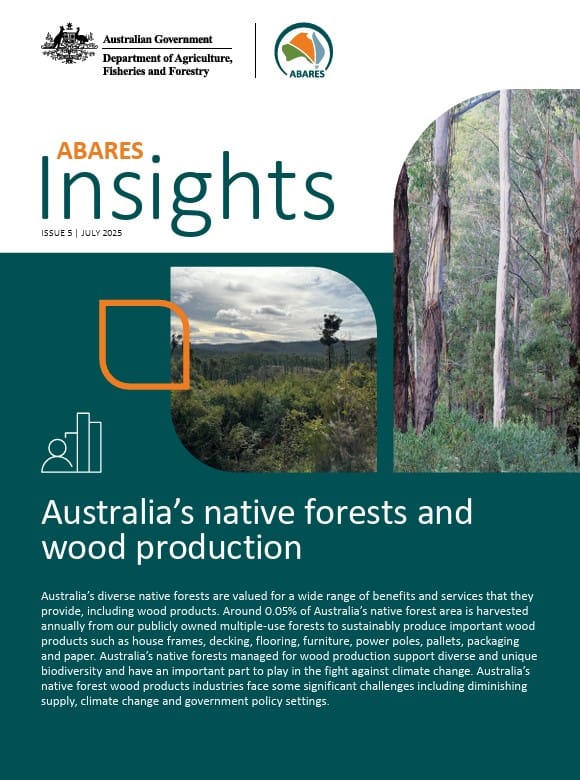
A new ABARES report, Australia’s native forests and wood production, highlights the important role Australia’s diverse native forests play in helping to combat climate change, providing a home to many flora and fauna species, and providing high quality wood products.
ABARES Executive Director Dr Jared Greenville said sustainable wood harvesting ensures the long-term productive capacity of forests is not compromised and long-term environmental values are upheld.
“Sustainably managed native forests and sustainable harvesting ensures that trees are regrown after harvesting, unlike deforestation,” Dr Greenville said.
“Between 2008 and 2021, Australia’s forest area increased by 2.8 million hectares, with most of this increase due to native forest regrowing and reduced first-time clearing.
“Around 0.05 per cent of Australia’s native forest area is sustainably harvested annually from our publicly owned multiple-use forests.
“This small proportion supports the creation of sustainably produced wood products that are used by Australians for residential construction, flooring, power poles, packaging and more.
“These wood products also help to combat climate change by offering a substitute for carbon-intensive products, such as concrete and steel.”
The report states that the total amount of carbon stored in Australia’s native forests in 2021 was 19,205 million tonnes, an increase of 27 million tonnes since 2016.
“Forests regrowing after harvesting absorb carbon, and carbon can potentially be stored in harvested wood products for many decades,” Dr Greenville said.
“Most sustainable wood harvesting uses selective techniques to identify single trees or small groups of trees for harvest. The remaining trees provide an ongoing source of food and a safe habitat for biodiversity, and a seed source for the regrowing forest.”
Read the report here: https://www.agriculture.gov.au/abares/products/insights/australia-native-forests-and-wood-production.

