

What began with an Ice Bucket Challenge aimed at Coles Yamba Manager Jack Gibb has turned into a powerful community fundraising effort for Motor Neurone Disease (MND).

Last Saturday, the Coles Yamba team hosted a packed trivia night at Yamba Bowling Club, attracting 198 guests across 33 tables and raising more than $3,500 on the night alone. Combined with months of in-store fundraising, the total has now surpassed $15,000.
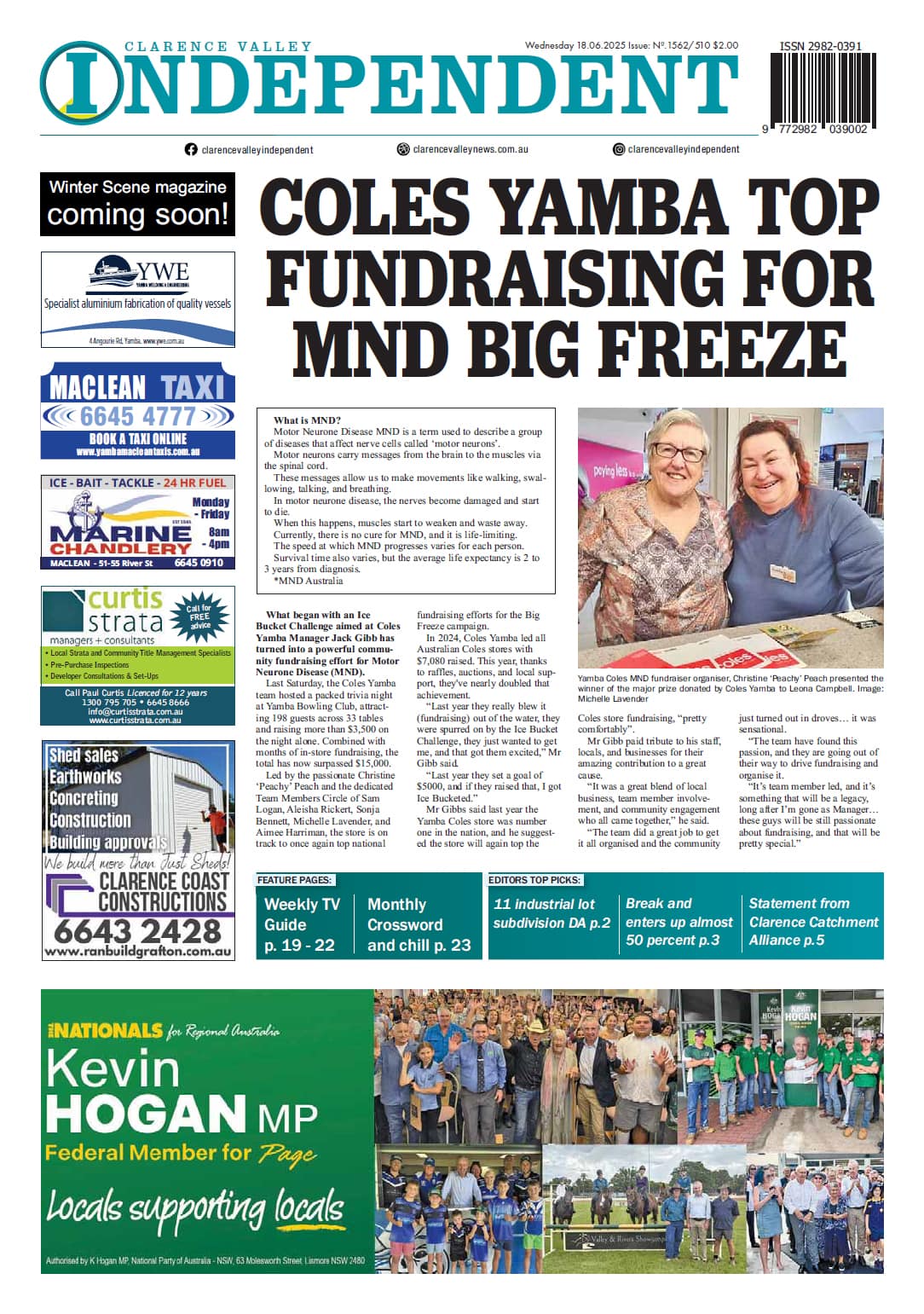
Led by the passionate Christine ‘Peachy’ Peach and the dedicated Team Members Circle of Sam Logan, Aleisha Rickert, Sonja Bennett, Michelle Lavender, and Aimee Harriman, the store is on track to once again top national fundraising efforts for the Big Freeze campaign.
In 2024, Coles Yamba led all Australian Coles stores with $7,080 raised. This year, thanks to raffles, auctions, and local support, they’ve nearly doubled that achievement.
“Last year they really blew it (fundraising) out of the water, they were spurred on by the Ice Bucket Challenge, they just wanted to get me, and that got them excited,” Mr Gibb said.
“Last year they set a goal of $5000, and if they raised that, I got Ice Bucketed.”
Mr Gibbs said last year the Yamba Coles store was number one in the nation, and he suggested the store will again top the Coles store fundraising, “pretty comfortably”.
Mr Gibb paid tribute to his staff, locals, and businesses for their amazing contribution to a great cause.
“It was a great blend of local business, team member involvement, and community engagement who all came together,” he said.
“The team did a great job to get it all organised and the community just turned out in droves… it was sensational.
“The team have found this passion, and they are going out of their way to drive fundraising and organise it.
“It’s team member led, and it’s something that will be a legacy, long after I’m gone as Manager…these guys will be still passionate about fundraising, and that will be pretty special.”
What is MND?
Motor Neurone Disease MND is a term used to describe a group of diseases that affect nerve cells called ‘motor neurons’.
Motor neurons carry messages from the brain to the muscles via the spinal cord.
These messages allow us to make movements like walking, swallowing, talking, and breathing.
In motor neurone disease, the nerves become damaged and start to die.
When this happens, muscles start to weaken and waste away.
Currently, there is no cure for MND, and it is life-limiting.
The speed at which MND progresses varies for each person.
Survival time also varies, but the average life expectancy is 2 to 3 years from diagnosis.
*MND Australia
This article appeared in the Clarence Valley Independent, 18 June 2025.

