In Part 1 of this column published last week, the writer reminisced about his early days of working among friendly African tribal people in East and Central Africa during the early 1950s when the locals still possessed their innocence and apparent joy for life. All this, however, was destined to severely change as soon as Mau Mau terrorists started to operate in the Colony of Kenya with the murder of both Black and White in mind.
As soon as I uncovered tangible evidence of the organised gangs of terrorists running rampant in Kenya, I immediately concluded that the formerly placid and highly relaxed tribespeople must have been politically stimulated by some unidentified outside forces.
After my subsequent arrival in Kenya from neighbouring Tanganyika, my investigations soon revealed that certain extreme left-wing political groups in Britain and Europe were using the ‘Cold War’ years to apply pressures on Kenya and on the rest of Africa to achieve freedom for all Black Africans from their White colonial administrators.
When I eventually managed to discover who exactly was responsible for this foreign intrusion from overseas, I hit on one man who was locally and directly responsible for the propaganda and arming of Kikuyu, Meru and Embu tribespeople with weapons to kill White farmers and any
The person in question was the new-style leader of the previously co-operative Kenya African National Union, an academic known as Jomo Kenyatta.
When I looked into his somewhat then hidden and dubious personal history, I found he had been quietly educated in Moscow at Soviet Russia’s terrorist training ground within the ‘University of the Toilers’ after spending some time at the London School of Economics and other left-leaning overseas institutions.
With this information, I was able to follow definite links to certain pro-Communist political groups in the United Kingdom and Europe whose bent was to support immediate political Independence in Africa.
My investigations revealed that these anti-colonialists were financing Kenyatta’s Mau Mau terrorists and, in cahoots with the Soviets, were starting to send White advisors disguised as migrants into Kenya and other African States to spread their message there.
These private political agents were quite obviously being used by the Soviet Russians who, due to the need to maintain a non-aggressive Cold War, refused to allow any Russian people to step foot within Africa’s coastlines.
The Soviets feared that their direct presence in Africa might encourage the Western Powers to defend the continent against any official Russian Communist calls for immediate State Independence and thus create another world war.
As Kenya’s Mau Mau campaign progressed, I soon found that the former African laid-back psyche had changed dramatically. Literally overnight, an inter-racial divide appeared, just as later happened in the rest of Africa where I also worked as a journalist and foreign correspondent.
Even though the advent of Mau Mau terrorism killed a very large number of Africans at the hands of people from their own and opposing tribes, most Kenyan Blacks quickly became less friendly and communicative. This led me to the conclusion that myriads of tribal drums must have sent out their bush message — as did the African drum-beating jungle ‘town criers’ of yesteryear.
Although the advent of Mau Mauism was initially mainly restricted to Kenya, I found the same sad state of inter-racial affairs when I travelled on assignment to other corners of the mighty African continent until many of the African countries had achieved Independence in the 1960s.
There is no doubt in my mind that the political force pervading Africa from outside was the first real opposition to British rule since London lost control of India in 1947 and was responsible for setting the rest of Africa alight with a pro-Communist mindset.
This was particularly the case in Apartheid South Africa where that now independent country is a member of the Communist- induced BRICS political and economic consortium and is currently home to Chinese and Russian military and naval interests.
I have not been to Africa in recent years and have been told that the people now living without any colonial influences have only regained half their initial pre-1950s friendly spirit to outsiders and are sadly being bothered by wars, economic problems and failing electric power supplies and essential services, to name a few.
I can only but hope that the original joy and friendliness of the Africa I initially experienced over 70 years ago will resurface one of these days from major world change.
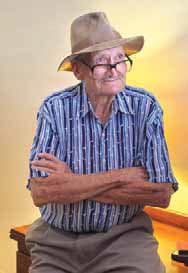
Yamba resident and former foreign correspondent Oscar Tamsen whose work around the world from the early 1950s saw him in Colonial Africa for nearly two decades as a working journalist. Oscar’s years in the ‘Dark Continent,’ as it was then known, had him travelling from Cairo to Cape Town, meeting some of the world’s top newsmakers of the time as well as participating in a number of wars and rebellions.
This article appeared in the Clarence Valley Independent, 28 May 2025.