


Cattle Australia (CA), Media Release, 9 May 2025
The Australian beef industry can play a positive role in the climate solution provided policy settings recognise the science of the biogenic carbon cycle, according to a leading international air quality specialist.
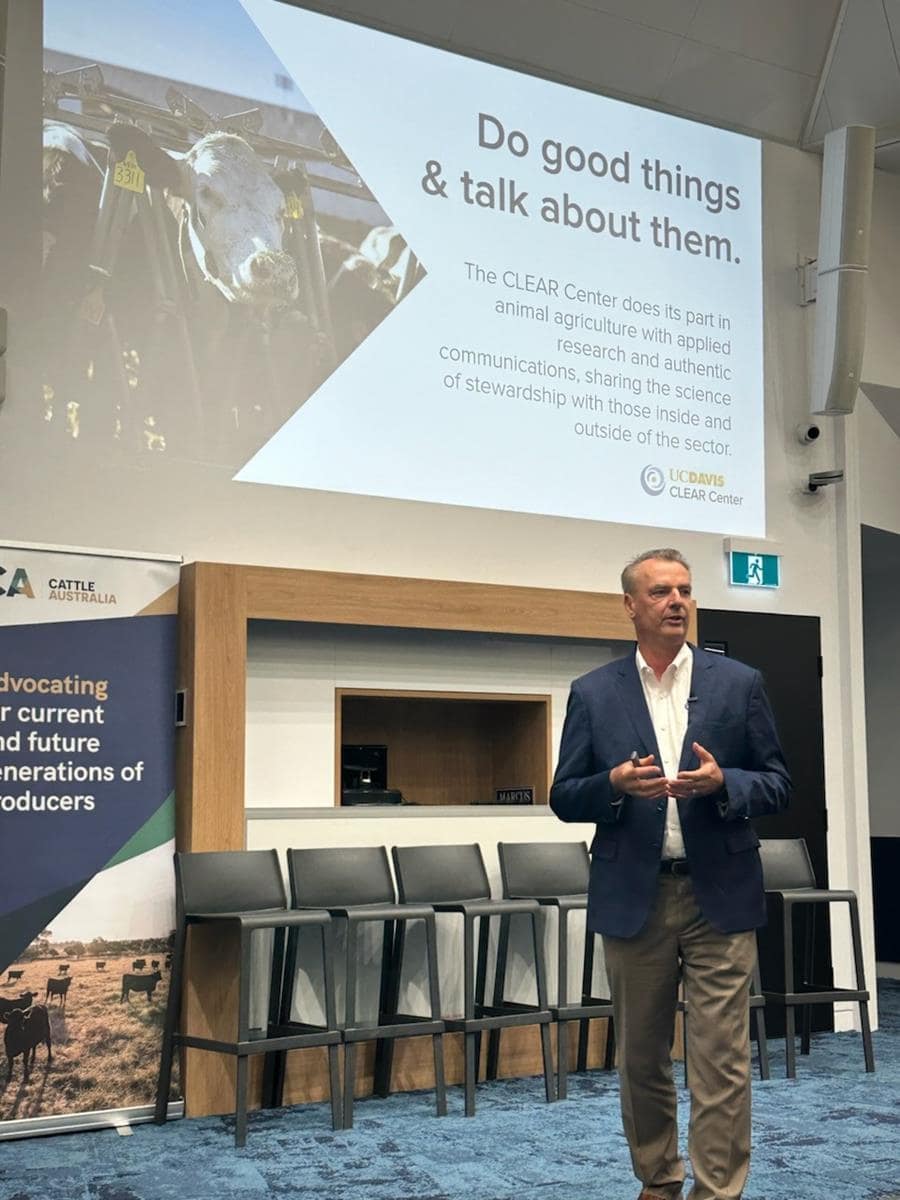
Professor Frank Mitloehner, of UC Davis in the United States, told today’s Cattle and Climate forum, organised by producer representative body Cattle Australia (CA), that while livestock do have an impact on our climate, the contribution of animal agriculture is often exaggerated at the expense of farmers and viable solutions.
He told the forum that high school students know that for plants to grow they need carbon dioxide, sunlight and water. Pastures absorb CO2 and store it as cellulose, which is consumed by livestock and then released back into the atmosphere as methane.
After 10 years, that methane is converted back into CO2 and the cycle starts again. As a result, methane levels remain relatively stable in the atmosphere if emission sources are stable, unlike CO2 emissions from the burning of fossil fuels that add carbon to the atmosphere.
“Methane warms our climate differently than CO2, which persists for hundreds of years, while methane warms for about a decade. Methane is more potent that CO2, but that also gives us an opportunity to quickly reduce warming,” Prof. Mitloehner said.
“If we continue to reduce methane emissions in livestock sectors, whether through better grazing and forage, genetics, or tools coming online such as feed additives, livestock can be part of a climate solution. There aren’t many sectors that can say that.”
More than 100 people participated either in person or online in CA’s Cattle and Climate forum, which was held at Marcus Oldham College Geelong, Vic, to connect producers and industry to discuss market opportunities connected to sustainability initiatives.
Rather than being wrongly cast as a climate villain, Prof. Mitloehner presented an opportunity for the livestock industry to be part of the climate solution.
“Farmers and graziers are stewards of the land and have been for generations. Stewardship is sometimes called sustainability, but regardless of the term, it’s part of the make-up of agriculture to manage the environment responsibly,” he said. “If we can reduce methane emissions from livestock, which we have, we can reduce warming by absorbing some of the excess greenhouse gases being emitted by industry.”
In California, an aggressive target was set for the dairy industry to reduce methane by 40 per centby 2030 – a goal it is on track to meet through the combination of herd improvement, manure digesters converting methane to energy, alternative manure management strategies and methane-mitigating feed additives.
“California decided to work with their farmers to reduce emissions by incentivising the adoption of climate tools,” Prof. Mitloehner said. “Taking the carrot versus the stick approach has made all the difference as the dairy sector is roughly two-thirds of the way to its methane reduction goal.”
Cattle Australia Chief Executive, Dr Chris Parker, urged politicians and activists to stop blaming burping cattle and embrace the beef industry as part of the climate solution.
“Australian cattle producers manage 50 per cent of Australia’s land mass which presents a massive opportunity to sequester emissions in natural sinks like our soils, but policy settings need to change to provide producers with both the tools and economic incentives to achieve this,” Dr Parker said.
“Firstly, the biogenic carbon cycle must be incorporated into Australia’s national carbon accounting systems so that graziers have the means to participate in carbon markets. We also need the Beef Herd Method, which accounts for improvements in grazing efficiency, to be reinstated by the Federal Government as soon as possible.”
About CA
CA is the national peak body for the grass-fed beef industry, providing a visible, unified, and influential voice for Australia’s 52,000 grass-fed cattle levy payers.
CA is responsible for developing and driving contemporary policy; guiding research, development, and adoption (RD&A) and marketing investment for the sector; and advocating on all matters important to the Australian beef industry.


I have always thought that any INCREASE in methane from cattle since around 1950/ 60 from increased ruminant numbers, is an issue for CC, not just total emissions. Therefore the question is have ruminant numbers in Australia increased since that time? If so that change is contributing to current CC, just as excessive use of fossil fuels for our ever increasing living standards and consumer driven society are, and methane from coal mines etc. We all need to share appropriate load, and not as a rural industry blamed excessively for more than our fair share.