Isabelle Flett, The Buloke Times
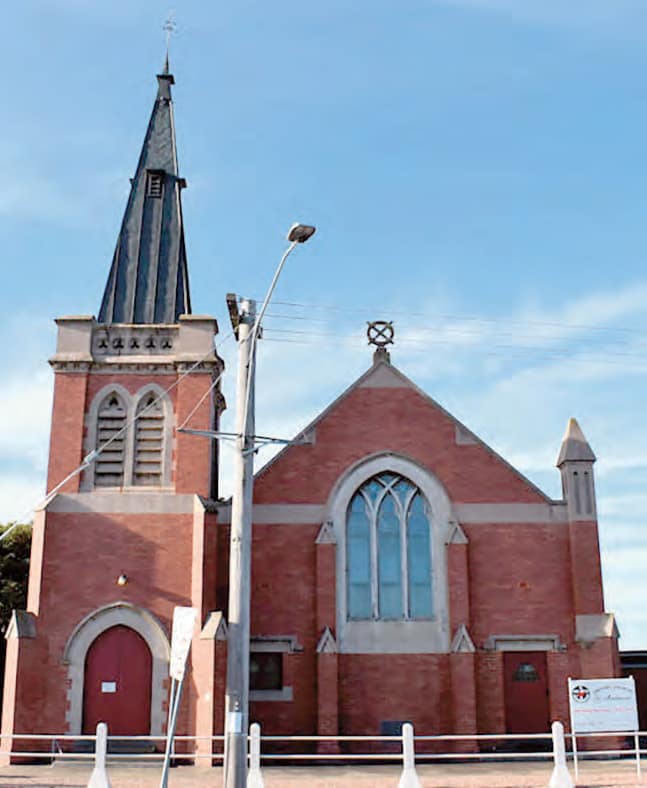
Today as we celebrate the official opening of this building 100 years ago on the 19th of March, 1925, we give thanks for the faith and foresight of that early Presbyterian congregation.
But, more than that, we celebrate the early settlers who saw the need 52 years before, to call the Rev. Hugh McKail in 1862 to minister to the pastoralists and their employees of the St. Arnaud-Richardson River area.
Almost three years later the first manse, “The Willows”, made of pine logs, was built on the west bank of the river for the Rev. McKait who had lived at first at St. Arnaud, and then at times, on station properties until the manse was ready. Fortnightly services were held there.
The land had been given by the Aitken family of Banyenong.
Site reserved
In 1870, during the 2-year ministry of the Rev. George Tait, who was ordained at Donald, a site was reserved, and in July 1872, shortly before he left, a foundation stone was laid for the first St Andrew’s Presbyterian church in Donald. Just 5 months later the building was officially opened on December 15th. Built by J. A. Meyer for the contract price of 535 pounds 10 shillings, this was the first church of any denomination in Donald, when the town consisted of only a blacksmith’s shop, a store and a hotel. James Aitken, Thomas Guthrie and J.A. Meyer were part of the building committee.
In later years Rev. Tait played an important role in the extension of the Victorian church as Home Missions Superintendent. The Rev. Kennedy followed in 1873 and his wife commenced a Sunday school at “The Willows”.
Three years later in 1876 St. Arnaud became a separate Charge.
With the land now open for selection, the population grew rapidly and with it the desire for a regular place of worship.
Laen Church
At Laen, John and James Flett together with A. and J. Adams were instrumental in building a church and had travelled to the Bolangum Ranges to fell trees for the timber. In September 1875, the Presbyterian congregation opened the Laen Church debt free. This was demolished in 1902 and they then joined with those further north. Meanwhile at North Laen, services were held in a building given by George Pyers in the early 1880s and later, in 1891, moving to a new site given by W. Coates, a new church was opened, costing 175 pounds.
Rev. Swan’s ministry from 1877 was followed in 1885 by Rev. Donald Cameron who also was ordained at Donald. He and his wife were the first to occupy the new manse beside the church, which served the church for 70 years before being demolished in 1955. After 2 years Mr Cameron left to become Convener of the Home Missions.
Over the following decade most ministries were short terms until 1898 with Rev Shallburg staying 8 years, during which time the Cope Cope church was built. Early services had been held in the home of James Harvey and later in the Church of England until their new church was built in 1902. The names of Gilmour, Bugge, McClelland, Crosbie, Scott and Harvey were the building committee.
In 1912 during the ministry of the Rev. John Walker, the first thoughts of a new larger church bega, which became well advanced during the Rev Scarfe’s ministry. A missionary was also employed. Services were held in the Laen hall, the school at Lawler, as well as the regular services at Donald, North Laen and Cope Cope.
Foundation stone
The Rev K.C. Billinge, arriving in 1923, saw the efforts of the congregation rewarded, with the laying of the foundation stone of the new church on February 23, 1924, by Senator J. F. Guthrie. This stone had been presented by Mr and Mrs W.H. Gray. Then on March 19, 1925, the new church was officially opened at a cost of 5000 pounds, which included the furnishings. Many of the parishioners’ gifts were noted with plaques. Moderator of the Maryborough Presbytery, the Rev, Fiddian, handed the door key to Mrs Gray and the bell was rung. Built by B.M. Bassett, it seated 300 people. The “Donald Times” described it as being of red brick… a handsome addition to the town… with an imposing spire covered with sheet copper… total height being over eighty feet, including the weathercock… the main body of the church built in the traditional form of a cross…….pews and pulpit consist of pacific maple.
Glass windows
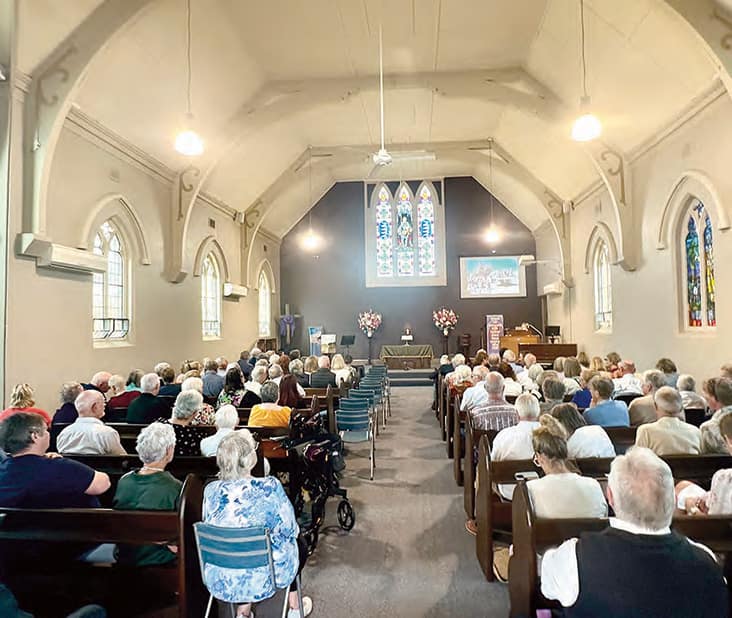
The following Sunday the Memorial stain glass window and honour board were unveiled and dedicated by the Rev. Donald Cameron. The window depicts a Knight bearing the shield of faith. Side panels bear the inscriptions “ Fight the good fight of faith” and “Endure hardness as a good soldier of Christ”
And now, 100 years later we have seen many changes. The Rev. Langhorne, The Rev. John Shaw (who baptised my late husband Ray) and the Rev. Stanley Thompson followed. Then in 1948 the Rev. H.V. Jenkin began a 14 year ministry. This was a boom time in our congregation. Young families prevailed. Regular full capacity attendances, with 160 children on the Sunday school roll and a staff of 24 teachers. This growth led to serious overcrowding for the children. Besides the old church being used as the hall, classes were in the tennis shed, and the old stable. This was a little old shed near the back fence used in the horse days. Over 40 children were crammed in there with Misses Clem Pope, Alice Flett, and Janice McArthur on Sundays.
In 1955 a new manse was built, and the following year a new church at North Laen replaced the old one. In 1959-60 church furniture was rearranged with the pulpit repositioned, new elders chairs and new carpet added, and a new organ given in memory of elder, Alan Dunn who tragically was killed in a tractor accident.
With the rearrangement of boundaries in 1958, the Maryborough Presbytery ceased to exist, with Donald and St. Arnaud rejoining the Wimmera Presbytery.
The old manse site was cleared and a building fund was begun. Rev. Robert Maclachlan arrived in 1962 and soon after plans for new buildings were drawn up. A tender for 17000 pounds was received. Deciding to build in 2 stages and to be named the Christian Education Centre, the hall, cloak room, kitchen and toilet block were built first, by Mr. Harold McClelland, and opened and dedicated on the 14th March, 1965. Six months earlier Miss Clem Pope had laid the foundation stone.
The following year the Cope Cope church was closed and moved to Metcalf where it was rededicated.
The final stage with the kindergarten, storeroom and meeting rooms were opened in memory of Miss Pope in 1968. A fitting tribute to a loved kindergarten leader who had taught at Cope Cope for 14 years and then at Donald for 20 years until 1965.
The following May, a new stained glass window given in memory of Thomas and Catherine Guthrie, parents of the late Oliver Guthrie was received and dedicated.
The original church was dismantled in 1967 shortly after Rey. I.N. Whyte arrived and the site marked where the original foundation stone is now placed. There was great jubilation when a time capsule with papers and 1872 information was found.
In 1971 a bookcase and cupboard set in the entrance porch was gifted in memory of Mr Charles Richards, former elder at Watchem and later Donald. Late in 1972, Rev. Stan Fishley’s ministry began following the sad passing of Rev. Whyte in February.
Miss Joyce Laing, in 1973, at North Laen, became the first lady elder to be elected in this parish. The Uniting Church of Australia began on the 22nd June, 1977, with the coming together of the Congregational Union in Australia, and the Methodist and Presbyterian Churches of Australia. The former Methodist minister Rev. lan Porter and Rev. Fishley shared the ministry and the congregation continued to meet in both buildings until eventually settling at St. Andrew’s. In 1981 commemorative plaques were placed at the sites of the former district churches. Rev. Laurel Davey, our first female Minister who came in the drought year of 1982, led the service with the Rev. Porter at the closing of the Methodist buildings in 1986.
In 1983 major repairs were made to the memorial stained glass window which had started to buckle.
In 1989 when Rev. Roy Westaway arrived, plans to enlarge the kitchen and add a toilet for the disabled were being made, and then officially opened in 1991 by the Victorian Moderator Rev. Kerrie Graham. A bequest enabled a new piano and clavinova to be purchased and later a sound system in the church. New carpet and pew cushions were added. Next came Rev. Stan Clark for 6 months until Rev. Malcolm Hay’s ministry began in 1998, until his retirement in July, 2003.
Margaret Russell followed as a Pastor and was ordained at Donald in 2008.
Re-opening
When the congregation decided to make the church more easily accessible, the major renovations uncovered extensive white ant damage and a front wall leaning out, which was able then to be corrected. The floor was levelled and the inside turned around. It was officially re-opened by the President of the Uniting Church, Rev. Alistair McCrae on 13th September, 2009. With the removal of some large pews replaced by single arm chairs, the church can no longer seat 300 people. The rest of the complex was also upgraded at that time.
The very community minded 10-year ministry of Rev. Margaret and husband John closed with retirement early 2014. During their time, Margaret and John and our lay people began to minister to surrounding towns of St. Arnaud, Stuart Mill, Wycheproof and Birchip. This resulted in the formation of the North Central Living Waters Cluster and a move into the Loddon Mallee Presbytery from the Presbytery of Western Victoria.
In October 2016 Rev. David Thompson became the first minister for the new Cluster, retiring 3 years later, just prior to the Covid restrictions. Since then, with help from Presbytery, we have continued without a minister in placement.
Special times
Over the century and before, christenings, confirmations, weddings and funeral services have been special times in the lives of many. Sunday school, picnics, walk-a-thons to Jeffcott for the Bible society, concerts, fellowship groups, youth groups, catering and working bees bring happy memories.
And always central has been the nurturing of the Christian faith, which inspired some to become ministers and others to serve the wider church both here and overseas.
The bricks and mortar of this century-old building have seen many come and go, but always the true church is the people who gather in worship, encouraging and supporting each other, and who serve our community in the name of Christ.
See all the pictures in the issue.
This article appeared in The Buloke Times, 28 March 2025.