

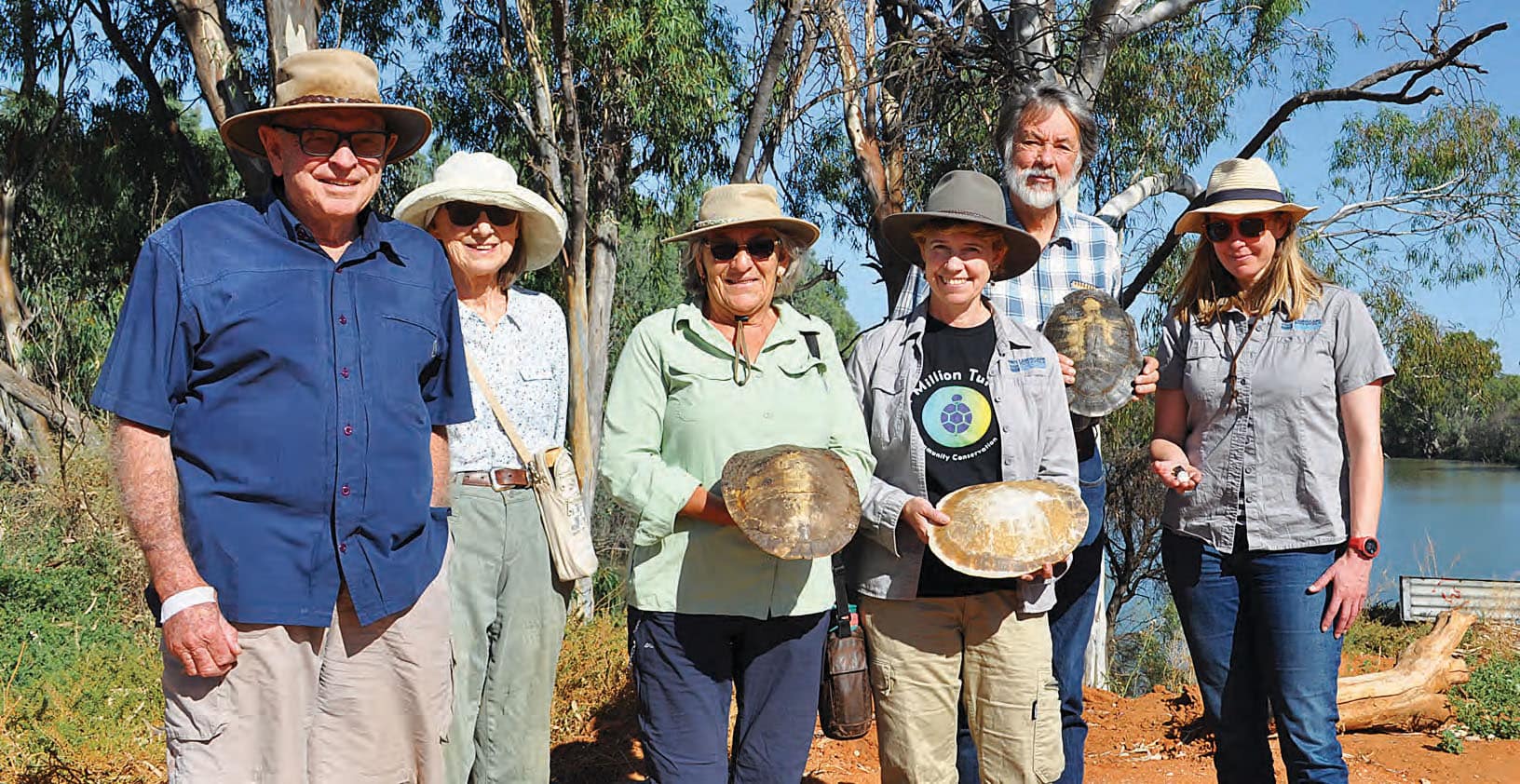
Madison Eastmond, Murray Pioneer
The Murraylands and Riverland Landscape Board (MRLB) has been awarded State Government funding to understand the serious decline in the local population of freshwater turtles along the Murray.
The Together Understanding Restoring Turtles in our Landscapes and Ecosystems (TURTLE) Project has been granted $450,000, from a $4.76m State Government initiative to aid a number of landscape projects across the region as part of the 2024-25 round of the Landscape Priorities Fund.
“Our state’s landscape boards are often the organisations which can make impactful on-ground changes across both public and private land in their regions,” Minister for Climate, Environment and Water Susan Close said.
“These funds help the boards to undertake projects that could otherwise be beyond their usual resourcing.
“All of the work that is funded through this program is vital for helping to protect our precious natural environment and biodiversity.”
Also, being carried out in the Hills and Fleurieu, Limestone Coast and Northern, and Yorke as a multi-region intuitive, the TURTLE Project is a collaborative effort of landscape boards, First Nations, citizen scientists, NGOs, councils and landholders to gather information to guide the protection of freshwater turtles across South Australia.
Meeting The Murray Pioneer at a Murtho Turtle Nest survey earlier this month, MRLB senior project officer citizen science and community engagement Sylvia Clarke said funding for TURTLE project has helped to continue priority on-ground action and develop a management plan of conservation of the three vulnerable Murray River turtles: the broad-shell, short-neck, and long-neck.
“We had funding and undertook the 1 million Turtles project the past three years, where (the MRLB) was able to undertake research and collect more information about the decline of turtles,” she said.
“However, this is quite a large problem which needs more time and […] efforts to find out more information — currently we are still trying to get a handle on their population numbers and how many juvenile turtles are making it from the nest to the water.”
Researching and raising awareness for the plight of turtles for much of his career, University of Sydney emeritus professor in zoology Mike Thompson said predictions of a dangerous decline of turtles he made in the 80s after sampling the Barmera population, “were now sadly coming true”.
“I had gone out and sampled all the turtles, and they were nearly all adults,” he said.
“What we have found (in a Victorian study) is that over the last 30 years, long-necks — which are the most widespread turtle in Australia — has declined on average by 90 per cent, the short-necks have declined by 69 per cent, and the broad shell has (remained threatened).
“Now undertaking a rapid survey along the River Murray, we have found that those numbers are worse in South Australia, and the further downstream you go the worse it gets.
“So, South Australia is in big trouble.”
Labelling foxes as a major predator of turtle nests, as they dig up the eggs with an almost 100 per cent success rate each time, Mr Thompson said community attended nest surveys made available through the funding are key to gaining for continued conservation.
“Through turtle surveys, and finding dug up nests, we are able to see where turtle nesting hot spots are,” he said.
“The best management options can be undertaken, such as predator fences.
“If you see a disturbed nest — the shells left above ground are the obvious signifier — I really encourage local people to lodge the information in the app TurtleSAT — we don’t have much information between Waikerie and Morgan so we would love to fill that gap.”
For more information on TurtleSAT, visit the website (www.turtlesat.org.au/turtlesat/).
This article appeared in Murray Pioneer, 26 February 2025.

