


Australian Bureau of Agricultural and Resource Economics and Sciences (ABARES), Media Release, 24 February 2025
Agriculture, fisheries and forestry is well placed to take on future challenges and opportunities, according to the latest ABARES Snapshot of Australian agriculture.
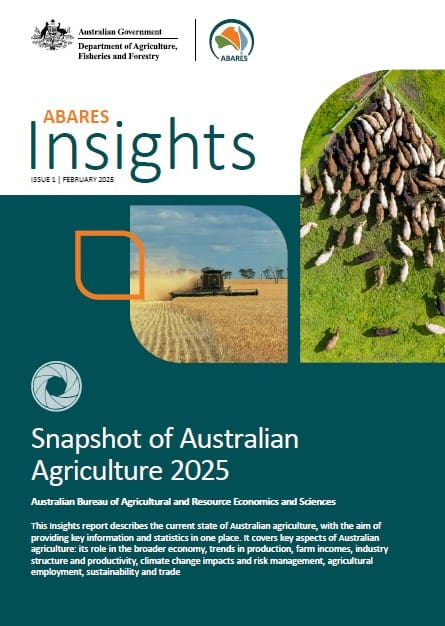
Sector value and production have continued to grow over the past 20 years with another strong performance expected in 2024-25.
ABARES Executive Director Dr Jared Greenville said the sector was looking resilient.
“The agriculture, fisheries and forestry industries are in a good position to respond to the challenges of climate variability, slowing productivity and global trade uncertainty,” Dr Greenville said.
“The past 20 years have shown us that one of the main reasons for this success is the industry is flexible and responsive. Our farmers have been quick to change their practices for what consumers want and what the market is doing.
“Gross value of agricultural production has increased by 34 per cent in the past 20 years from $61.5 billion in 2004–05 to $82.4 billion in 2023–24.
“When we include fisheries and forestry, the total value of production has increased by 30 per cent in the same 20-year period from approximately $67.7 billion to $88.3 billion.
“We also see strong growth in our exports. Last financial year, Australian agricultural, fisheries and forestry exports were valued at $75.6 billion.
“Employment in the sector has also been increasing. Australian agriculture employed 274,900 people on average over the four quarters to November 2024, up 6.7 per cent from the previous year.
“We saw average cash incomes for broadacre and dairy farms over the 3 years to 2023–24 were well above the averages for the previous 10 years, albeit with differences across the sectors. This reflects the record incomes recorded in most industries in 2021–22 following good seasonal conditions and high commodity prices, however, recently sheep specialists have seen below average incomes.
“Global interest in emissions and sustainability is growing. Australian agriculture has strong sustainability credentials. The sector’s chemical and fertiliser use is at world best practice levels. Australia also has remarkably low on-farm emissions per unit of agricultural output.”
Australian agriculture has benefited from five decades of sustained productivity growth. However, since 2000, broadacre farm productivity growth has slowed up and there is more volatility. Productivity growth will remain important for the sector to compete in international markets where competition is high and prices can quickly change.
“It’s a reminder to not get complacent. We need to make sure policy encourages competitiveness, investment is going to research and development, and the sector stays responsive to changes in the market,” Dr Greenville said.
To read the full report go to https://www.agriculture.gov.au/abares/products/insights/snapshot-of-australian-agriculture.
ABARES’s Outlook 2025 conference is on 4-5 March. For more details about the program, speakers and registration, visit ABARES Outlook Conference 2025 – DAFF.

