Rachel Hagan, Yorke Peninsula Country Times
The exciting news Coobowie residents have been waiting for is finally here with their precious osprey pair hatching not two, but four chicks on the town’s community-made nesting platform.
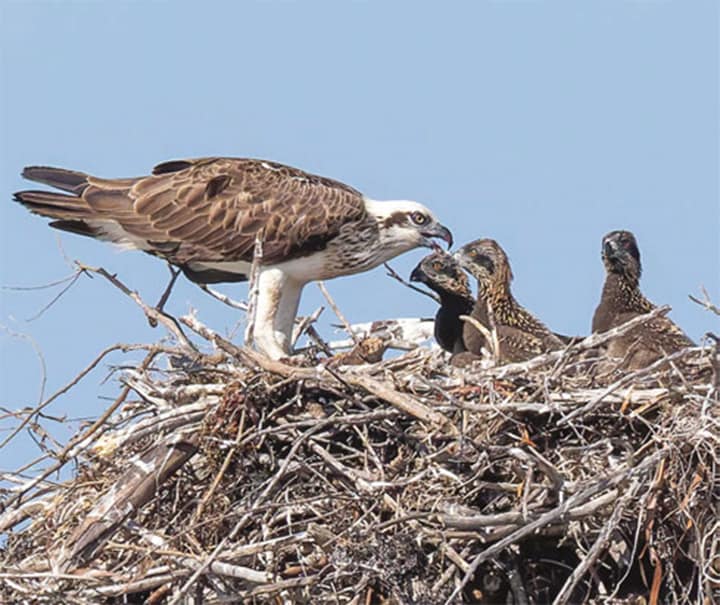
About two weeks ago, little osprey heads were seen bobbing up and down in the nest, which has caused bird enthusiasts to flock to Coobowie.
South Australian raptor expert Ian Falkenberg said it was rare for ospreys to lay four eggs in a season.
“It is almost certain that the last one hatched will probably not make it, but if we get three young off that nest, it would be an absolutely fantastic result,” Mr Falkenberg said.
Osprey chicks do not hatch at the same time, often two days apart, with the strongest and healthiest hatching first, giving them a big head start on their siblings.
“It’s the law of the jungle in that nest, the parents will invest in the strongest birds,” he said.
The oldest chick would nearly be double the size of the last one when it hatched, and female chicks are already 10 to 15 per cent bigger than the male chicks, Mr Falkenberg said.
“Birds of prey, you can almost see them growing day by day if there was a camera on the nest.”
During their first few weeks of life, ospreys grow fast and will reach the size of their parents in four to five weeks.
“The smallest young, and that would be the last one to hatch, won’t have the begging power to get the food it requires,” Mr Falkenberg said.
“Adults don’t give food equally to all young, and it really depends on the begging of those young.
“The more they call, the more food they get.”
Mr Falkenberg said he thought the chicks would be ready to take flight by about the end of November, and it was vital to keep humans away because there were plenty of predators, such as pacific gulls, waiting for an opportune moment to snatch a chick.
Before the chicks fledge, Mr Falkenberg said he planned to attach a satellite tracker to one of the males, so more could be discovered about what they do around the coast and where they find the most suitable habitats.
“We really want to try and target more males because generally we’ve had a higher mortality rate for females,” he said.
“Males seem to select habitats a bit more quickly and are critical to selecting the breeding nest.”
Unlike males, young female ospreys disconnect from their parents and fly longer distances.
“It’s very sad; on average with the birds that have satellite trackers, about 50 per cent of them are subject to mortalities,” he said.
“It is a combination of inland flights, electrocution from power lines and also fox predation.”
Mr Falkenberg said life is tough out there for ospreys, but they had some good news with one of the chicks born at Wills Creek in 2023.
Thanks to a satellite tracker, it has regularly been seen at an empty platform in Port Broughton.

This article appeared in Yorke Peninsula Country Times, 22 October 2024.