

Stories behind the General Sir Harry Chauvel Foundation’s
Chauvel Border Light Horse Trail
Honor Auchinleck, Corryong Courier
“Why wasn’t this done years ago? We need to get the Light Horse Trail into our schools,” someone said as we delivered Chauvel Border Light Horse Trail brochures to the Visitor Information Centre in Gundagai. The initial responses to the trail have been a measure of how well it is being received.
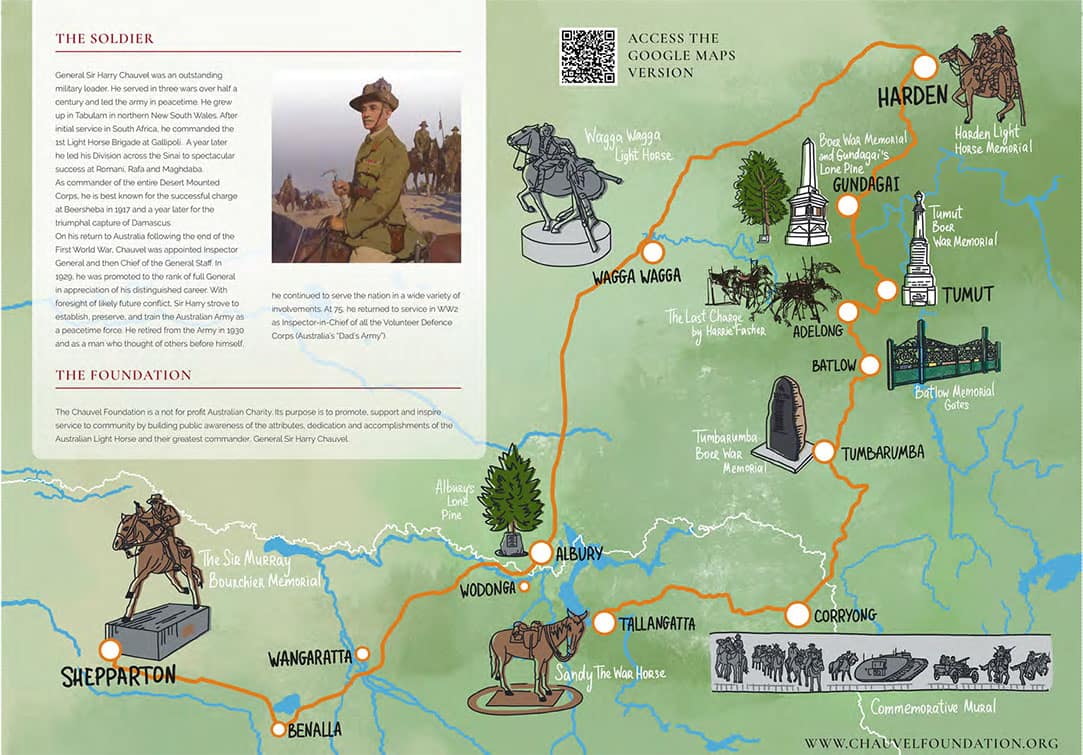
On Gundagai’s fine memorial is the name Sergeant Major G A Griffin, the first Australian killed in action in the Boer War. With a Lone Pine and the memorials in Anzac Park, Gundagai is central on the Light Horse Trail and in the Hilltops local government area.
The Hilltops district encompasses the heartland of rich light horse history with the First Light Horse Regiment and early recruits coming from the hinterlands of the twin towns of Harden-Murrumburrah. Harden-Murrumburrah have poignant memorials with Gundagai marking the point where the Chauvel Border Light Horse Trail turns south towards Adelong, Tumut, Tumbarumba and the border towns of the Upper Murray.
The Trail runs from the Light Horse Memorial in the New South Wales regional capital of Wagga Wagga to the statue of Brigadier Murray Bourchier CMG DSO in Victoria’s regional capital of Shepparton. The trail follows the road winding through the hills and along the spectacular valleys of the foothills of The Great Dividing Range on the border of New South Wales and Victoria.
It passes through the apple orchards between Tumut and Batlow and the Tumbarumba vineyards. Perhaps one day someone will tell me about the descendants of light horsemen who work in the orchards and the vineyards. There might be some among them who ride in Tumbarumba’s New Year’s Day Rodeo.
The Southern Cloud Memorial at Maragle has one of the best High Country views, particularly when snow lies on the mountains in winter. It is from these mountains that some of the brumbies were mustered and sold as remounts for the Light Horse and the British Army in India.
Along the entire length of the trail there are still stories to be told.
Fine Boer War or South African war memorials in towns such as Gundagai, Tumut and Tumbarumba and in villages such as Cudgewa, remind us that the legacy of service to the nation had early beginnings.
Its roots gained strength among those who served in the Boer War in the Mounted Infantry Regiments, the forerunners of the Light Horse regiments.
The Border Light Horse Trail has had a long germination since the seed was sown in 2018. That year Corryong College teacher Stephen Learmonth and his Year 5 and 6 classes wrote and published to local acclaim, the biographies of 57 Upper Murray Light Horsemen.
Between Christmas and New Year 2019-20 the Black Summer bushfires devastated the Upper Murray before the pandemic locked everyone down.
Rainy days during lockdown saw the Border Light Horse Trail grow from maps and a collection of photographs of memorials. On the map, members of the Chauvel Foundation followed the routes of men who enlisted in the Light Horse and carried the independent, resilient and resourceful spirit of the bush to the First World War. During their service and on their return in 1919, these men contributed the Light Horse story to the spirit of Anzac which still burns strongly today.
A trail provided a fitting way to commemorate Light Horsemen from the border area who left home to serve their country and their communities. General Sir Harry Chauvel, who had commanded many Light Horsemen in the Desert Mounted Corps, said that he received honours and awards on behalf of the men who did the job. The trail is a memorial to these Light Horsemen and also to others serving on the Western Front and in other theatres of war.
Behind the trail are the stories and memories of those who contributed their service and returned home to work and contributed in their communities. There are also those who didn’t return. Some of these stories can be found on the General Sir Harry Chauvel Foundation’s website’s Online Anthology. The anthology welcomes stories that have never been told before and as well as lesser known stories. Visit www.chauvelfoundation.org
Two former commanding officers of the 4th/19th Light Horse Regiment – Lieutenant Colonels John Boyce and Tony Stevens – have picked up the concept and developed it into a brochure for distribution to the Visitor Information Centres, newsagencies and local history museums along the trail. The foundation hopes that the Chauvel Border Light Horse Trail is the first of many.
In 2018 Stephen Learmonth and his students were not to know that they were sowing seeds for a wider, cross-generational educational initiative encouraging the preservation of history and linking like-minded people.
The Border Light Horse Trail links to a plethora of other trails, such as the Cudgewa Rail Trail and Snowy Valleys Sculpture Trail, thus providing a rich variety of experiences for visitors to the Victorian and New South Wales border and beyond.
Parts of the Silo Art Trail are easily accessed from the Chauvel Border Light Horse Trail. Visit https://www.australiansiloarttrail.com.
The trail seeks to highlight the historic fabric in local communities, demonstrating the role returned Light Horsemen have played in local, state and national government and the development of the agricultural and racing industries.
Born in 1859, just six years before General Sir Harry Chauvel, Major General James A K Mackay had been too old to serve in WWI. In the late 19th century he represented the electorate of Boroowa in the NSW Legislative Assembly. After Federation in 1901, as one of Chauvel’s predecessors, Major General Mackay went on to command the 1st Light Horse Brigade and supervised the re-organisation of the 3rd Light Horse Brigade in the first decade of the 20th century.
In September 2019 a memorial statue of Major General Mackay was unveiled in Harden-Murrumburrah, standing alongside the sculpture of war horse ‘Bill the Bastard’ by Carl Valerius.
Memorialised in bronze by Paul Smits and Ewan Coates, Brigadier Sir Murray Bourchier is another Light Horseman who went on to serve his community in the political arena. Other Light Horsemen who turned to politics were Lieutenant Colonel Sir Michael Bruxner KBE, DSO, JP and Sir Wilfrid Kent Hughes KBE, MVO, MC; the latter being distinguished by service in both World Wars.
Perhaps the best-known First World War Light Horseman to serve in politics was Major General Sir Granville de Laune Ryrie KCMG CB VD.
The foundation’s online anthology also welcomes stories about Light Horsemen who went on to serve their communities in different capacities.
The foundation sees Light Horse Trails as highlighting and opening the door to the spirit of Anzac with its legacy of service, courage, bravery, mateship, resilience, resourcefulness and loyalty in regional communities. The aspiration is for those who follow the trails to travel through the countryside and towns from which the Light Horsemen came.
Trail brings history alive
The foundation hopes that the trail will be a catalyst for some of the communities to bring to light the lesser-known stories of their forefathers who served as mounted troops.
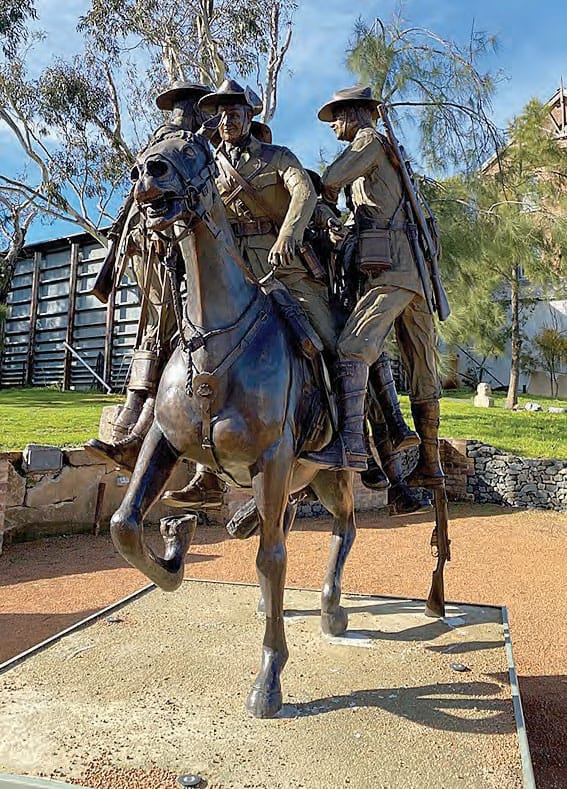
The Border Light Horse Trail provides opportunities for conversations and as a focus for local schools.
The trails will also engender a sense of wellbeing and to enable people to witness how talented commemorative artists and sculptors bring local history alive in a way where on occasions traditional education fails.
Most of the trail visitors will drive between the memorials. Others might ride bicycles along shorter stretches, for example along the rail trail between Cudgewa and Tallangatta. The Murray Valley Highway and the Rail Trail follow more or less the route along which the Remounts were brought from the Upper Murray. After the outbreak of WWI, men rode the same route to enlist in Tallangatta before catching the train to Melbourne.
As a measure of its ability to inspire, I understand experienced rider and Light Horse re-enactor Pat Leary and seven other horsemen plan to ride the 700km route of the Chauvel Border Trail beginning in Shepparton in March, 2025 (the 80th anniversary of General Sir Harry Chauvel’s death) and finishing on April 16th (the 160th anniversary of Chauvel’s birth) in Tallangatta. Rather than following stretches of the Hume freeway, the commemorative group plans to take some of the back roads, visiting some of the small towns and schools before rejoining the main trail.
Chauvel Foundation Ambassador, Dr Anne Flood in Wagga Wagga, is creating a Riverina Light Horse Trail.
There are possibilities for a trail beginning from the Shrine of Remembrance in Mel-bourne and for the Seymour district which includes Puckapunyal, now home to the Light Horse successor, the Royal Australian Armoured Corps. A Light Horse Trail in Canberra is under development.
While the Chauvel Border Trail has aspirations for its community impact, there is a limit to the number of memorials that can be included in a brochure. Those wanting to highlight other memorials and sites of Light Horse significance should contact the General Sir Harry Chauvel Foundation with stories and photographs. The foundation is keen to include these stories in its online anthology.
Visit www.chauvel foundation.org for guidelines.

This article appeared in the Corryong Courier, 10 October 2024.

