

Hugh Schuitemaker, Murray Pioneer
The sustainability of Riverland horticulture is being pressured by “unavoidable” increases to electricity costs, according to numerous local business figures.
The Advertiser reported on Monday a number of notable Riverland businesses were struggling with “surging power bills”.
Nippy’s joint managing director Ben Knispel said costs had increased despite attempts to use less electricity.
It is understood Nippy’s was invoiced $51,600 last June, for 260,073kw/h of electricity use at its Moorook plant.
However, this month the company’s invoice was $109,580.10 – including almost $34,350 of market or network charges – despite using almost 6200 less kilowatt hours. Nippy’s has also invested almost $1m on solar panels, energy efficient lighting and special pump equipment.
“It just would be nice if we had reliable power 24 hours a day and grid stability because it’s a mess,” Mr Knispel said.
“It’s just so frustrating doing the right thing, trying to reduce our footprint.
“But it’s all over the place. We’re growing and we’re doing ok, but we will have energy price increases, sadly, and we can’t absorb these costs forever.”
Century Orchards chief executive officer Brendan Sidhu was recently misquoted in the media as saying his annual electricity bill has skyrocketed to $100,000 per annum, when this figure was actually for his monthly bill.
Century Orchards’ annual bill is now well over $1m, which has increased from about $700,000 two years ago.
Another prominent local almond and wine grape grower, who spoke to the Pioneer on condition of anonymity, comes out of contract in December 2025 and has been told to lock in a ‘forward contract’ before prices hike even further, but at best needs to expect a 60 per cent increase in power costs.
This would take his annual costs from $400,000 to almost $700,000. The grower was told South Australia is heavily reliant on expensive gas power, especially when renewables like wind and solar are unable to supply the grid.
“Some growers are simply not able to offset their power costs with solar due to proximity to the grid, or lack thereof, so for some the rising costs are totally unavoidable,” the grower said.
Chaffey MP Tim Whetstone said Riverland horticultural production required high electricity inputs.
“We are a high-energy user in the Riverland,” Mr Whetstone said. “We have to lift water, harvest fruit, process fruit and keep it cold. Where we’ve got manufacturing… these are significant costs that have been absorbed by these Riverland businesses.
“We are an exporting region, we grow everything for an export market and what doesn’t go to exports goes to the domestic market.”
Mr Whetstone said increases in business costs would eventually impact local consumers.
“It has been a serious burden on day-today cost of living, that’s impacting on the individual’s cost of running a business,” he said.
“The headline number at the moment is the cost of power, because it now is a significant part in the cost of producing world-class food.
“The cost of doing business in South Australia is at the point now where businesses are shutting on weekends”¦ because of the cost of power, and it really does highlight the lack of respect (that) our primary producers deserve.
“At some point in time, that cost has to be reflected and passed on to the consumer.”
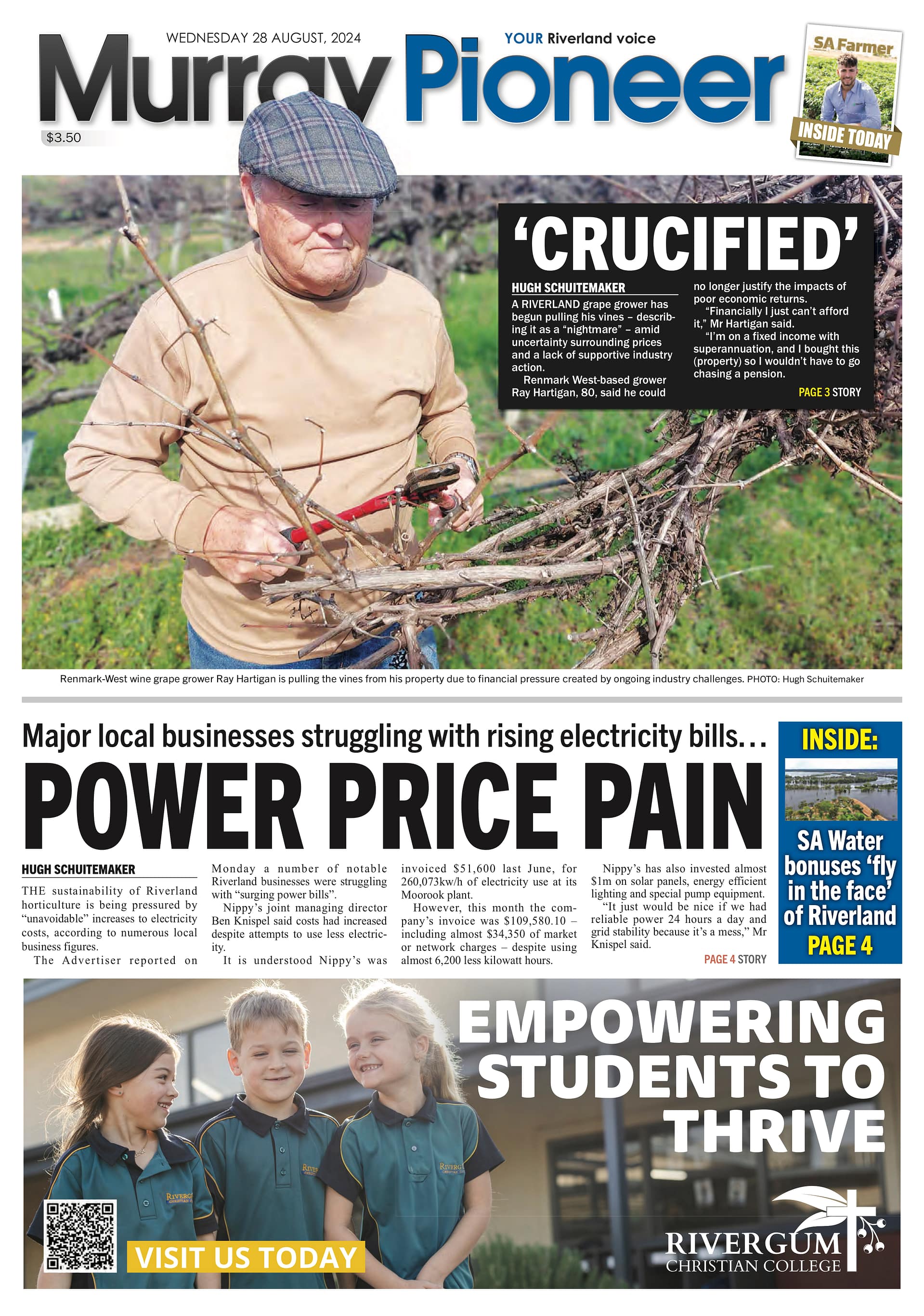
This article appeared in the Murray Pioneer, 28 August 2024.
