As part of a Connecting Country event held last Sunday, Mulga Urban Landcare (MULGA) Secretary Bev Phillips took a group of Landcare colleagues on a tour of some of Maldon’s oldest trees. This included trees located at the Bill Woodfull Recreation Reserve, the Police Reserve and Maldon Primary School.
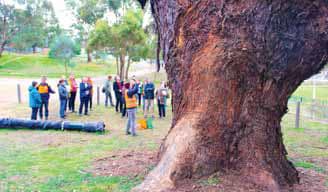
In terms of age, Maldon’s historic streetscape pales into insignificance with these eucalypts – the oldest one, which grows on Parks Victoria land, is estimated to be around 645 years old. These trees pre-date European settlement and are truly living treasures!
Over the past 15 years, MULGA has done extensive work mapping the old eucalypts and estimating their age. These trees grow incredibly slowly, at a rate of around 3.5mm a year across their diameter. This means that an indigenous eucalypt (a Yellow Box, Grey Box, Red Box or Long-leaved Box) with a relatively slender trunk may still be 200 years old, or more.
Since 2017, MULGA volunteers have surveyed 340 trees on public and private land that they estimate were growing in the area prior to 1852. Almost all the forests surrounding Maldon were blitzed during the gold rush years, with very few trees remaining.
Those old trees still growing at the Bill Woodfull Reserve, Bev believes, were probably left to provide shade for the horses. This area was originally the Government camp during the early gold mining years, providing accommodation for troopers and their horses. Tree protection zones have been placed around most of the old eucalypts. These zones prevent disruption and compaction near the trees’ root systems.
It was disappointing, therefore, to see that during the building works at the Bill Woodfull Reserve, some heavy light poles had been placed within the tree protection zone of the oldest tree, which is estimated to be 540 years old.
How to identify the four indigenous eucalypts? They look very similar. Bev handed out samples of each, and explained the differences between leaf and fruit size and shape, bark formation and canopy thickness.
As Bev pointed out, these beautiful old eucalypts are a vital part of the local ecosystem. They flower more abundantly than younger trees and have more hollows which are important habitat for birds, possums and bats.
If you’d like to take a walk around Maldon to view some of these living treasures, you can pick up a brochure at the Maldon Visitor Information Centre which contains a map and plenty of useful information.
You owe it to yourself – and the trees themselves – to pay a visit to these living treasures.

This article appeared in the Tarrangower Times, 24 May 2024.