

Michelle Daw, Yorke Peninsula Country Times
The efficiency and sustainability of high productivity, heavy vehicles should be taken into account when responding to the challenges of maintaining roads.
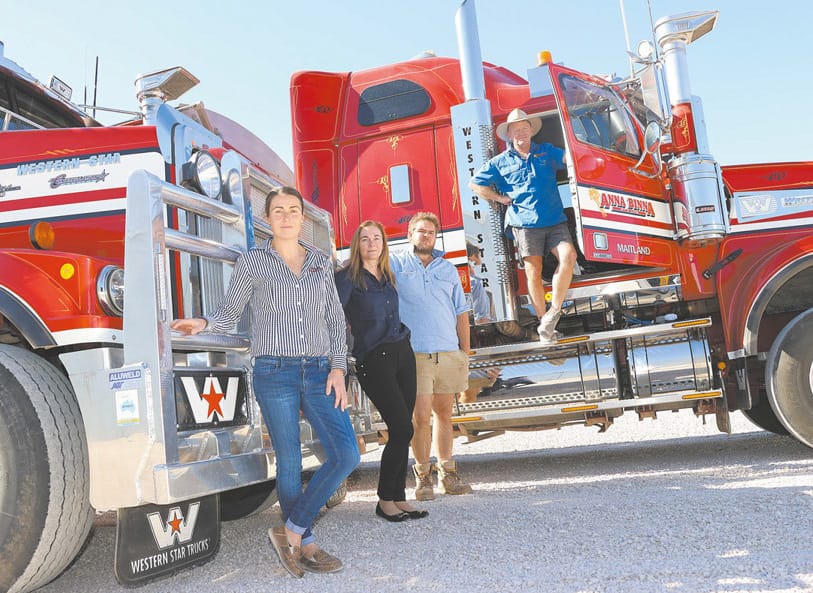
That’s one of the main points made in a developing submission representing a dozen farming and transport businesses in response to the Heavy Vehicle Access Strategy proposed by Yorke Peninsula Council.
The strategy is aimed at managing risks associated with heavy-vehicle access to the council’s road network, and identifying practical measures to address road safety issues, with public submissions on the strategy open until Friday, May 24.
Proposed measures for heavier vehicles include: banning trucks longer than 19 metres from driving at night (except for B-doubles operating under gazette at general mass limits); speed reductions to 30 kilometres an hour, and use of rotating amber hazard beacons on high-risk roads; daylight-driving-only permits; and no permits for driving on high-risk roads in wet weather.
Submission group spokeswoman Melissa Kenny said larger vehicle combinations had lower emissions and fuel usage and reduced impact overall on road surfaces, for the same volume of product movement as other vehicles.
“Council should support the use of high productivity heavy vehicles to enable operators to realise gains in productivity, financial capacity and economic contribution whilst boasting positive environmental outcomes,” Ms Kenny said.
The group was also concerned that the strategy was “fundamentally flawed”, as it was based on a review that did not reference traffic data.
“The road rating system’s criteria is designed to include the element of traffic use, yet no data was provided and the consultants did not consider such data in their report,” Ms Kenny said.
“Thus, the severity of the issues identified may be inaccurately escalated.”
Ms Kenny said a maximum speed limit of 60km/h instead of 30km/h on identified roads was fair, reasonable and in line with the current permit system.
“We oppose council’s proposal to have certain (not all) heavy vehicle combinations display amber flashing beacons as we believe this creates confusion amongst motorists,” she said.
“These safety precautions should be reserved for oversize loads, agricultural machinery and workers on roadsides.”
The group is also opposed to wet-weather restrictions for high-productivity heavy vehicles.
“With no restrictions on other combinations moving during wet weather and no clarification on what constitutes ‘wet weather’ conditions, this clause seems unreasonable and unable to be enforced by council, as it may rain in one place and not a short distance away.
“How can the council monitor such an unpredictable and unknown element?”
Ms Kenny said high-productivity heavy vehicles should not be prevented from operating at night because drivers had to comply with standardised lighting requirements and stringent fatigue management.
“Most would agree that a heavily illuminated heavy vehicle is much more obvious at night, so we are unsure why the council is suggesting there is a significantly increased risk,” she said.
Ms Kenny said the group also questioned how YPC could manage a user-pays system, as it would need to be implemented for all road users, including tourists.
“We would like to see the funds from already-applied primary producer rate rises directed to road maintenance/upgrades, commencing with the most critical issues identified within the report,” she said.
Ms Kenny said the group wanted to work constructively with the council to address road safety and funding challenges.
The group has developed a two-page form to help people make a submission, such as farmers who are busy at seeding time.
For details, visit roads@yorkesfuture.com
Submissions to YPC on the Heavy Vehicle Access Strategy are open until 4pm, Friday, May 24. More information: yorke.sa.gov.au/community-services/public-consultation/community-engagement-heavy-vehicle-access-strategy.
This article appeared in the Yorke Peninsula Country Times, 14 May 2024.

