

Johnny Cash could hear the train “a comin’”, as did local representatives as they wrote submissions and pleaded with the ‘Authority’, now it’s here.
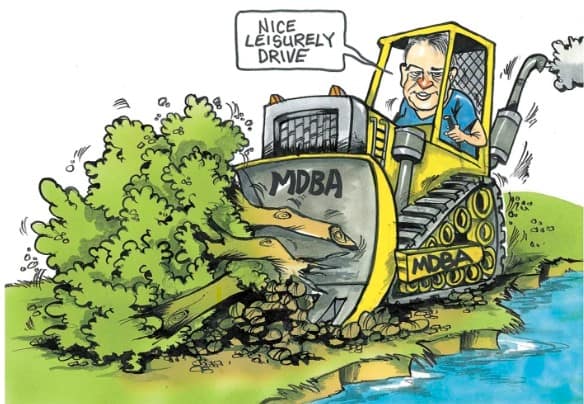
A recent report on the Water Supply and Demand in the Southern Murray-Darling Basin released by the Victorian Government conveys the catastrophic convergence of events that are unfolding under a plan to “restore the balance” and “save the Murray.”
The report brings into focus the extent to which water scarcity will increase in the future as existing and new permanent horticulture plantings explode below the natural constraints of the river system and fight for dam storage.
Historically, Australian logic fostered annual crops and a small percentage of permanent plantings due to a land challenged with a variable climate and seasonal allocation. Despite this, the Murray-Darling Basin Authority and the ‘plan’ pushed highest financial return per megalitre with no other caveats, such as deliverability, salinity or soil suitability.
One such crop that has exploded under the wild west of water reform has been almonds. In the year 2000, the humble almond tree covered a total area of 3,555 Ha of irrigation plantings. According to Australian Almonds, the total crop area for 2020-21 was a whopping 58,523 Ha and still growing.
Fifty known permanent horticulture developments are at various stages of planning across Victoria, NSW and SA, and there are an additional eight potential permanent horticulture developments that are larger than 1,000 Ha.
The Victorian report highlights that all other irrigation industries – including for irrigated dairy, cropping (e.g., rice and cotton) and annual vegetables – will be competing directly with permanent horticulture for all available water.
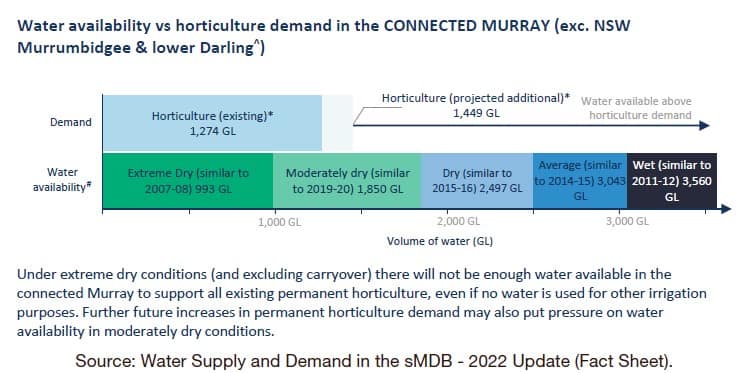
If total permanent horticulture water demand exceeds the total volume of water available for irrigation, as shown in average to extreme dry water availability scenarios, allocation prices will rise, which will induce market responses. News that will be surely welcomed by Australia’s almost $2 billion unregulated water industry.
Ironically, the Murray-Darling Basin Authority is now scrambling to find ways and means of increasing the delivery capacity of the natural constraints, such as the Barmah-Milewa Choke, or Barmah-Milewa Reach, as the MDBA now uses, wouldn’t want to imply a restriction.
Luckily, basin communities can rest easy in the knowledge that they’re in good hands, guided by the wise, honest politicians who act in the best interests of the people and not for political gain or survival. If that statement makes you uncomfortable, that’s okay. Remember, we have a fully independent authority which values community consultation and open forums. If, in the unlikely event, anything does go wrong, rest assured they will select their own panel members or consultants to review their own implementation, management and outcomes.
Sleep soundly, dear ones, to the purr of the locomotive, the rocking of the cars and blare of the horn.

This article appeared in The Koondrook and Barham Bridge Newspaper, 30 March 2023.

