

The CSIRO was engaged by the National Emergency Management Agency (NEMA) in 2022 to undertake the Northern Rivers Resilience Initiative (NRRI). The final report of the CSIRO team behind the initiative has been delivered, Scenario testing and recommendations for future flood mitigation activities in the Richmond River catchment in the Northern Rivers region, NSW, Australia.
CSIRO says that the report brings together “years of extensive community engagement, robust flood mitigation options, high-resolution hydrodynamic modelling and analysis of historical flood events.”
CSIRO hydrologist Cr Jai Vaze said that, “while we might not be able to prevent a flood like 2022, with a coordinated approach we can reduce flood heights and impacts, which can help lessen damage and support future resilience for the community.”
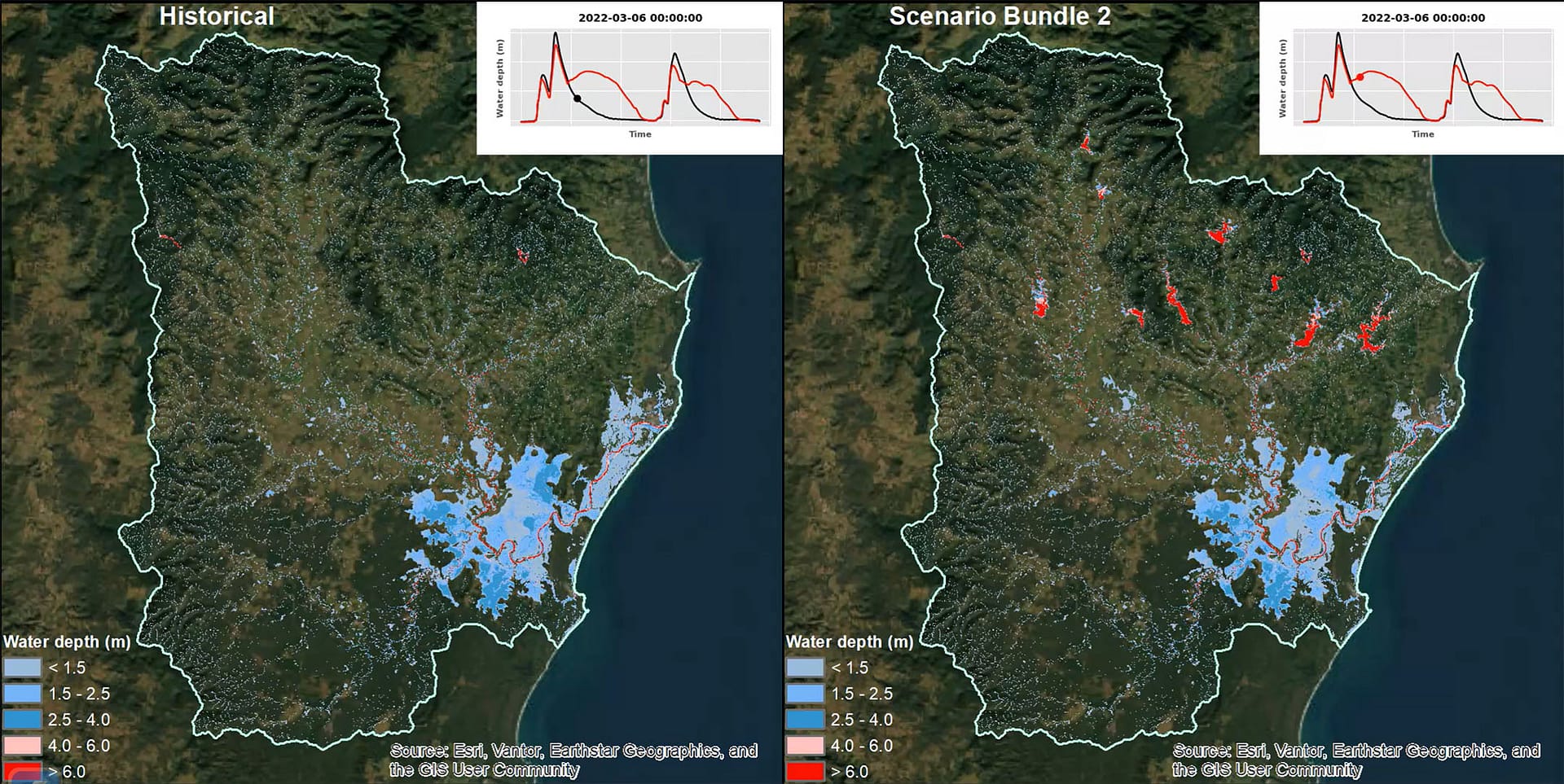
According to the CSIRO modelling, by applying the “Bundle 2” (more comprehensive) measures, the flood peaks at Lismore could have been reduced by up to 1.71 metres for the March 2022 flood and by up to 2.07 metres for the February 2022 flood.
NSW Greens MP and spokesperson for the North Coast, Sue Higginson and Kevin Hogan, Federal Minister for Page, respond notably differently to the report’s findings and recommendations.
No more excuses. No more delay: Hogan
The Hon. Kevin Hogan MP, Federal Member for Page, Shadow Assistant Treasurer, Shadow Minister for Financial Services, Media Release, 30 June 2026
Four years after we suffered Australia’s biggest natural disaster, the CSIRO report has been released. It details how flood mitigation could make our communities safer.
It models solutions such as dry holding ponds and opening up Boundary Creek to the ocean. The CSIRO report says the 2022 flood would have been over two metres lower with these mitigation solutions in place. The 2017 flood would have been 1.4m lower which in Lismore the levee would not have over topped.
The Resilient Lands Program has failed. No new homes have been delivered after four years.
The buyback scheme has produced streets with half the houses gone and left the other half there to flood again. This has not made the community safer. It has not made the business community safer, yet they expect businesses to keep living through floods over and over.
It’s not IF we have another flood in our region, it’s WHEN. The CSIRO have provided a solution to keep us safe. The State and Federal Labor Governments must act on this.
When we reduce flood risk, businesses invest, insurance becomes affordable again, and families choose to stay and build their futures here. Flood mitigation is the foundation everything else in our community is built on.
This report is four years in the making, the solutions are not a surprise. It’s time to get to work implementing these CSIRO solutions so we never have people going through the trauma we suffered four years ago.
10 new dams in Richmond River catchment and Lismore will still flood
The Hon. Sue Higginson, NSW Greens MP, Spokesperson for the North Coast, Media Release, 30 June 2026
The CSIRO report commissioned by the former Scott Morrison Coalition Government to assess new dams as flood mitigation for the Richmond River Catchment has been released today and confirmed that only possible minor flood reductions are possible if all ten proposed new dams are built.
The report shows that under the same conditions as the 2022 flood, the Lismore flood levee would still be over-topped even with all mitigation measures that are proposed, and that floods would last for days or weeks longer as water is slowly released.
Greens MP, Lismore local, and spokesperson for the North Coast Sue Higginson said, “This report confirms what flood experts and the community have been saying all along, billions of dollars in new dams for the Richmond River will not prevent severe flooding and could make floods far more dangerous and long lasting,”
“This project was commissioned and tasked with recommending hard-infrastructure like dams as flood mitigation – that’s why this report is only about pouring concrete in the upper catchment. Dams only offer false hope of flood mitigation, our community needs solutions and not just disinformation that will cause more harm,”
“Now that the science is in this report, it’s time for Kevin Hogan and the Nationals to admit that floods will continue to hit the communities of the Richmond River and that their favourite solution of more dams will make the problem worse,”
“There is incredible work happening throughout Australia and around the world that shows planned retreat and nature based solutions are the best, cheapest, and longest lasting mitigation measures for floods. This is the tough conversation that our Richmond River communities need to be having,”
“Replanting the forests of the upper catchment, revegetating and repairing the banks of our streams and rivers – these measures will catch more water and slow it down before it joins the major flood happening on the plains. We get a healthier river and more flood resilience – it’s a win-win,”
“Our community needs more investment in genuine climate resilience, and we have the opportunity to be a world leader by re-imagining our CBD as the wetland cultural market hub it can be – while cleaning up the river at the same time. We should be the region who fixed one of the most broken dirty damaged rivers in the country and made it a swimmable, drinkable, fishable world heritage rainforest-to-coastal river once again,”
“The Lismore CBD will still flood even if all ten new dams are built. Those dams will flood vast areas of the environment, destroy cultural heritage, and will create instability in new areas – and the floods will last longer and do more damage. It’s time to ask ‘how many hundreds of millions of dollars need to be wasted before Lismore adapts to living on a floodplain?’,”
“Now that the proposed dam locations are in this report, I expect the communities directly impacted will be pretty concerned. The Government will do a business case for these projects and realise the cost-benefit analysis doesn’t stack up. The community must be actively and transparently included in consideration of other options,” Ms Higginson.
Related story: Flood report a welcome step, but leaves some Tweed impacts unrecognised